
12 February 2026 The Future is the Product of the Past

First Trilobite Fossil Amulet from Roman Early Empire (1st–3rd Century CE) Found in Spain

In a discovery that may reshape our understanding of how ancient Romans perceived the natural world, archaeologists have uncovered a fossilized trilobite intentionally modified and likely worn as an amulet at a Roman-era site in northwestern Spain.

The fossil—identified as an Ordovician trilobite (Colpocoryphe)—was found during excavations at the settlement of A Cibdá de Armea, near the modern-day town of Allariz, Galicia. Dating to between the 1st and 3rd centuries CE, the object represents the first known example of a trilobite fossil being used in Roman material culture, and among the rarest fossil artifacts found in archaeological contexts globally.

A Fossil from Deep Time in a Roman Context

Trilobites, marine arthropods that lived more than 400 million years ago, are long extinct. Yet this particular specimen was found not in a museum or scientific collection, but within the remains of a Roman domus, surrounded by pottery, coins, glass shards, and animal bones.

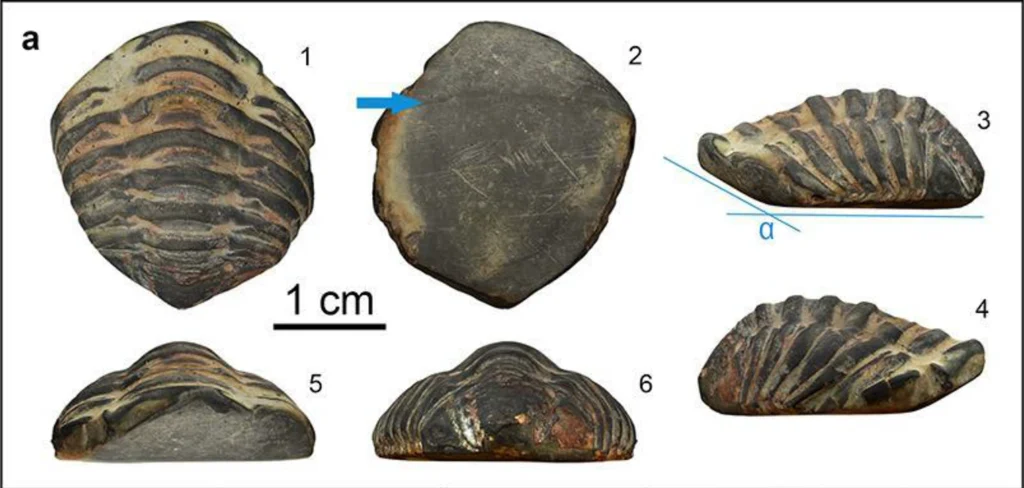
What sets this fossil apart is its clear anthropogenic modification. Seven distinct facets on the fossil’s ventral (underside) surface indicate that it was deliberately ground down—possibly to be worn against the skin as an amulet, pendant, or component of a bracelet.
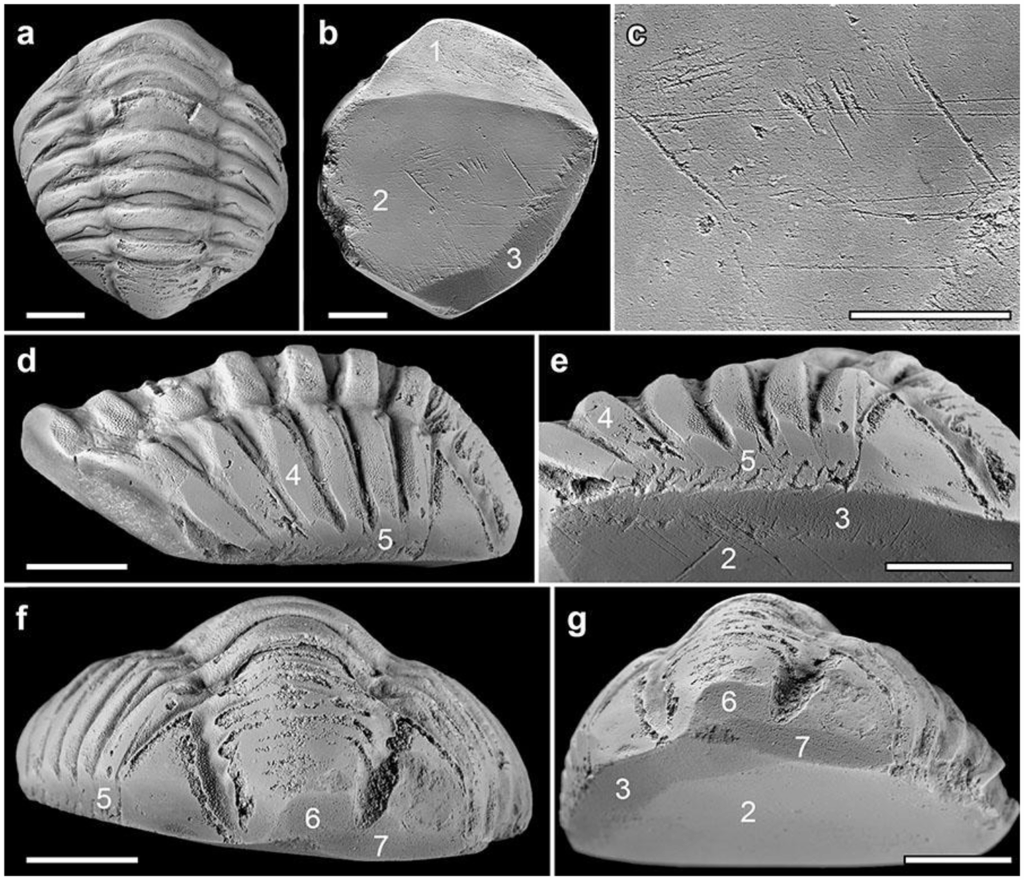
High-contrast images of the Armea trilobite fossil showing anthropogenic wear facets from various angles. MgO vapour treatment enhances surface details. Scale bars: 5 mm. Credit: Fernández-Fernández et al., Archaeological and Anthropological Sciences (2025), https://doi.org/10.1007/s12520-025-02266-8

A 430-Kilometer Journey Across Iberia

Geochemical analysis suggests the trilobite originated in the Toledan or Ibor Group formations of central Spain—located over 430 km from the excavation site in Galicia. This implies that the fossil was deliberately transported across the Roman province of Hispania, either through trade networks or as a personal possession.


📣 Our WhatsApp channel is now LIVE! Stay up-to-date with the latest news and updates, just click here to follow us on WhatsApp and never miss a thing!!


Its value likely went far beyond aesthetics. Researchers propose the trilobite was seen as a symbolically or spiritually charged object, possibly connected to healing, protection, or magical rites.

“This is not merely a curiosity—it’s a powerful example of how ancient people attributed meaning to the remnants of Earth’s deep past,” said Dr. Adolfo Fernández-Fernández, lead author of the study.

Fossils in Antiquity: More Than Just Stones

While there are documented cases of large fossil bones—like mammoth tusks—being displayed in Roman temples and villas, this is the first confirmed case of an invertebrate fossil being shaped and worn in antiquity. It reveals a new dimension of Roman spirituality and highlights the symbolic use of natural materials in personal or ritual life.

In Roman thought, unusual natural objects often carried symbolic or magical meaning. Fossils, with their strange shapes and mysterious origins, may have been interpreted as divine signs or protective talismans—an interpretation echoed in many other ancient and indigenous cultures.
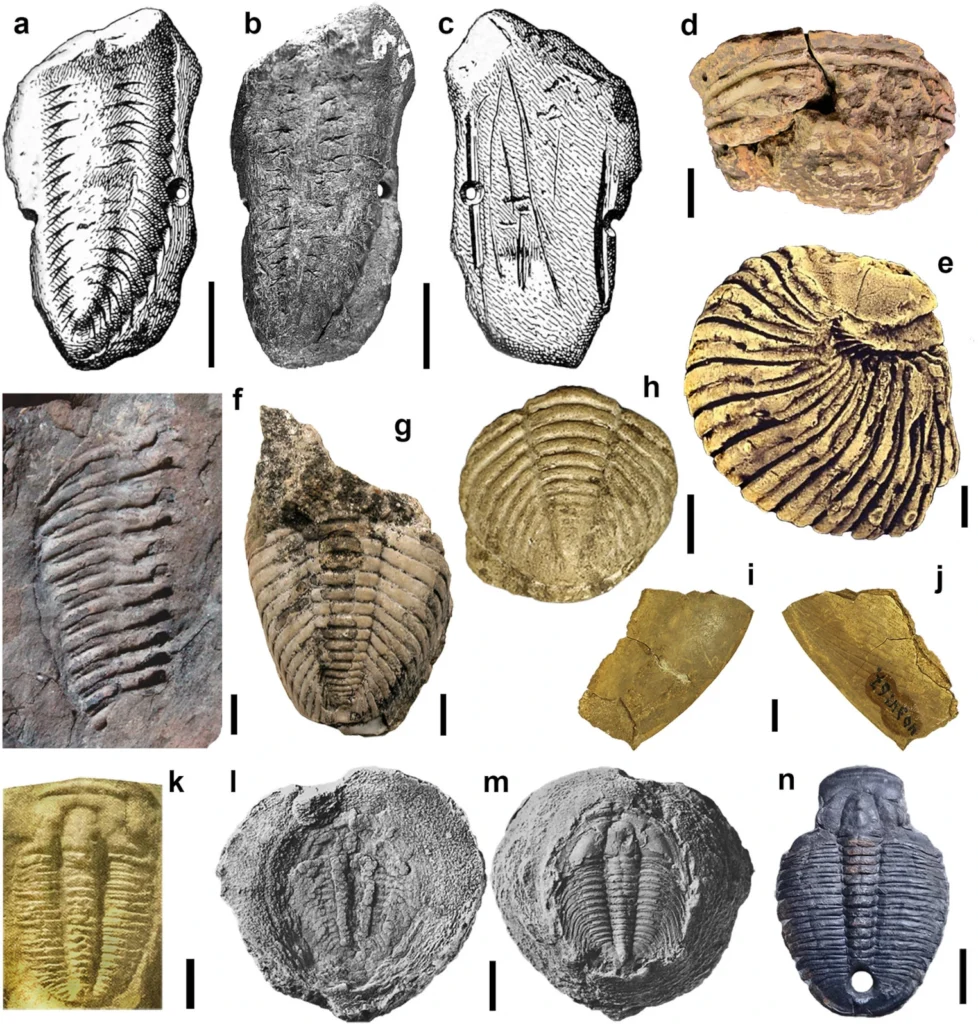
Summary of trilobite fossils found in archaeological contexts across the globe, including sites from the Paleolithic to the Viking and Pre-Columbian periods. Specimens originate from Europe, Africa, Australia, and North America, showing diverse cultural interactions with fossil material. Scale bars: 5 mm / 10 mm. Credit: Fernández-Fernández et al., Archaeological and Anthropological Sciences (2025), https://doi.org/10.1007/s12520-025-02266-8

Rare on a Global Scale

Globally, only eleven trilobite fossils have ever been recovered from archaeological contexts, with examples found in:

Paleolithic France

Stone Age South Africa

Pre-Columbian North America

Viking-era Scandinavia

What makes the Armea trilobite exceptional is the intentional modification and the specific historical context: early Roman Hispania. It demonstrates not only that fossils were known to ancient peoples but that they were manipulated and invested with meaning—far earlier and more widely than previously thought.
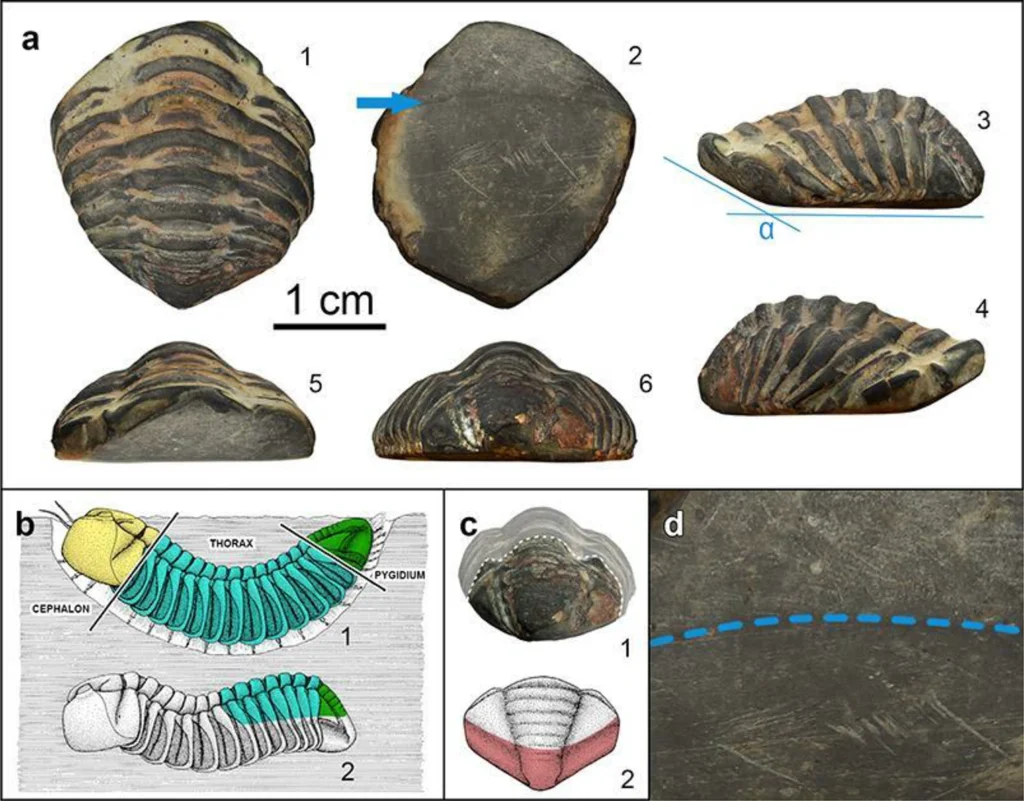
 Photographs and interpretive views of the Colpocoryphe sp. trilobite fossil from the Roman site of Armea, showing multiple angles, wear facets from human modification, and anatomical reconstructions. Includes life position depiction and inferred post-mortem deformation. Drawings adapted from Hammann (1983). Credit: Fernández-Fernández et al., Archaeological and Anthropological Sciences (2025), https://doi.org/10.1007/s12520-025-02266-8
Photographs and interpretive views of the Colpocoryphe sp. trilobite fossil from the Roman site of Armea, showing multiple angles, wear facets from human modification, and anatomical reconstructions. Includes life position depiction and inferred post-mortem deformation. Drawings adapted from Hammann (1983). Credit: Fernández-Fernández et al., Archaeological and Anthropological Sciences (2025), https://doi.org/10.1007/s12520-025-02266-8

Shifting the Timeline of Human-Fossil Interaction

This trilobite is now considered the earliest evidence of trilobite use in classical antiquity and the only example directly linked to the Roman world. It pushes the timeline of human-fossil interaction back further and reaffirms the idea that fossils have long been valued for more than scientific knowledge—as objects of wonder, reverence, and belief.

Fernández-Fernández, A., Valle-Abad, P., Rodríguez -Nóvoa, A.A. et al. Significance of fossils in Roman times: the first trilobite find in an early Empire context. Archaeol Anthropol Sci 17, 166 (2025). https://doi.org/10.1007/s12520-025-02266-8

Cover Image Credit: Fernández-Fernández et al., Archaeological and Anthropological Sciences (2025). https://doi.org/10.1007/s12520-025-02266-8

Related Articles

Earliest Known East Anglian Gold Coin Found: A Fusion of Pagan and Christian Imagery

12 June 2025

12 June 2025

A rare gold coin dating back to the early Anglo-Saxon period has been discovered near Norwich, UK, by a metal...

The “Horoscope” Scroll Found In the Judean Desert: A Glimpse Into the Mysterious Sect

26 March 2024

26 March 2024

One of the most interesting and mysterious scrolls discovered in the Judean Desert is a scroll called the “Horoscope.” This...

The Old Fisherman Founded the Turkish Sea Creatures Museum

26 March 2021

26 March 2021

The sea gives another life to man, sometimes love, sometimes a disappointment, often a longing. The sea is reminiscent of...

Archeological study shows unearthed Byzantine warrior had gold-threaded jaw

30 September 2021

30 September 2021

A Byzantine warrior who was beheaded after the Ottomans captured his fort in the 14th century had a jaw threaded...

Four-face ivory dice found at Keezhadi excavation site in India

18 February 2022

18 February 2022

The Tamil Nadu Archaeological department along with the Archaeological Survey of India has unearthed rectangular ivory dice,  in the excavation...

8,000-year-old Musical Instrument found in northwest Turkey

4 July 2021

4 July 2021

Archaeologists in northwestern Turkey’s Bilecik on Tuesday discovered a musical instrument that dates back to an estimated 8,000 years. During...

Archaeologists Uncover Asini’s Hidden Ancient Port Beneath the Waves of Greece

11 March 2025

11 March 2025

An international team of underwater archaeologists has made a groundbreaking discovery at the submerged site of Asini, near Tolo in...

Byzantine-Era Monastic Complex Discovered in Sohag, Egypt

8 January 2026

8 January 2026

Archaeologists in Upper Egypt have uncovered the remains of a remarkably well-preserved monastic residential complex dating back to the Byzantine...

‘World’s oldest dated rune stone’ found in Norway

18 January 2023

18 January 2023

The oldest known Rune stone in Norway has been discovered by Norwegian archaeologists working at the Museum of Cultural History...

For the first time, a Viking Age grave rich in artifacts has been found in Norway’s capital city, Oslo

23 December 2022

23 December 2022

A Viking Age grave rich in artifacts has been discovered for the first time in Norway’s capital city, Oslo. The...

New documentary searches history of Turkey’s 7,000-year-old Arslantepe Mound

28 December 2021

28 December 2021

The tale of Turkey’s fascinating 7,000-year-old Arslantepe Mound, an ancient building in Malatya, eastern Turkey that was just added to...

Around 400-year-old Bronze idols found during house construction in India

25 April 2024

25 April 2024

Three bronze idols, estimated to be about 400 years old, were unearthed during excavation for a house construction project in...

Rare Viking Armlet and 2,000-Year-Old Golden Neck Ring Discovered in Sweden

20 March 2025

20 March 2025

Recently, two extraordinary archaeological finds have captivated the attention of historians and enthusiasts alike in Sweden. The first discovery, an...

2,000-year-old graves found in ancient necropolis beneath Paris Train Station

24 April 2023

24 April 2023

Archaeologists have discovered 50 tombs in an ancient necropolis just meters from a busy train station in central Paris, and...

Bronze Age and Roman-era settlements unearthed in Newquay

10 April 2023

10 April 2023

Archaeologists from the Cornwall Archaeological have uncovered ancient dwellings from the Bronze Age and a Roman period settlement in Newquay,...