
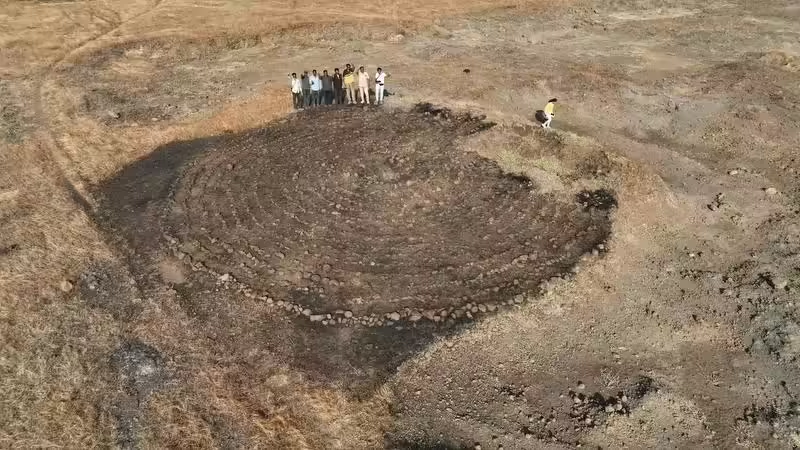
Archaeologists in India have uncovered the country’s largest known ancient circular labyrinth, a remarkable stone structure believed to have guided Roman merchants traveling across the subcontinent nearly 2,000 years ago. The discovery sheds new light on the scale of Indo-Roman trade and the sophisticated navigation systems used in ancient times.
The labyrinth was found in the Boramani grasslands of Solapur district, Maharashtra, an area better known today for wildlife conservation than archaeology. Measuring approximately 50 by 50 feet (15 × 15 meters), the structure consists of 15 concentric stone circles, making it the largest circular labyrinth ever discovered in India.
The find was reported by Sachin Patil, an archaeologist from Deccan College in Pune, and was first covered by The Times of India. According to Patil, the labyrinth likely served as a navigational landmark for Roman traders moving inland from India’s western coast toward major commercial hubs.
Evidence of Thriving Indo-Roman Trade
Patil believes the labyrinth points to intense trade activity between the ancient city of Ter (modern-day Dharashiv district) and the Roman Empire during the early centuries of the Common Era. Roman merchants are known to have exchanged gold, wine, glassware, and gemstones for Indian spices, silk, indigo, and textiles, commodities that were highly prized in Mediterranean markets.
“This region was part of a vast and active commercial corridor,” Patil explained. “Such labyrinths were likely used as orientation points along long-distance trade routes.”
The discovery aligns with historical records, including the Periplus of the Erythraean Sea, a Greco-Roman travel guide describing trade routes linking India with the Roman world.
International Scholarly Attention
The labyrinth has drawn global interest and will be formally documented in Caerdroia, a UK-based academic journal dedicated to labyrinth studies, in an upcoming issue. Jeff Saward, a leading international authority on labyrinths and editor of Caerdroia, described the find as exceptional.
“While this is a classical-style labyrinth, the spiral at its center is distinctly Indian,” Saward noted. “This feature, often referred to as Chakravyuha, reflects local cultural adaptation. It is undoubtedly the largest stone labyrinth of its type in India.”
Until now, the largest circular labyrinth known in the country had only 11 rings. Although the Boramani structure is second in overall area—after a 17-square-meter labyrinth in Gedimedu, Tamil Nadu—it remains the largest circular example ever recorded.
A Broader Archaeological Context
According to P. D. Sabale, head of the archaeology department at Deccan College, the discovery reinforces earlier evidence that this entire region—including Kolhapur, Karad, and Ter—was a major center of international trade.
Past excavations in nearby Brahmapuri (1945) uncovered a statue of the Greco-Roman sea god Poseidon and a polished bronze mirror, further supporting Roman presence. Similar labyrinths found in Sangli, Satara, and Kolhapur suggest the existence of a continuous trade route sometimes described as a western Indian “Silk Road.”
From Wildlife Survey to Major Discovery
Interestingly, the labyrinth was first noticed by members of the Nature Conservation Circle, a non-governmental organization monitoring populations of the Great Indian Bustard and the Indian wolf in the Boramani grasslands. Recognizing the unusual stone pattern, they documented the site and alerted archaeologists.
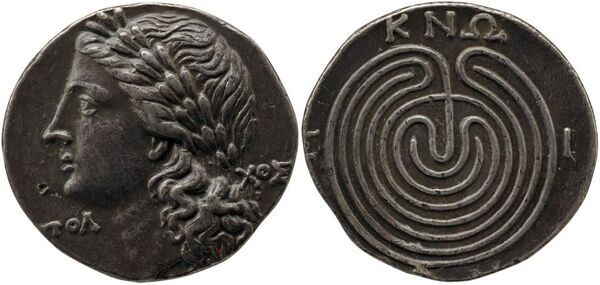
On-site examination revealed that the labyrinth is constructed from small stone blocks, with soil layers between the rings several centimeters thick—evidence that the structure remained undisturbed for centuries. Patil also noted similarities between the design and labyrinths depicted on Cretan coins from the 1st to 3rd centuries CE, strengthening the link to the Greco-Roman world.
More Than Navigation
Beyond their practical use, labyrinths have long held symbolic and spiritual significance across cultures. In India, they are often associated with fertility, cosmic order, and meditation, suggesting the Boramani labyrinth may have served multiple purposes.
With further study planned, this extraordinary discovery promises to deepen our understanding of ancient globalization and India’s central role in early international trade networks.
Cover Image Credit: India’s Largest Ancient Circular Labyrinth. Sachin Patil
