

He ruled China for only 27 days before being stripped of the throne and largely erased from imperial history. More than two millennia later, archaeologists found the deposed emperor buried beneath a staggering fortune: tons of bronze coins and more gold than had ever been recovered from a Han Dynasty tomb.
The treasure had remained hidden beneath Guodun Mountain in China’s Jiangxi Province, sealed inside the burial complex of a ruler remembered more for his downfall than his reign. When archaeologists finally entered the tomb, they uncovered not merely an elite burial, but one of the richest and most revealing archaeological discoveries ever made in China.
How the Discovery Began
The story does not start with construction crews or road crews, as some accounts have claimed, but with looters. In March 2011, villagers near Guanxi Village in Nanchang, the capital of Jiangxi Province, noticed a suspicious tunnel dug into the ground close to Guodun Mountain. Archaeologists rushed to the site and found a robbers’ shaft plunging nearly 15 meters underground, reaching all the way down to the outer wooden chamber of a tomb.
That discovery triggered a large-scale, officially sanctioned rescue excavation, launched in April 2011 under China’s National Cultural Heritage Administration. What followed was nearly five years of painstaking fieldwork across nine tombs, a chariot burial pit, and the remains of an entire walled settlement covering roughly 5 square kilometers.
Unearthing a Fallen Emperor
Archaeologists eventually identified the tomb’s occupant through a jade seal found near his waist, inscribed with his name: Liu He. His story reads like a cautionary tale carved into bronze and jade.
Liu He was the grandson of Emperor Wu, widely regarded as one of the most powerful rulers of the Han Dynasty. In 74 BC, Liu He was placed on the throne — only to be removed by the royal court after a mere 27 days, accused by officials of poor judgment and reckless conduct. Demoted to commoner status, he was later granted the lesser title of Marquis of Haihun, from which his tomb takes its name: the Tomb of the Marquis of Haihun, or Haihunhou. He died in his early thirties, largely forgotten by history — until his tomb told a very different story.
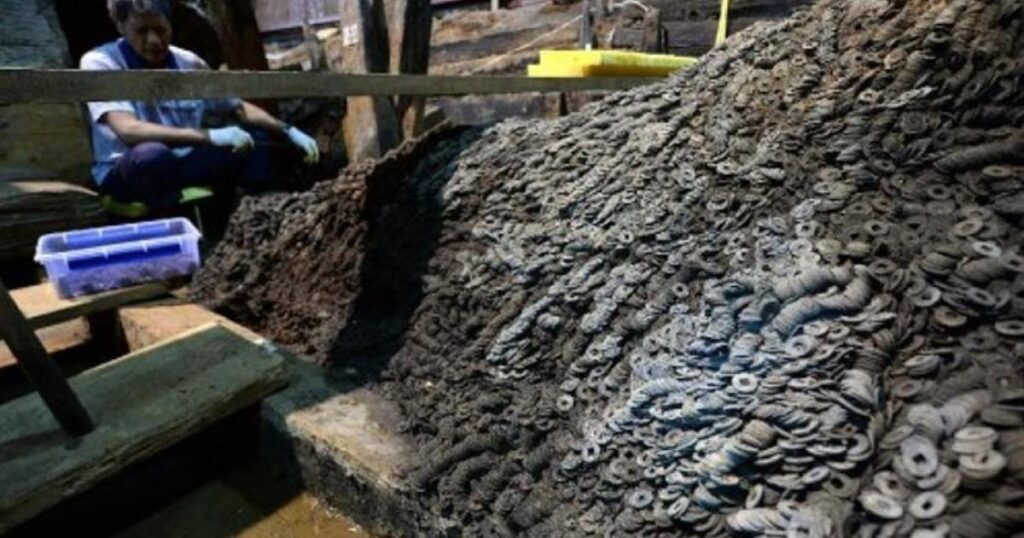
2 Million Ancient Coins. Credit: Xinhua
What Archaeologists Actually Found
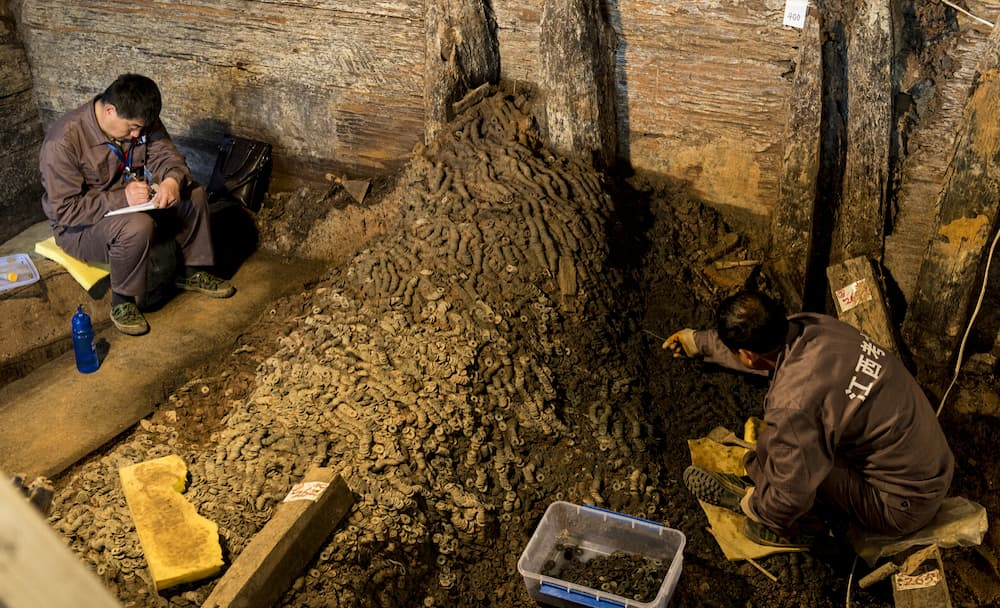
When they finally cracked open the burial chamber, researchers said the treasure was just piled up like a mountain. Chinese archaeological institutes went through it all, and here’s what they confirmed.
- Over 10 tons of ancient bronze “wu zhu” coins, close to 2 million individual pieces. Largest hoard of ancient Chinese currency ever pulled from a single tomb.
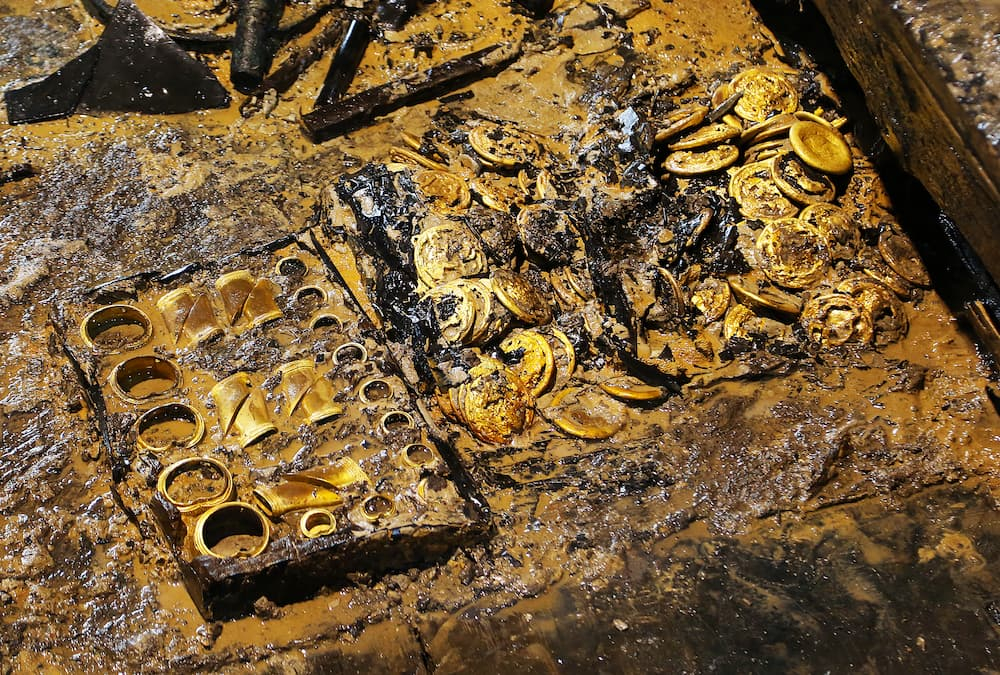
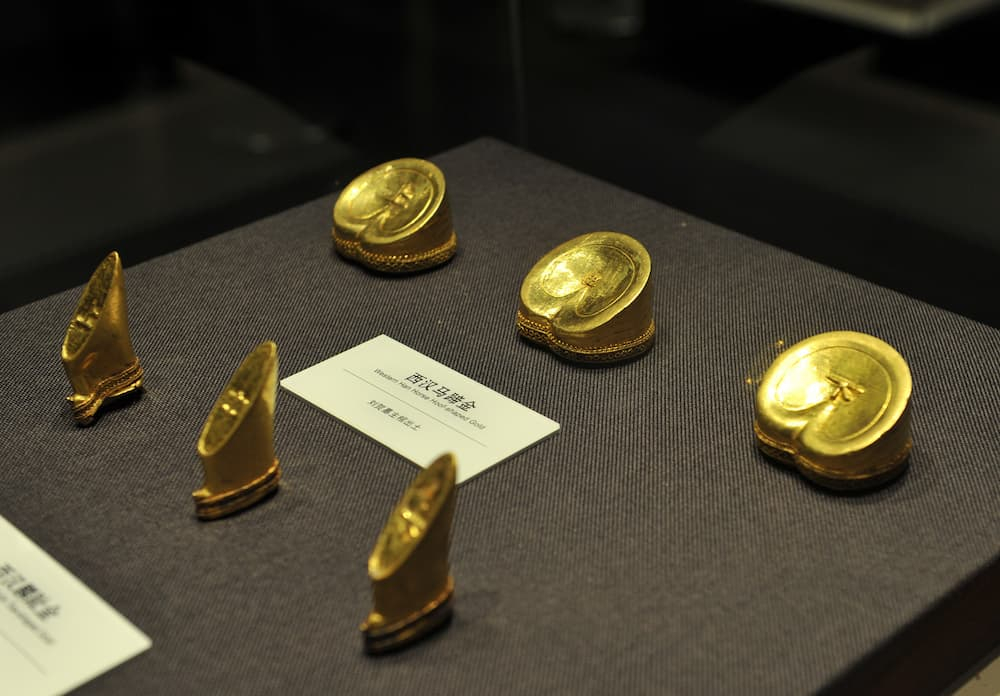
- Gold: some early reports claimed 200 kilograms, but that number got inflated somewhere along the way. Institutes that actually did the excavation, including the Jiangxi Provincial Institute of Cultural Relics and Archaeology, confirmed the real figure sits closer to 115 to 120 kilograms, spread across roughly 480 objects: hoof-shaped ingots, flat gold plaques, gold cakes. No other Han tomb has produced a gold collection this large or varied, even at the corrected weight.
- A bronze dressing mirror carrying what researchers believe is the oldest surviving portrait of Confucius.
- Thousands of bamboo strips preserving a version of the Analects that had been considered lost for around 1,800 years.
- A horse-and-chariot burial pit outside the main chamber, the only one of its kind ever found south of the Yangtze River.
A Different Side of the Emperor Branded Immoral
Official histories portrayed Liu He as an undisciplined and immoral ruler whose conduct threatened the stability of the empire. His removal after only 27 days appeared to confirm that reputation for centuries. Yet the objects placed in his tomb do not neatly match this one-dimensional image. They cannot overturn the written accusations, but they reveal a man whose life also included scholarship, ritual practice and sustained engagement with Confucian thought.
One of the most striking finds was a lacquered dressing mirror decorated with portraits of Confucius and his disciples. Short accounts of their lives and teachings were written beside the figures in ink. Each time Liu He dressed or attended to his appearance, he may have encountered not only his own reflection but also a reminder of Confucian discipline, moral conduct and personal responsibility.
His burial chamber also contained major Confucian works, including the Book of Songs, the Book of Rites and the Analects. Under the Han funerary principle of treating the dead as they had been treated in life, researchers believe these manuscripts may have belonged to Liu He’s personal collection. A casually inscribed wooden tablet has even been interpreted as a possible reading note in his own hand, offering an unexpected counterpoint to the pleasure-seeking figure described in the Book of Han.
The manuscripts were stored so systematically that the collection resembled an underground library. Among the texts were the long-lost Qi Analects, the most extensive surviving bamboo-slip version of the Book of Songs, and an early physical copy of the Spring and Autumn Annals. Together, they do not prove that Liu He was misunderstood or morally exemplary. They do, however, show that the deposed emperor’s intellectual and spiritual world was far mo
A Decade of Ongoing Discovery
Jiangxi authorities publicly announced the first major findings from the tomb in December 2015, and the site was named one of China’s top ten archaeological discoveries that year. Excavation and analysis, however, did not stop there. Researchers continued studying the tomb’s contents for years afterward, using infrared scanning to decode faded bamboo documents and hyperspectral imaging to reveal hidden text on the Confucius mirror.
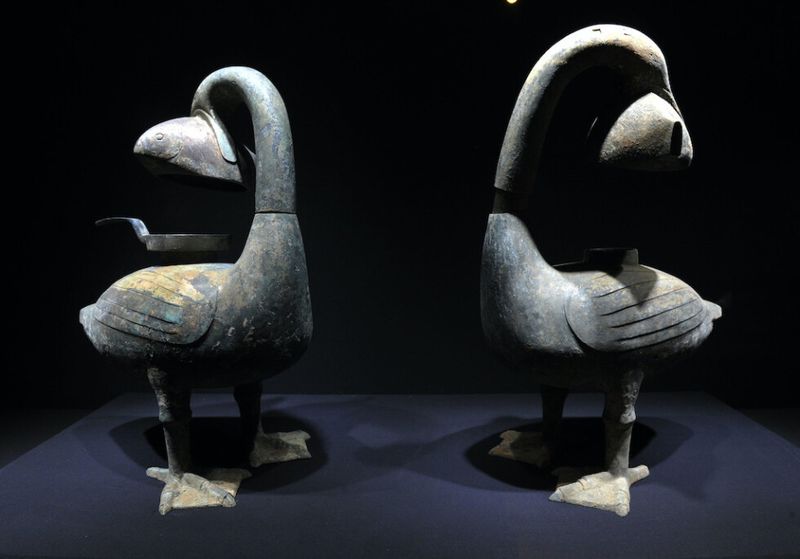
A museum built on the site, the Nanchang Han Dynasty Haihunhou site museum, later opened to the public, displaying over a thousand artifacts from the tomb. As of early 2026, Chinese state media were still marking the tenth anniversary of the initial excavation, describing the site as a continuing window into the political, cultural, and economic life of the Han Dynasty.
A Fallen Emperor’s Last Word
Today, the Haihunhou tomb is considered the best-preserved Western Han Dynasty aristocratic burial complex ever discovered in China — a rare case where archaeology filled in gaps that written history left blank. Liu He ruled for less than a month and was written off by ancient historians as a failure. Two thousand years later, the gold, the coins, and the quiet objects buried with him have rewritten that verdict, turning a forgotten footnote into one of the most closely studied figures in all of Han Dynasty history.
Sources: Xinhua News (新华网) 2026
Jiangxi Provincial Institute of Cultural Relics and Archaeology -2026
The World of Chinese (“Fields of Gold”)
