
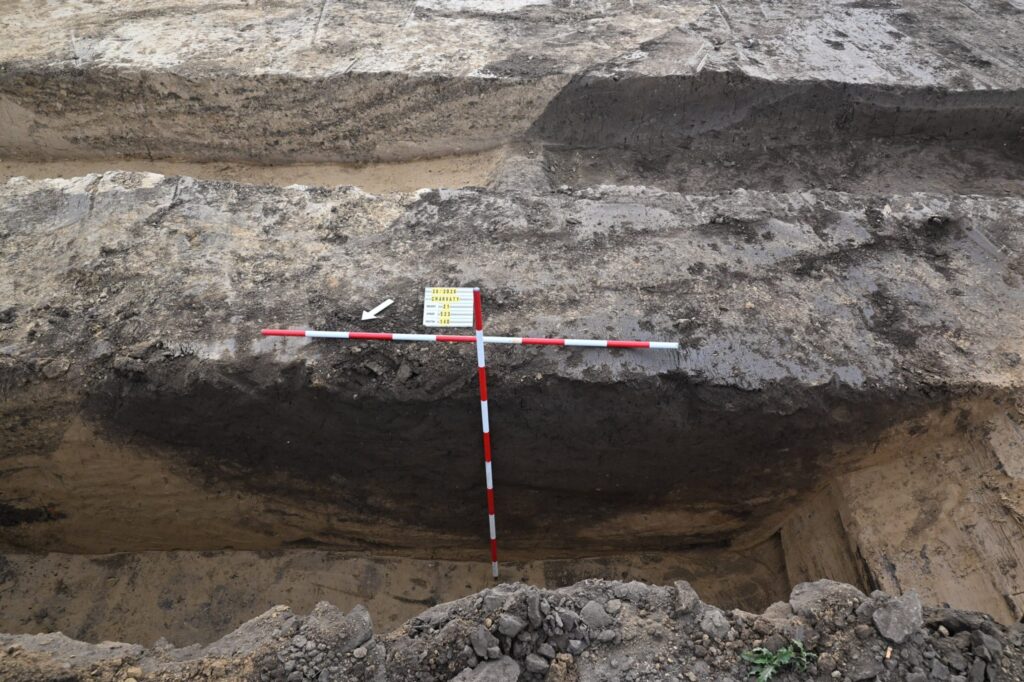
Archaeologists conducting excavations ahead of residential construction in Czechia have discovered a previously unknown Early Bronze Age settlement surrounded by three defensive ditches. Located in the village of Charváty near Olomouc, the settlement may offer new insights into how communities lived and protected themselves approximately 4,000 years ago.
The excavation also uncovered four human graves dating to different prehistoric periods. Among the most notable finds are the burial of a child approximately ten years old, accompanied by a stone battle axe, and a separate skeleton whose skull was missing.
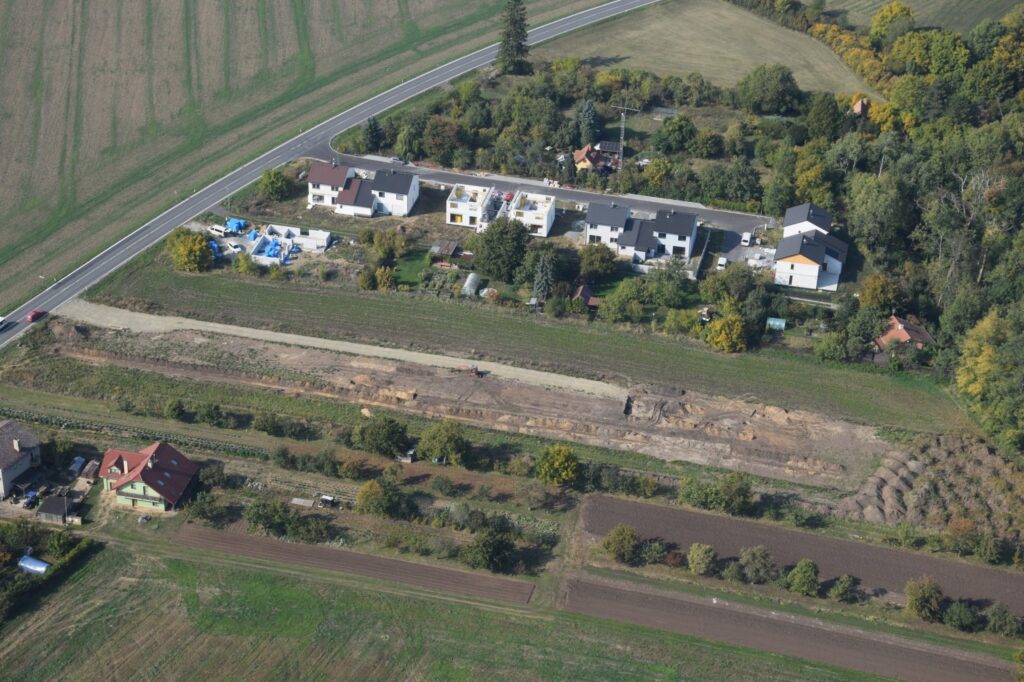
The results of the rescue excavation, carried out by the Olomouc Archaeological Center between September and October 2026, were announced on November 18. Working across four parcels where two semi-detached houses were to be built and a section of a planned road, the team documented approximately 40 archaeological structures and find contexts, including the settlement, storage pits, graves, and defensive ditches.
A Settlement Protected by Three Defensive Ditches
At the center of the discovery is a fortified settlement which, according to preliminary assessments by researchers, has been associated with the Věteřov culture of the Early Bronze Age in Central Europe.
The settlement was established on a high terrace above the Morava River. While natural protection was provided by the surrounding slopes, defensive ditches were dug in the more accessible sections. Three separate ditch lines were identified by archaeologists, two of which were partially investigated.
The outermost ditch was approximately 2.2 meters deep. The inner ditch reached a depth of 3.3 meters and a width exceeding 7.5 meters at its upper section. These dimensions indicate that a significant amount of labor was expended for the protection of the settlement.
Archaeologist Vít Záhorák from the Olomouc Archaeological Center stated that while traces of prehistoric settlements had been previously known in Charváty, encountering a fortified center was unexpected.
According to Záhorák, the settlement may have been important not only for those living there but also for surrounding communities. It is not yet known whether it was the center of a powerful community or an area where people from surrounding settlements took refuge in times of danger.
The position overlooking the Morava River may have provided an advantage in monitoring movement in the vicinity. However, further archaeological evidence is required to determine the actual function of the defense system and the regional importance of the settlement.
Settlement Extends Beyond the Excavation Area
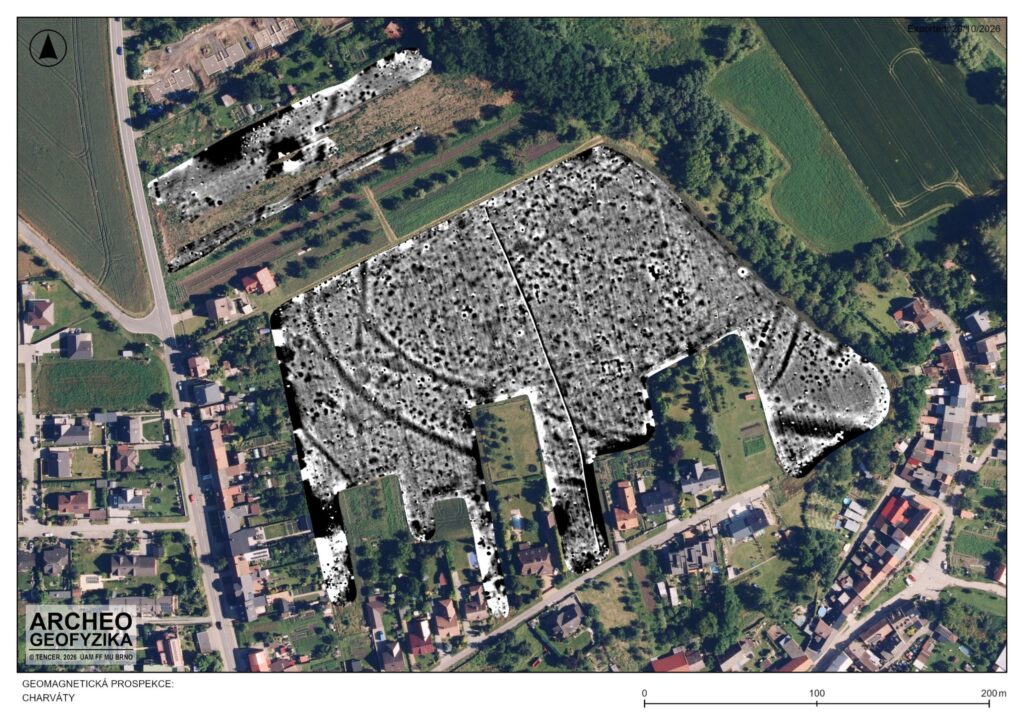
Upon the discovery of the defensive ditches, geophysical surveys were conducted in the surrounding area by the Institute of Archaeology and Museology at Masaryk University in Brno.
These measurements, which allow structural traces beneath the ground to be identified without digging the soil, showed that the fortified area continued toward neighboring fields and gardens. Other traces that could be structural remains were also identified by researchers, although their age has not yet been finalized.
Pollen and soil samples were also collected by the excavation team from the fill layers of the ditches. While old vegetation will be helped to be understood through pollen analysis, the microscopic examination of soil layers may reveal how the ditches were filled and whether they were regularly cleaned during the period they were used.
These studies are also important for understanding not only how the settlement was protected, but also for how long it was used and how it changed over time.
Child Buried with a Stone Battle Axe
The second important group of finds from the excavation consists of four human graves. However, not all of these graves belong to the same period as the fortified settlement. Charváty is an area that was used repeatedly by different communities in prehistory.
The earliest settlement traces extend back to the 5th and 4th millennia BCE. These are associated by archaeologists with the Lengyel and Jordanów cultures. Ceramic fragments, animal bones, and stone tools found in pits show that the region was a living space for humans long before the Bronze Age.
Two of the graves are linked, according to preliminary assessments, to the Corded Ware culture, dated approximately to 2900–2500 BCE.
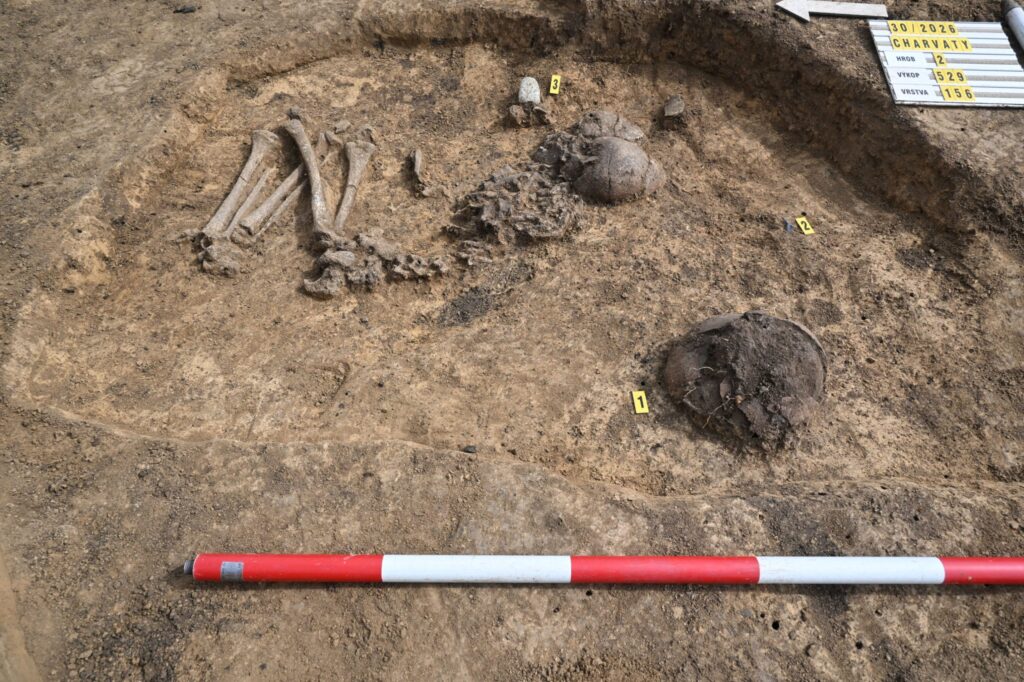
In one of these, the skeleton of a child of about ten years old and a stone battle axe were found. According to researchers, such axes are among the characteristic items seen in male graves of the culture in question. However, it is not possible to determine the biological sex of the child with certainty based solely on the grave goods.
The second grave exhibits more unusual characteristics. The skeleton of an adult individual was found in an unusual position, and three ceramic vessels and an object made of flint were left in the grave.
Záhorák notes that while the first burial is consistent with the known funeral traditions of the culture, the second displays different characteristics. It may be clarified by future analyses whether this grave truly belongs to the same period.
The third burial was found in a storage pit dating to the Early Bronze Age. No grave goods were identified in this burial. In the fourth grave, poorly preserved skeletal remains of an individual laid face down emerged. The skull was not preserved, and the period to which the burial belongs has not yet been determined.
New Analyses Will Illuminate the History of the Settlement
Following the completion of the first phase of excavation, the archaeological materials will be examined in the laboratory. Anthropological studies to be conducted on the human remains may help the age, biological sex, and other characteristics of the buried individuals to be determined more reliably.
The evaluation of ceramics, the examination of environmental samples, and possible radiocarbon dating will be used to distinguish the different settlement phases of Charváty from one another.
Excavations will continue depending on subsequent construction work. One of the primary goals of the researchers is to determine the actual boundaries of the fortified settlement, which has only been partially examined, and its role among the prehistoric communities in the area.
