
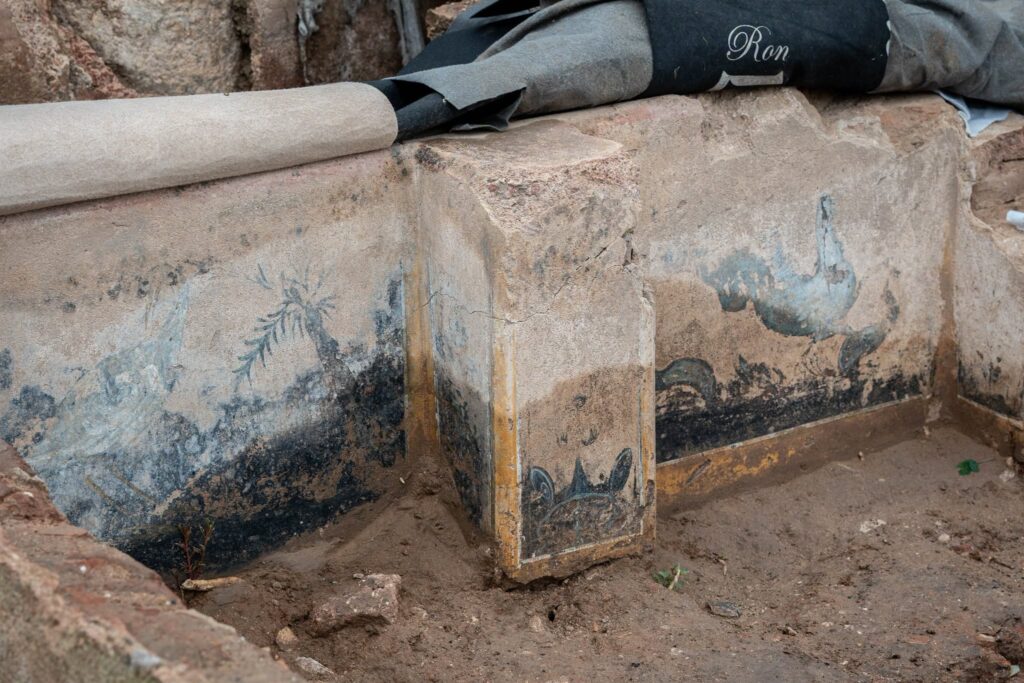
Archaeologists excavating a large Roman house in Mérida, western Spain, have discovered remarkably well-preserved wall paintings depicting peacocks, hunting scenes, and figures from ancient mythology. Among the images are a predator chasing two deer, birds gathered in a painted landscape, and a satyr associated with Bacchus, the Roman god of wine.
The paintings once decorated a columned courtyard inside one of the city’s substantial Roman residences. Their discovery adds a new dimension to a house that has already produced an elaborate Medusa mosaic, giving archaeologists a clearer picture of how its wealthy occupants decorated the spaces where they lived and entertained guests.
A Roman Courtyard Filled with Color and Mythology
The discoveries come from Huerta de Otero, an archaeological site where the Barraeca V training program, working with Mérida’s municipal authorities, has been excavating sections of a large Roman house, or domus.
The latest work focused on a strip of ground that earlier excavators left untouched in 1976. Archaeologists wanted to understand how the room containing the Medusa mosaic connected with the house’s peristyle, an open courtyard surrounded by columns.
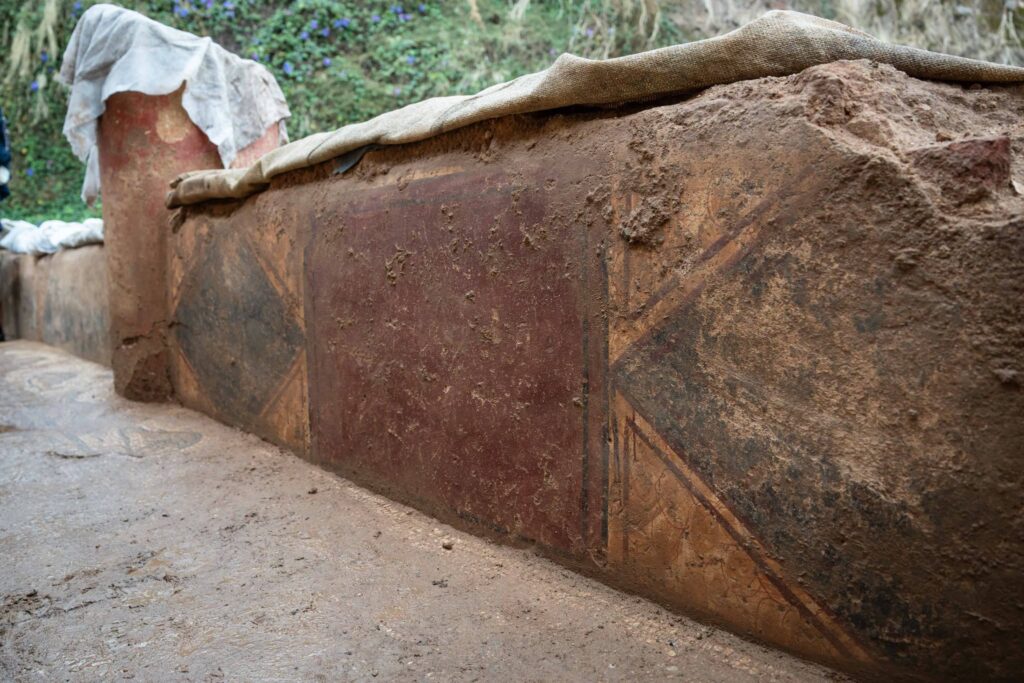
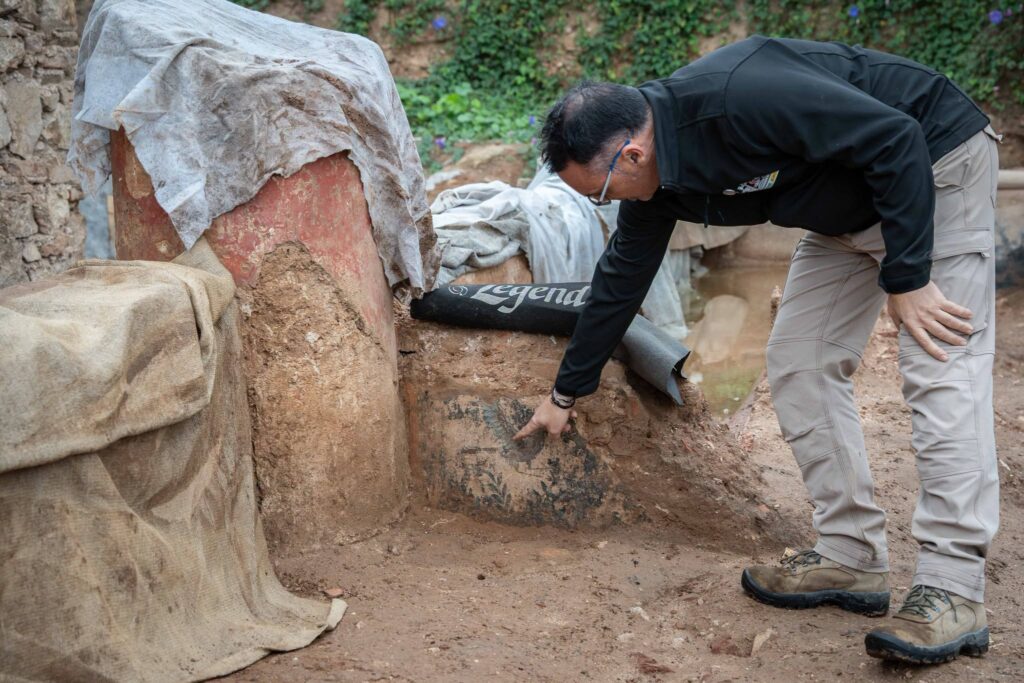
Instead, they encountered painted walls on both the inner and outer sides of the courtyard.
José Vargas, the archaeologist supervising the Barraeca excavations, described decorative panels featuring cranes, peacocks, and other birds. One scene shows a satyr, a mythological figure associated with Bacchus and his celebrations. Another depicts a feline predator pursuing two deer.
The paintings combine wildlife with mythological subjects, creating an elaborate decorative setting for the courtyard. Rather than leaving its walls bare, the household surrounded this part of the residence with images of animals, nature, and figures familiar from Roman religious and cultural traditions.
The Mérida City Council’s official announcement describes the paintings as exceptionally well preserved. Their condition has attracted particular attention because such extensive surviving decoration has become increasingly uncommon in the city’s recent excavations.
A Medusa Mosaic and the Home of a Wealthy Roman Family
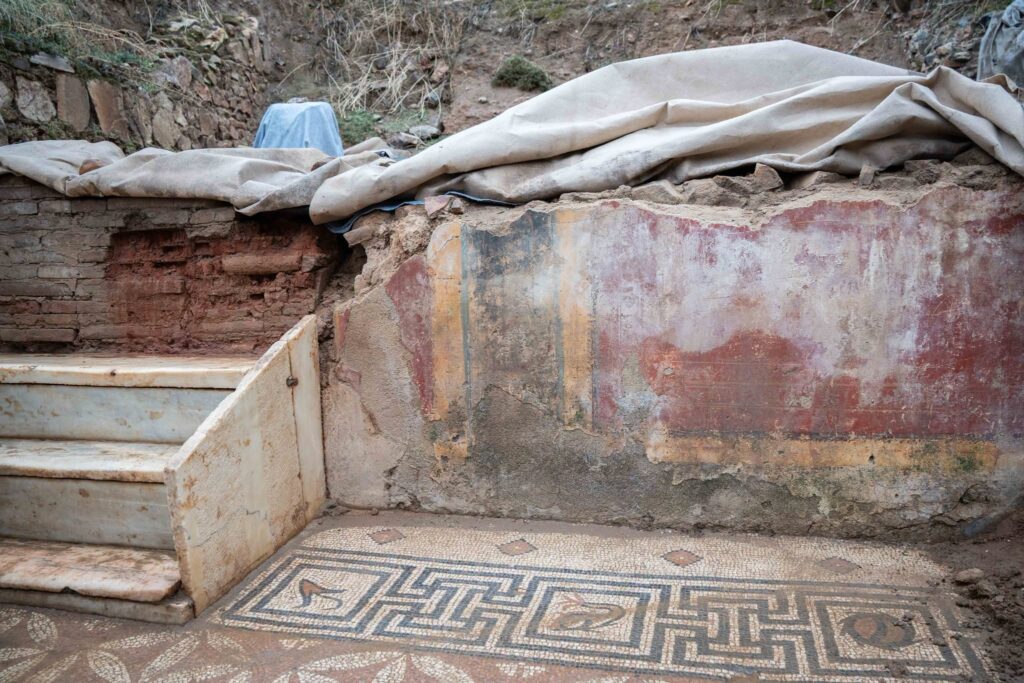
The murals belong to a residence that archaeologists have been investigating for several years. Earlier excavations exposed a mosaic depicting Medusa, the snake-haired figure from Greek mythology who could turn anyone who looked directly at her into stone.
The mosaic decorated a room adjoining the painted courtyard. Together, these discoveries show that the owners invested in expensive interior decoration, combining elaborate floor mosaics with richly painted walls.
Such decoration served more than an aesthetic purpose in Roman domestic architecture. Wealthy homeowners could use reception rooms, courtyards, and gardens to entertain visitors while displaying their education, cultural tastes, and social standing.
At Huerta de Otero, the combination of Medusa, Bacchic imagery, birds, and hunting scenes suggests that the house’s occupants wanted their surroundings to convey a particular sense of refinement and prosperity.
Archaeologists have not identified the family that lived here. Yet the scale of the building and the quality of its decoration point to a household with considerable resources.
The property extends across more than 5,000 square meters, although researchers have excavated only about 15 percent of the site. That leaves much of the residence unexplored, including areas that could clarify how its rooms, courtyards, and domestic facilities functioned together.
Credit: Ayuntamiento de Mérida
Mérida, a Roman Capital in Western Spain
The discovery carries particular significance because Mérida was no ordinary Roman town.
Emperor Augustus founded the settlement in 25 BCE under the name Augusta Emerita, initially establishing a colony for veterans of Rome’s military campaigns in Hispania. The city later became the capital of Lusitania, a Roman province that included much of present-day Portugal and parts of western Spain.
As a provincial capital, Augusta Emerita developed monumental public buildings, sophisticated water infrastructure, and substantial private residences. Its surviving Roman theater, amphitheater, bridge, and aqueducts remain among the most important monuments of Roman Spain.
UNESCO added the city’s archaeological ensemble to its World Heritage List in 1993, recognizing the extensive survival of its Roman urban landscape.
While the city’s public monuments demonstrate the power and resources of Roman government, houses such as Huerta de Otero tell a more personal story. Their mosaics and painted walls preserve traces of the domestic surroundings that wealthy residents experienced every day.
The new murals help connect those two sides of Mérida’s history: the grandeur of a Roman provincial capital and the private lives of people who made their homes within it.
Credit: Ayuntamiento de Mérida
Much of the Roman House Remains Unexplored
Archaeologists first investigated Huerta de Otero in 1976, but systematic work resumed in 2019 through Mérida’s Barraeca archaeological training program. Since then, successive excavation teams have explored different sections of the residence under the supervision of the Consortium of the Monumental City of Mérida.
The latest excavations have established how the room containing the Medusa mosaic connects to the columned courtyard, where paintings survive on both its inner and outer walls. This connection gives archaeologists a clearer understanding of the house’s original layout and shows that its elaborate decoration extended beyond a single room.
