
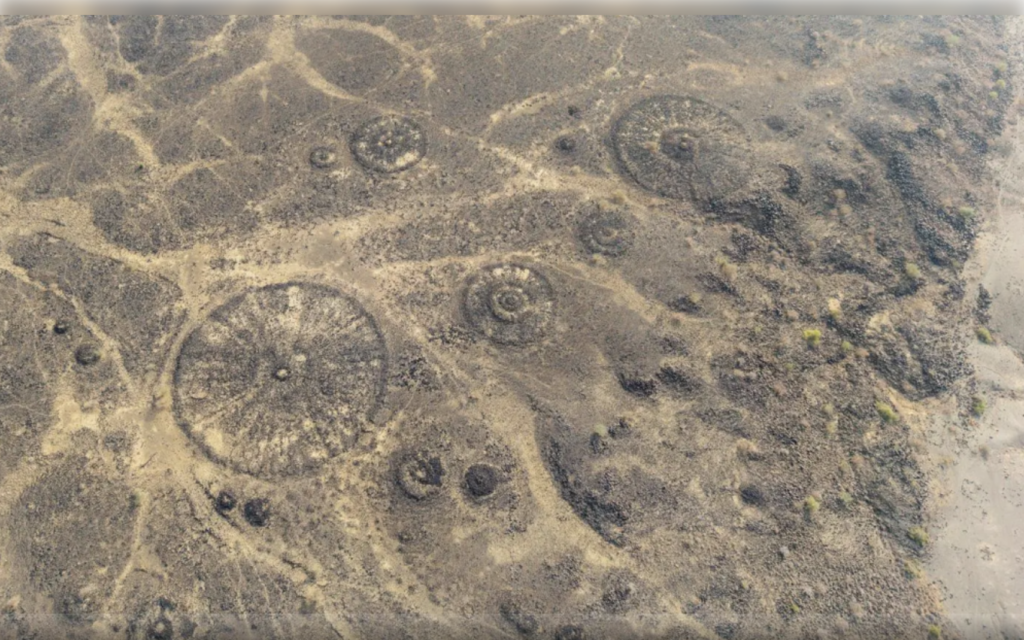
Giant stone circles arranged in intricate geometric patterns have been found in Hali, in western Saudi Arabia’s Makkah Region. Aerial photographs reveal large circular and spiral-shaped stone formations spread across the rocky landscape, some positioned close together and others forming smaller rings within larger structures. Their age, builders, and original purpose remain unknown.
According to the Saudi Press Agency (SPA), the formations lie in Al-Qunfudhah Governorate and consist of stones arranged in distinct geometric patterns. Saudi historian Dr. Mohammed Khurais Al-Marhabi has suggested that the structures may have served astronomical or seasonal purposes, although no archaeological evidence has yet confirmed this interpretation.
A Mysterious Geometric Pattern Visible from Above
The stone circles occupy an area characterized by volcanic rocks and varying soil colors. Their builders appear to have used stones from the surrounding terrain, creating formations that blend into the landscape.
From above, however, the circular arrangements become much clearer. Some rings overlap, while others differ considerably in diameter, producing a complex geometric pattern.
Saudi historian and researcher Dr. Mohammed Khurais Al-Marhabi believes the arrangement deserves closer archaeological investigation. Speaking to SPA, he suggested that the regularity of the circles, their intersections, and the positioning of their stones could indicate a deliberate system rather than a random accumulation of rocks.
Nevertheless, the formations have not been securely dated, and their original builders remain unidentified. No published excavation results currently establish their function.
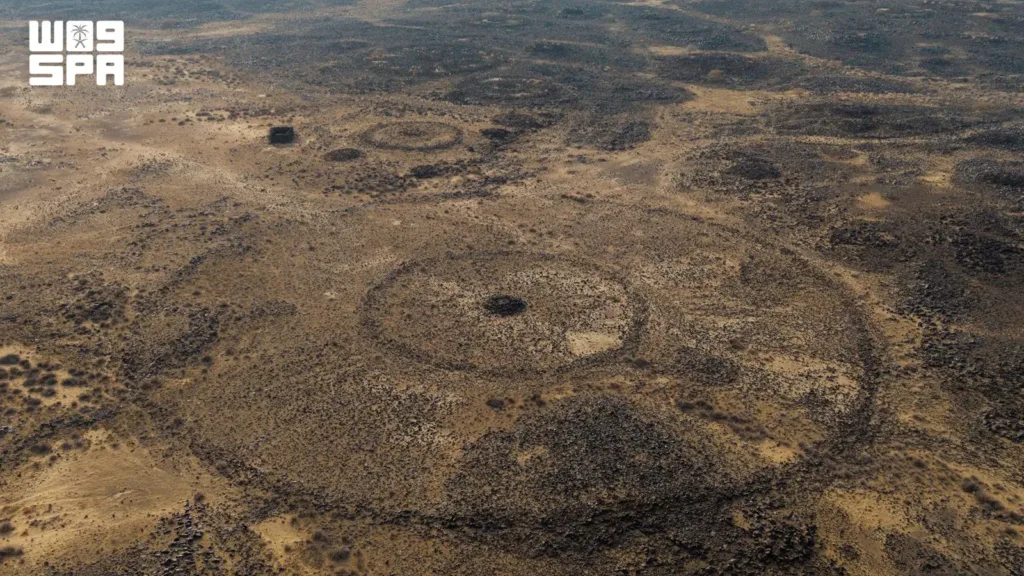
Could the Stone Circles Have Tracked the Sun and Moon?
One possibility raised by Al-Marhabi is that the structures served a mathematical or astronomical purpose.
He suggested that their geometric arrangement might relate to observations of weather, seasonal changes, or the movements of the Sun, Moon, and planets. Such knowledge could have been valuable to communities whose agricultural activities depended on recognizing seasonal patterns.
The researcher also questioned whether the circles were intended for habitation or burial, arguing that their arrangement appeared inconsistent with those functions.
These suggestions remain hypotheses rather than established archaeological conclusions. Determining whether the stones align with celestial events would require precise surveys, chronological evidence, and systematic analysis of their orientations.
Hali’s Long History of Human Settlement
The stone formations stand within a region associated with a long history of settlement and agriculture.
Al-Marhabi pointed to the nearby Qouz Al-Shahid cemetery, which he documented during earlier field research. According to the researcher, the burial ground covers more than 250,000 square meters, making it one of the most extensive cemetery sites identified in Al-Qunfudhah Governorate.
He also connected the wider area with the historical settlement of Hali bin Yaqub, associated in his research with the ancient locality known as Al-Sahariya.
Hali Valley occupies a fertile part of the Tihama region along western Arabia. Its agricultural landscape and historical connections with Makkah provide a broader context for investigating the stone formations, although no direct chronological relationship between the circles and nearby historical sites has been established.
An Archaeological Question Still Unanswered
Stone circles and other large stone structures occur across Saudi Arabia, but their dates and functions vary considerably. Similar appearances do not necessarily indicate that different sites shared the same builders or purposes.
For Hali, the central questions remain unresolved: when were the circles constructed, how were they used, and why did their builders choose such an intricate arrangement?
The aerial photographs provide a starting point for further investigation. Until archaeological surveys and scientific dating establish their history, the interlocking circles remain an intriguing but largely unexplained feature of western Arabia’s archaeological landscape.
