
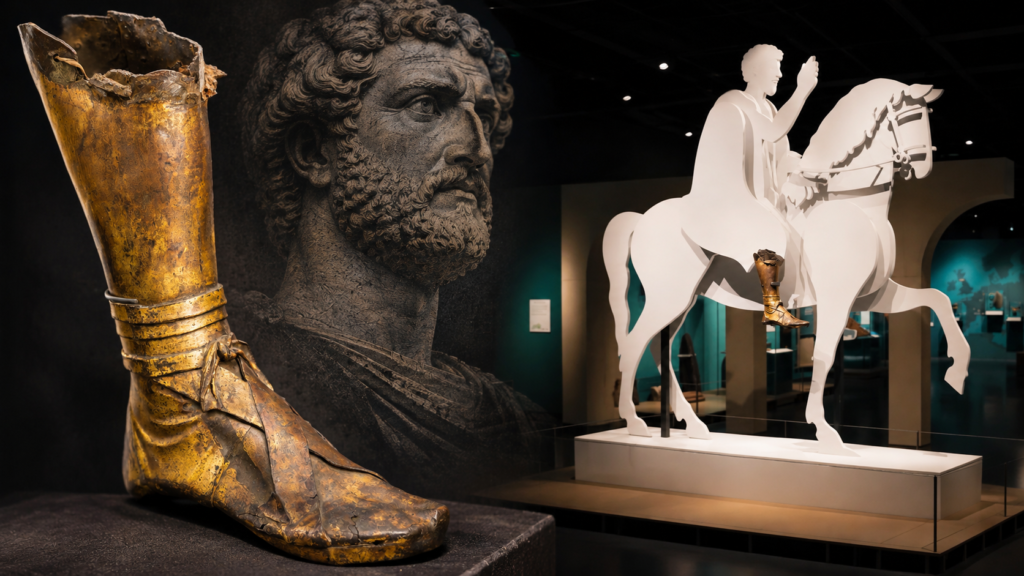
A gilded bronze leg found in a Scottish bog more than 200 years ago may change how archaeologists interpret Rome’s withdrawal from Scotland. Long considered a piece of war booty carried north from England, the 1,800-year-old fragment may instead belong to a monumental statue of a Roman emperor that once stood in southern Scotland. Its unusual condition suggests Roman soldiers may have carefully dismantled the monument when they abandoned their northern frontier.
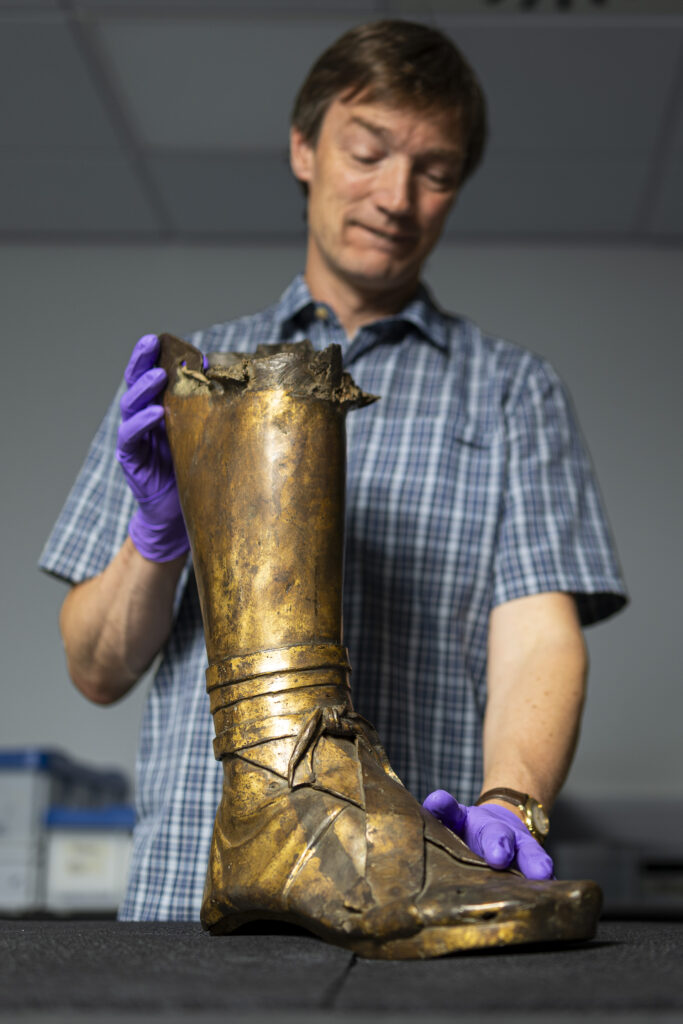
Dr. Fraser Hunter, Principal Curator of Prehistoric and Roman Archaeology at National Museums Scotland, has linked the surviving leg to a possible equestrian statue of Emperor Antoninus Pius. The museum’s November 12 announcement places the monument within Rome’s second attempt to conquer southern Scotland during the second century AD. The interpretation also raises a broader question about what Roman troops chose to remove, bury, or preserve when they left the territory.
A Roman Bronze Leg That Challenged a 200-Year-Old Explanation
The story began in 1820, when workers discovered a larger-than-life bronze lower leg and boot-clad foot in a bog at Milsington, near Hawick in the Scottish Borders. Its surviving gilding indicated that the fragment had belonged to an expensive monument rather than an ordinary decorative object. Yet its isolated location presented archaeologists with a problem: why would such an imposing Roman sculpture have stood in this part of Scotland?
For generations, scholars favored an explanation involving plunder. They proposed that local inhabitants had seized the fragment from a Roman statue farther south, possibly in York, the ancient city of Eboracum, before carrying it into Scotland. The assumption reflected an older understanding of Roman frontier settlements as unlikely locations for monumental imperial sculpture.
Research into bronze statue fragments from other Roman frontier forts has weakened that argument. Archaeologists now recognize that military communities displayed imperial statues, including large equestrian monuments, far beyond the empire’s major cities. A monumental statue in Roman-occupied Scotland therefore no longer seems as improbable as earlier researchers believed.
The surviving leg provides a further reason to reconsider the traditional account. Its physical condition does not match the damage that archaeologists would normally expect from a statue violently broken apart during an attack.
The Physical Evidence for Careful Dismantling
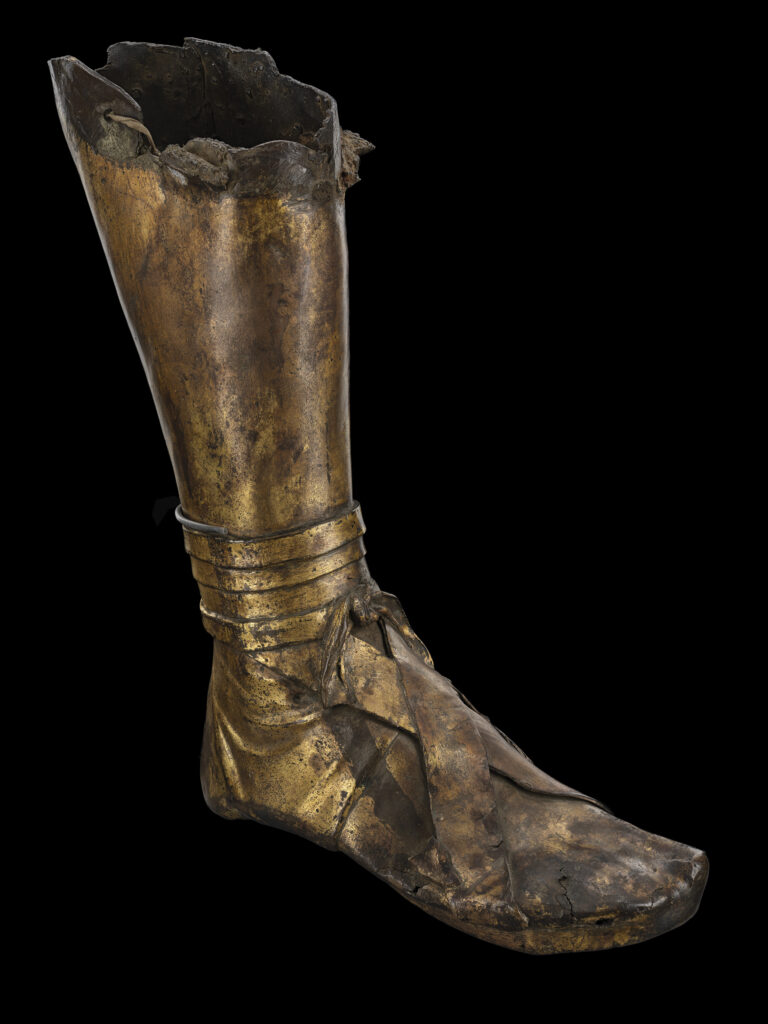
The upper end of the Milsington leg retains the form it acquired during casting, without the cutting marks that would indicate someone had hacked it from the rest of the sculpture. The absence of gilding around the knee also helps explain the statue’s original appearance. Researchers believe a tunic or cloak covered this area, while surviving bronze projections connected the leg to the folds of the garment.
These details support the possibility that workers separated the leg from a larger sculpture through its original construction rather than destroying it with tools. Roman metalworkers commonly assembled monumental bronze statues from separately cast sections, making the connections between those sections important evidence for how a monument came apart.
The distinction matters because ancient statues could meet very different ends. Soldiers and civilians sometimes destroyed imperial images during political upheaval, while metalworkers cut sculptures into smaller fragments for recycling. In contrast, the Milsington leg appears to have survived without the extensive damage associated with either process.
Hunter’s interpretation does not establish who dismantled the statue or exactly when it happened. Nevertheless, its condition fits a pattern that archaeologists have documented at Roman military sites in Scotland, where valuable monuments sometimes received careful treatment during the abandonment of forts.
What the Antonine Wall Tells Us About Rome’s Retreat
The proposed statue dates to the AD 140s, when Antoninus Pius sought to extend Roman control beyond Hadrian’s Wall. Roman forces advanced into southern Scotland and constructed the Antonine Wall between the Firth of Forth and the Firth of Clyde. The new frontier represented an ambitious effort to establish imperial authority farther north.
Rome eventually abandoned the Antonine frontier and returned its principal defensive line to the south. Archaeologists continue to debate aspects of the withdrawal and the timing of individual military departures, but excavations provide evidence that the process involved more than simply leaving fortifications behind.
At several sites, Roman troops removed inscribed stones from their original positions and buried them. Archaeologists have also documented deliberate deposits of religious objects, including the Mithras altars from Inveresk, near Edinburgh. These discoveries suggest that departing communities sometimes took particular care with monuments associated with imperial authority or religious practice.
The Milsington leg may belong to this wider pattern of deliberate removal and deposition. Rather than treating the fragment as an object seized by Rome’s enemies, researchers can consider whether the army itself dismantled a prestigious imperial monument during the frontier’s final years.
However, the evidence does not prove that the leg entered the bog as part of an organized military withdrawal. Its watery findspot also leaves open the possibility of a deliberate ritual deposit, an interpretation that earlier scholarship has considered.
Why Antoninus Pius Is the Leading Candidate
Identifying the statue’s subject presents another challenge because the surviving bronze carries no inscription naming its original figure. Nevertheless, the monument’s likely date and location point toward Antoninus Pius, who ruled from AD 138 to 161 and placed considerable political importance on his military achievements in Britain.
Antoninus celebrated the conquest of southern Scotland as a major imperial success. According to National Museums Scotland, the campaign was the only foreign military venture for which he adopted the victory title Imperator. A gilded equestrian statue would have provided a conspicuous expression of that achievement in territory that Roman troops had only recently occupied.
Such a monument would also have carried a political message. Imperial statues represented the emperor’s authority in places where most inhabitants would never encounter the ruler himself. In a frontier region, a large gilded sculpture could have communicated Rome’s power to soldiers, visiting officials, and neighboring communities.
The identification remains provisional. Without the statue’s head, an associated inscription, or additional diagnostic fragments, researchers cannot establish beyond doubt that the figure represented Antoninus Pius.
An Older Interpretation Gains New Significance
The suggestion that Roman soldiers carefully dismantled the Milsington statue did not originate with the museum’s 2026 announcement. Hunter had already discussed the possibility in earlier research, while subsequent scholarship examined whether the bronze leg’s deposition in a bog might have carried ritual significance.
The latest assessment gains its importance from a broader comparison with imperial statues from frontier forts and with evidence for the Roman withdrawal from Scotland. Together, these findings strengthen the possibility that the leg originated in a local monument rather than arriving as plunder from England.
The location of the rest of the statue remains unknown. Its missing sections may have entered ancient recycling networks, survived elsewhere as unidentified fragments, or disappeared through processes that the archaeological record can no longer reconstruct.
For now, the Milsington leg changes neither the established chronology of Rome’s occupation nor the fact that its northern military frontier was abandoned. Its significance lies in a different possibility: the Romans may have deliberately taken apart one of their most visible symbols of imperial power before leaving Scotland.
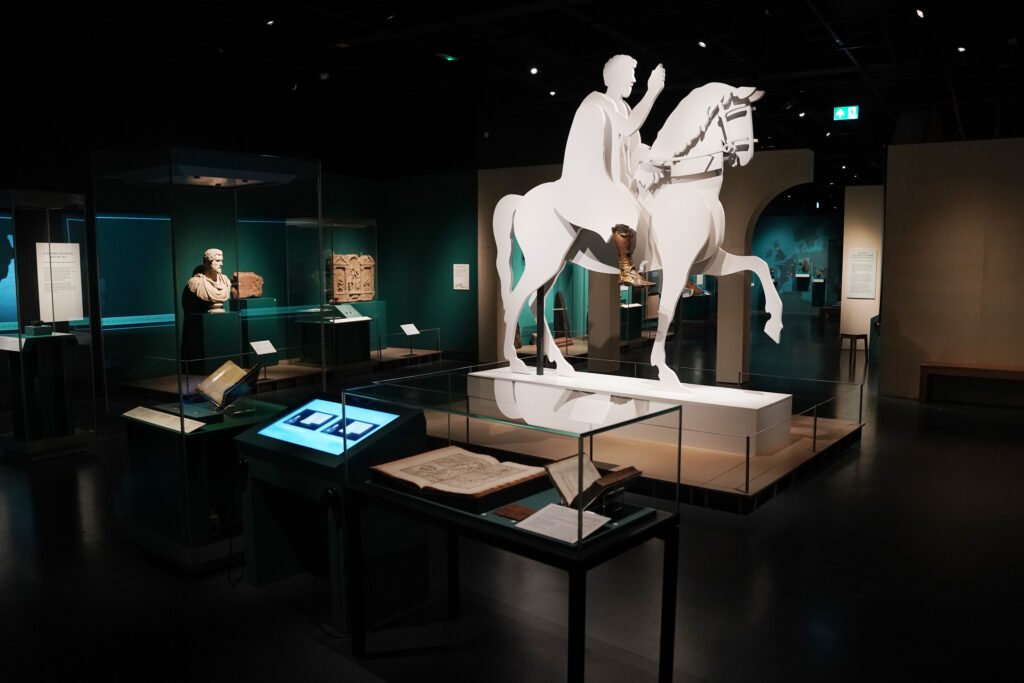
The gilded bronze leg features in the National Museum of Scotland’s exhibition Roman Scotland: Life on the Edge of Empire, which opened on November 14, 2026. A reconstruction places the surviving fragment within the outline of a monumental equestrian statue, allowing visitors to appreciate the scale of the imperial image that may once have dominated a Scottish frontier settlement.
