
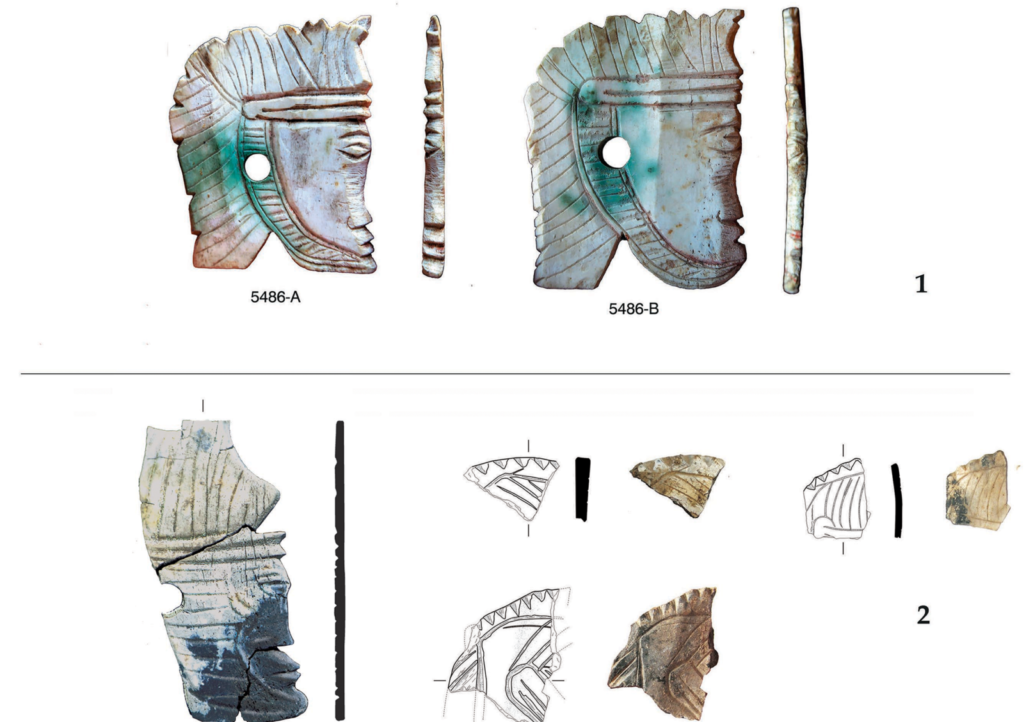
More than 2,000 carved bone fragments from the ancient Roman city of Pompeii have provided new evidence of the elaborate funeral beds used by wealthy residents nearly 2,000 years ago. Decorated with helmeted soldiers, Hellenistic shields, triumphal wreaths, and even traces of gold leaf, these luxury furnishings reflected the importance of military imagery in Roman funerary culture. A new study also identifies striking similarities between decorations recovered from a cemetery outside the city and those found in a possible furniture workshop within Pompeii.
The research, published in the Journal of Roman Archaeology, examines material from the Porta Nola necropolis and the Casa del Fabbro, or House of the Craftsman. Archaeologists Pilar Mas Hurtuna, Llorenç Alapont Martín, and Agustín Ángel Diez Castillo compared the objects’ designs and manufacturing techniques to investigate how Pompeii’s inhabitants commissioned, decorated, and used luxury furniture during the first century AD.
Funeral Beds Decorated for the Journey to Death
In Roman funerary traditions, a decorated bed could play a central role in the ceremonies surrounding a person’s death. Families placed the deceased on an elaborate wooden couch for display and transportation before carrying it to the funeral pyre, where flames consumed much of the furniture alongside the body.
The surviving bone ornaments offer evidence of furnishings that would otherwise have disappeared. At Pompeii’s Porta Nola necropolis, archaeologists recovered hundreds of fragments among cremation ashes, charcoal, and burial deposits, allowing them to reconstruct aspects of the beds’ original appearance.
One important assemblage comes from the tomb of Marcus Obellius Firmus, which archaeologists first investigated in 1976. Excavations between 2015 and 2017 enabled researchers to examine 450 fragments associated with the burial, including decorative elements that once formed part of a wooden funerary bed.
Another cremation burial, known as Tomb A, contained approximately 540 fragments, some inside a ceramic urn. A nearby cremation deposit yielded around 500 additional pieces, including an almost complete bed leg and part of a frame still bearing carved bone plaques.
Together, these discoveries show that funeral beds could carry elaborate ornamentation across several structural components. Their decoration extended beyond isolated figures to create coordinated visual arrangements of military symbols, shields, and other motifs.
Helmeted Warriors, Ancient Shields, and Traces of Gold
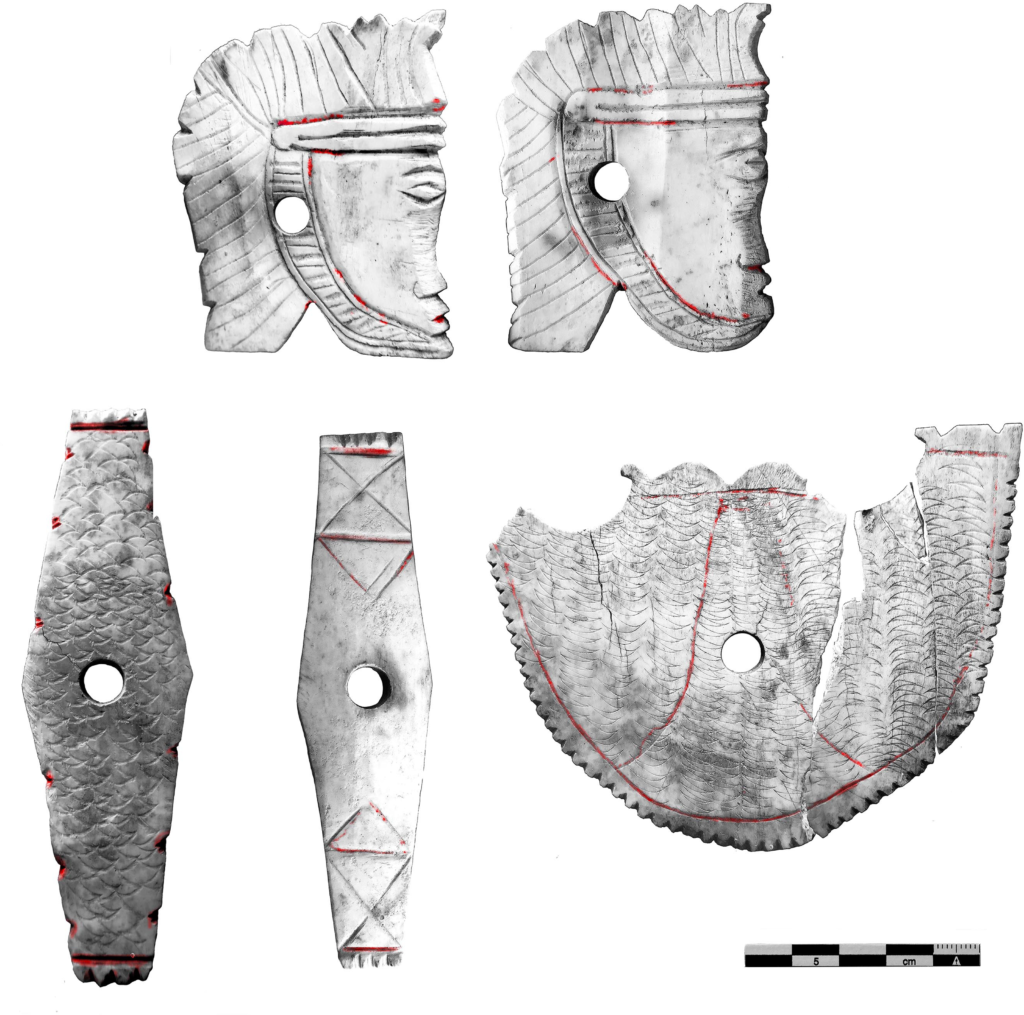
Among the most distinctive ornaments are small representations of soldiers wearing elaborate helmets. Some imitate the Attic style, which Greek and Roman artists frequently associated with military commanders, while other surviving figures display characteristics of Hellenistic military equipment.
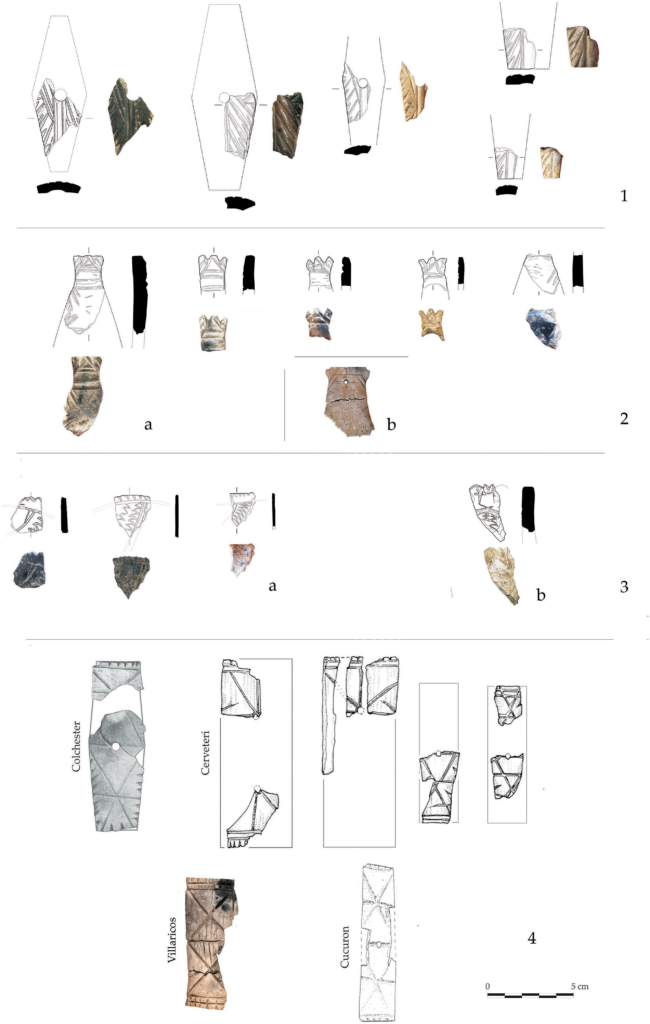
The researchers identified different categories of helmeted heads, including small profile plaques and larger medallion-like decorations. Craftspeople carved the figures into thin pieces of bone, using incised lines to define helmet crests, cheek guards, facial details, and clothing.
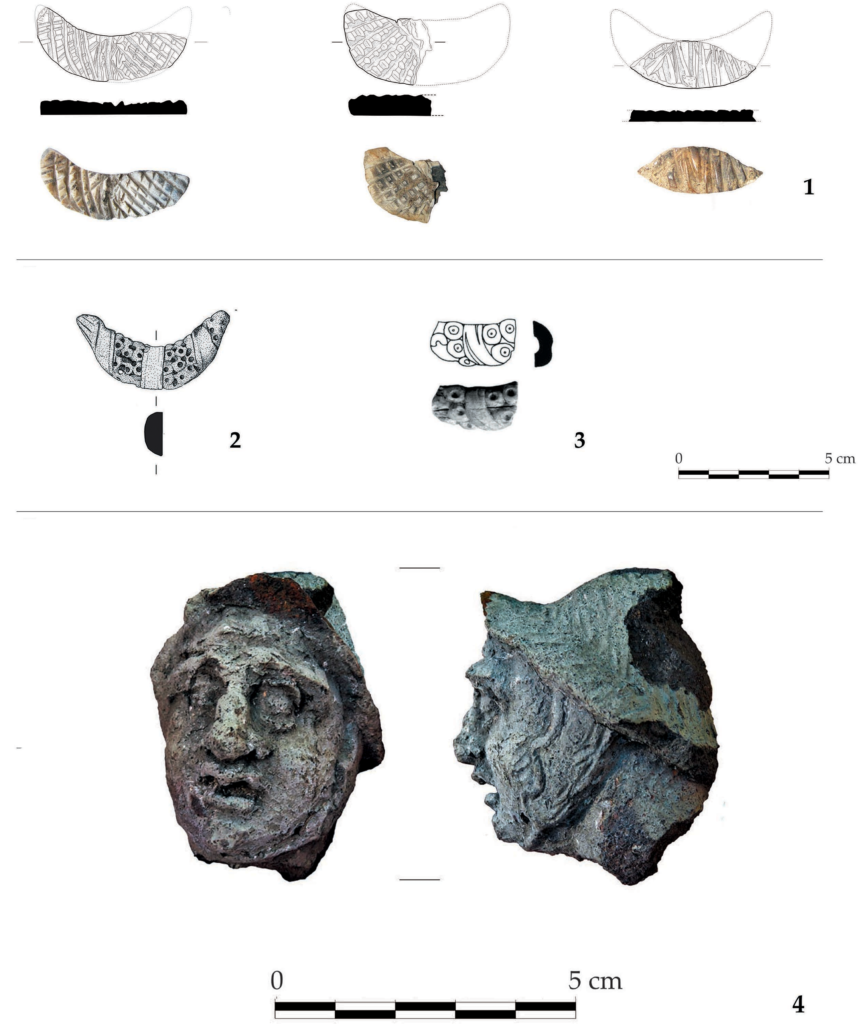
The collection also includes miniature shields in hexagonal, rectangular, and crescent-shaped forms. Several designs resemble equipment associated with Macedonian and other Hellenistic military traditions, suggesting that Pompeian artisans borrowed established artistic symbols rather than simply reproducing contemporary Roman weapons.
Some plaques preserve especially revealing evidence of their original appearance. At the Casa del Fabbro, researchers identified red pigment within the carved grooves of soldiers’ heads and shields, demonstrating that craftspeople enhanced the ornaments with color rather than leaving every surface untreated.
A decorative garland from the tomb of Marcus Obellius Firmus also retains traces of gold leaf. Although the researchers do not suggest that entire beds carried gold coverings, this surviving detail indicates that at least some ornaments incorporated precious finishes to increase their visual impact.
The combination of carved bone, painted details, and occasional gilding helps explain why such furniture represented a significant investment. These were not merely practical objects for transporting the dead; their elaborate decoration communicated wealth and social identity during highly visible funeral ceremonies.
Carved bone shield ornaments from Roman funerary beds, showing different shapes and decorative patterns. Credit: Mas Hurtuna et al., Journal of Roman Archaeology (2026).
A Possible Luxury Furniture Workshop Inside Pompeii
One of the study’s most significant findings concerns the relationship between the Porta Nola cemetery and the Casa del Fabbro, a building within Pompeii’s residential district.
Excavations conducted at the house between 1926 and 1933 recovered numerous worked bone objects. In one room, archaeologists documented 20 decorative plaques alongside 322 additional fragments, including ornaments that closely resemble those associated with funerary beds at Porta Nola.
The building’s history makes this connection particularly interesting. Following the devastating earthquake of AD 62, the Casa del Fabbro appears to have lost its original residential function and may have operated as a workshop or storage facility during the years preceding Mount Vesuvius’s eruption in AD 79.
The new analysis identifies similarities that extend beyond shared decorative themes. Craftspeople at both locations used comparable carving methods, including a technique involving curved gouges that produced repeated scale-like patterns across the surfaces of certain shields.
The researchers argue that these distinctive characteristics point toward a connection between luxury furniture production and funerary consumption within Pompeii. However, the available evidence cannot establish that the Casa del Fabbro manufactured the specific beds recovered from the cemetery.
Another possibility is that the house stored finished ornaments, reused decorative pieces, or maintained components that artisans intended to incorporate into new furniture. Some objects show evidence of earlier use, raising questions about whether craftsmen repaired or repurposed valuable furnishings.
These findings suggest that Pompeii supported specialized activities involving luxury furniture decoration, even during the city’s final decades. They also demonstrate how archaeological material from domestic and funerary contexts can help researchers investigate economic relationships that individual discoveries cannot explain on their own.
Military Triumph and the Symbolism of Death
The repeated appearance of soldiers and shields raises another question about Roman funerary culture: why did families choose military symbols to decorate furniture associated with death?
The researchers suggest that these images carried meanings beyond their ornamental value. Hellenistic military equipment and triumphal motifs formed part of a broader artistic tradition that Roman society associated with victory, authority, and prestige.
Such imagery did not necessarily indicate that the deceased had served in the military. Instead, its presence on expensive funerary furniture may have expressed the family’s social aspirations or connected the deceased symbolically with Roman ideals of triumph.
The study also considers a more symbolic interpretation. Military victory could serve as a visual metaphor for triumph over death, giving images of armed soldiers and captured weapons a significance within funerary rituals.
Similar decorations from archaeological sites in present-day Switzerland, Germany, France, Spain, and Britain demonstrate that this artistic tradition extended beyond Pompeii. The researchers compare these examples to identify common designs and investigate how decorative styles circulated across the Roman world.
The findings also raise the possibility that some elaborately decorated beds served domestic purposes before becoming part of a funeral. Wealthy Romans used luxurious couches for reclining and dining, and the researchers suggest that certain furnishings may have passed from everyday life into the ceremonies surrounding their owners’ deaths.
Although surviving evidence does not establish how frequently this happened, the possibility illustrates the close relationship between Roman domestic luxury and funerary display.
Mas Hurtuna, P., Alapont Martín, L., & Diez Castillo, A. Á. (2026). Military iconography on bone plaques for funerary beds from the Porta Nola necropolis and the Casa del Fabbro in Pompeii. Journal of Roman Archaeology, 1–28. doi:10.1017/S1047759426100993
