
Archaeologists excavating a prehistoric burial cave in northeastern Spain have discovered human remains that suggest ancient communities moved parts of the dead while connective tissues still held their bones together. The findings offer important evidence of how people repeatedly used and reorganized collective burial spaces thousands of years ago.
The discoveries come from Cova dels Xaragalls, near Vimbodí i Poblet in Catalonia, where researchers recovered connected skeletal remains belonging to adults, alongside other human remains, including those of children. Two unusually small polished-stone adzes and newly identified prehistoric animal deposits add further evidence of the cave’s long and complex history.
Human Remains Show How Burial Spaces Were Reorganized
The excavation team worked at Cova dels Xaragalls from October 5 to 26, 2026, concentrating on deposits near two of the cave’s entrances. Researchers from the Catalan Institute of Human Paleoecology and Social Evolution (IPHES-CERCA), Rovira i Virgili University, and the Institute of Archaeology of Mérida conducted the investigation.
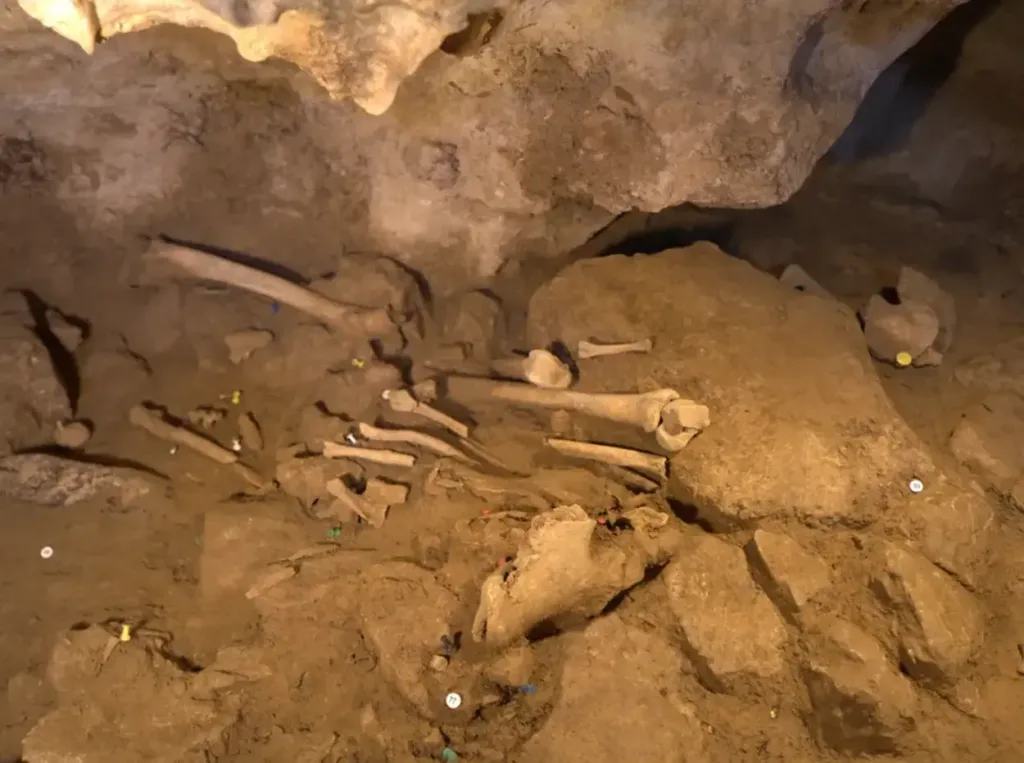
The most significant discoveries include several human skeletal segments that retain their original anatomical connections. Archaeologists recovered a complete pelvis connected to the sacrum and several lumbar vertebrae, along with portions of an adult’s lower limbs, including tibiae, fibulae, and ankle bones.
Unlike the mostly disarticulated remains recovered during earlier excavations, these bones preserve relationships that help researchers reconstruct what happened to the bodies after burial. They are not complete skeletons but connected anatomical sections that appear to have been relocated within the cave.
According to the official IPHES-CERCA announcement, the preservation of these connections indicates that some movements occurred before the connective tissues holding the bones together had completely disappeared.
Excavation co-director Dr. Antonio Rodríguez-Hidalgo, a researcher at the Institute of Archaeology of Mérida, explained that the connected remains provide evidence of how bodies were handled as communities continued using the cave for burials.
Collective burial sites often accommodated successive generations of the dead. As communities introduced new bodies, they sometimes rearranged earlier remains to make room. At Cova dels Xaragalls, the position and condition of the bones could help archaeologists distinguish between these episodes and reconstruct the sequence of funerary activities.
The precise age of the burial deposits remains uncertain. Researchers are awaiting radiocarbon results from cranial remains recovered in 2025 from the same funerary context.
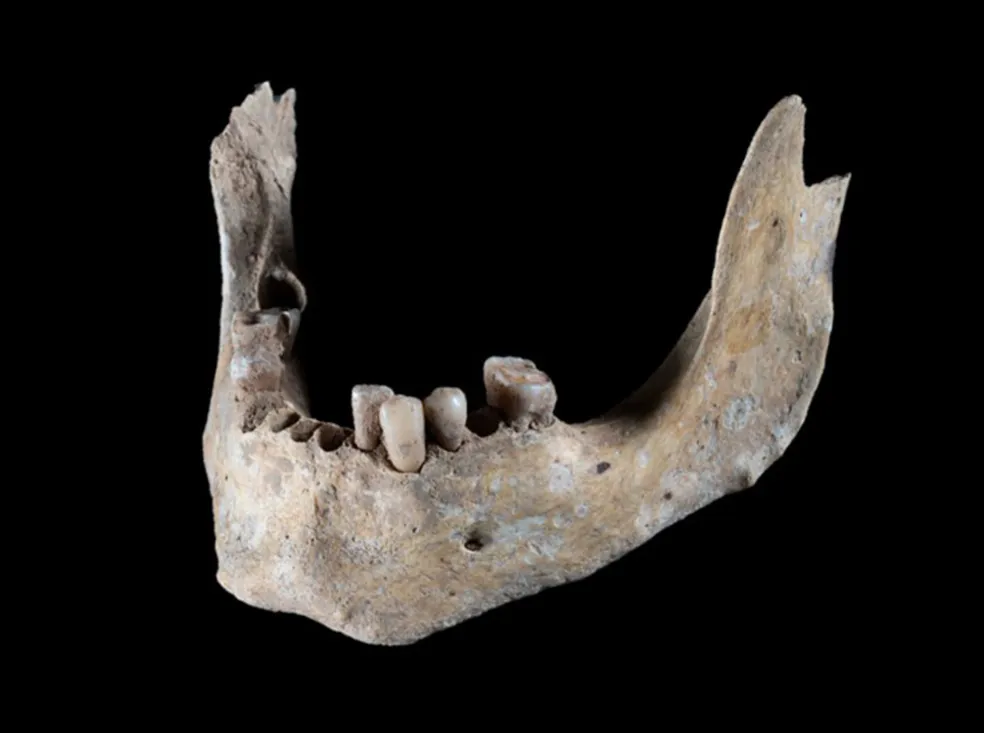
Human jawbone recovered from Cova dels Xaragalls in Catalonia, Spain. Dental remains from the cave will support research into the diet, oral health and living conditions of prehistoric populations. Credit: IPHES-CERCA.
Two Miniature Stone Adzes Raise Questions
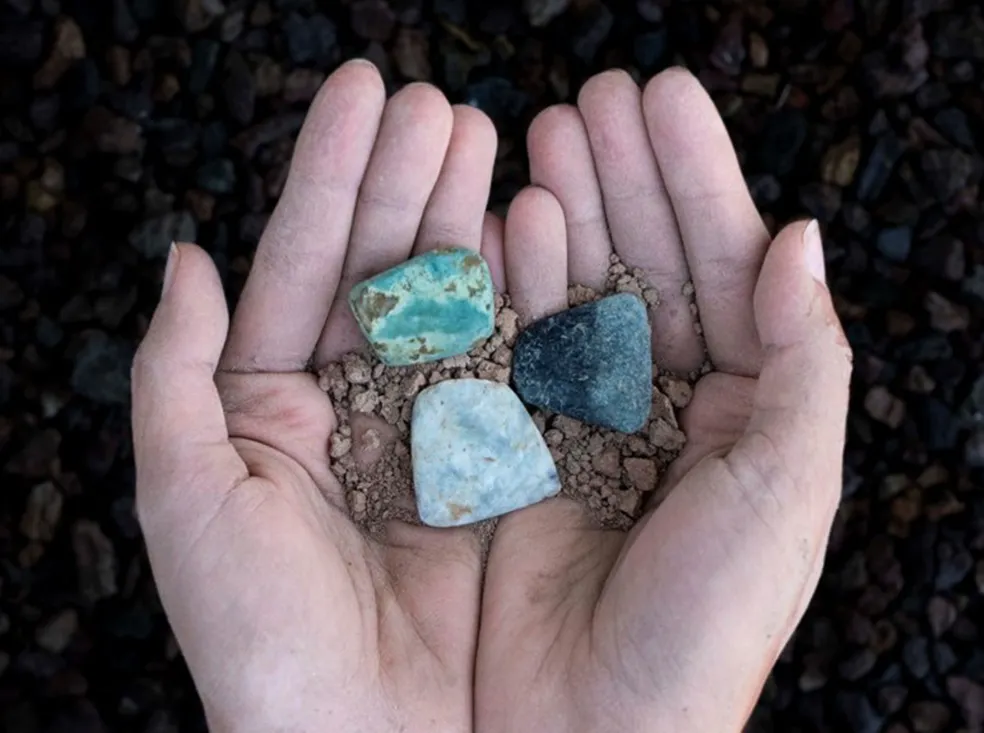
The excavation also produced two polished-stone adzes measuring approximately three centimeters in length. Researchers have not yet determined the mineral composition of the hard stones used to make them.
Their small size raises questions about whether they served practical purposes before entering the burial deposit or carried a primarily symbolic meaning. Although polished-stone implements occur in Neolithic and later prehistoric funerary contexts, their presence alone does not establish their function.
Specialists at IPHES-CERCA will examine the objects for microscopic traces of manufacture and use. Such evidence could help determine whether the adzes were working tools, grave offerings, or objects whose roles combined practical and symbolic elements.
Their discovery also expands the range of artifacts associated with the cave’s funerary deposits, offering another way to investigate the people who used the site.
Older Animal Deposits Discovered in Another Entrance
Beyond the human burials, archaeologists identified previously undocumented Pleistocene sediments at entrance B. These deposits contain large-mammal remains, including red deer (Cervus elaphus), and may extend the known distribution of the cave’s earliest archaeological and paleontological layers.
Until now, researchers had primarily identified deposits of this age near entrance A. Finding them elsewhere suggests that older sediments survive across a larger portion of the cave than previously recognized.
The discovery also raises the possibility that prehistoric humans accessed areas near entrance B during the Pleistocene. However, the excavation team has not identified archaeological evidence that confirms such an occupation.
Dr. Josep Vallverdú, an IPHES-CERCA and Rovira i Virgili University researcher who co-directs the project, emphasized that the new layers open opportunities to investigate the cave’s earlier history without yet establishing a human presence during that period.
Further Research Into Prehistoric Lives
The research team is also expanding its investigation of the people buried at Cova dels Xaragalls. Two doctoral researchers will study human teeth from the site, examining dental microwear, oral diseases, and other indicators that may provide information about diet and living conditions.
Meanwhile, three-dimensional recording and laser scanning are helping archaeologists document the precise positions of the finds. These records will be especially important when researchers compare the connected skeletal remains with the cave’s broader burial sequence.
Together, the discoveries show that Cova dels Xaragalls preserves evidence from different chapters of prehistory: a repeatedly used collective burial space and much older deposits containing traces of extinct environments. Further analysis will help establish when communities buried their dead there and how their funerary practices changed over time.
