
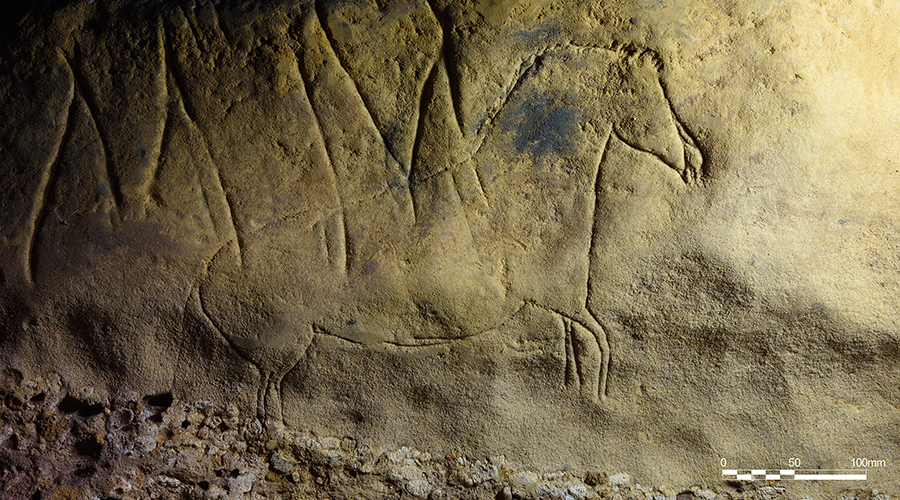
For decades, tourists walked past Ice Age engravings inside a cave in northeastern Spain without realizing what they were seeing. Some even scratched their names and dates over the prehistoric artwork, unaware that the walls contained traces of a much older artistic tradition.
A detailed archaeological study has revealed the remarkable scale of this overlooked collection and its importance to the history of Paleolithic art in Europe.
A new study published in Antiquity examines 280 engravings identified at Cova de la Font Major in Catalonia, including dozens of animal figures. Researchers say the collection challenges long-standing assumptions about the scarcity of Paleolithic cave art in northeastern Spain and reveals the archaeological importance of a site that thousands of people had already visited.
Ancient Art Hidden Among Modern Graffiti
The Cova de la Font Major cave lies beneath the town of Espluga de Francolí in Catalonia, northeastern Spain. Visitors have explored its underground passages since the main entrance reopened in 1957, and the cave became an established tourist attraction in 1993.
On October 30, 2019, archaeologist Josep Maria Vergès Bosch noticed unusual markings among the modern graffiti covering the walls of a section known as Gatoneres de Cal Palletes. Several engravings displayed characteristics associated with Paleolithic art, prompting a closer examination of surfaces that thousands of visitors had passed for more than six decades.
The discovery was particularly unexpected because the engraved galleries formed part of an established tourist route. Visitors had repeatedly walked directly in front of the ancient figures, sometimes leaving modern inscriptions across them, without recognizing their prehistoric origin.
Vergès Bosch and fellow researcher Míriam Salas-Altès have now presented a comprehensive analysis in the journal Antiquity. Their findings identify one of the largest collections of Paleolithic cave engravings along the Mediterranean side of the Iberian Peninsula.
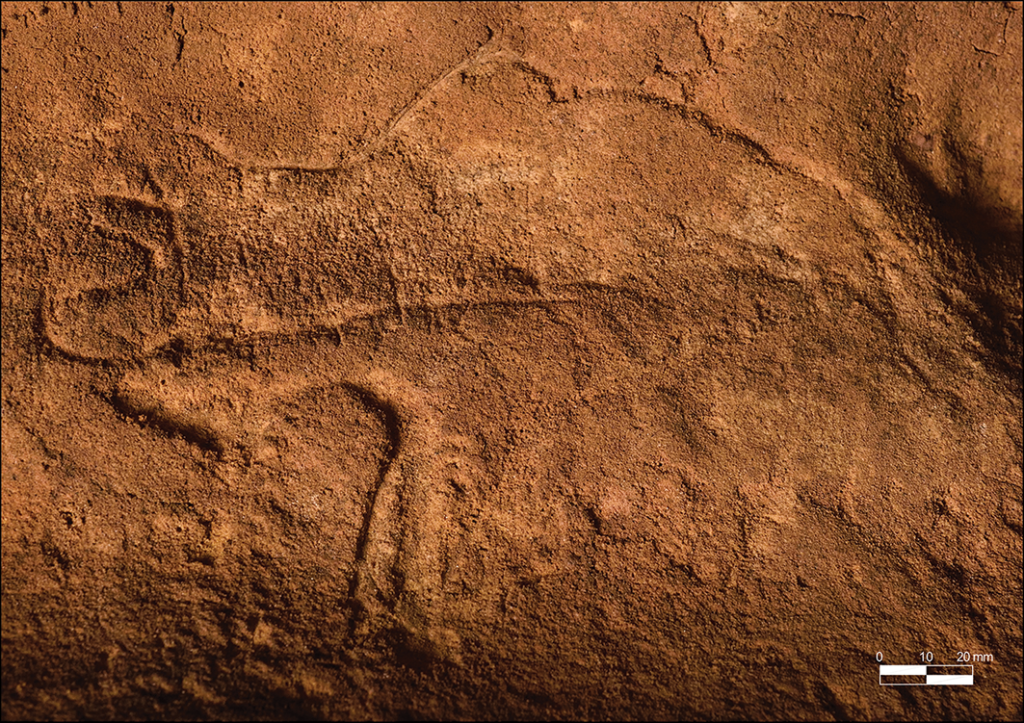
Paleolithic engraving of a bear at Cova de la Font Major in Catalonia, Spain. The artist depicted the animal with its ears facing forward and its mouth slightly open. Credit: Vergès Bosch & Salas-Altès / Antiquity (2026).
Horses, Deer, Wild Cattle and a Rare Bear
Researchers documented 280 graphic elements across five sectors of the cave, approximately 250 meters from its present entrance. Among them, they identified 55 animal representations, including horses, deer, wild cattle, and goat-like animals.
One particularly unusual engraving depicts a bear with its ears shown from the front and its mouth slightly open. Another portrays the front half of an aurochs, an extinct species of wild cattle, with its horns and ears presented in frontal perspective.
Not every animal could be identified with certainty. Approximately 30 percent of the representations lack enough anatomical detail for a reliable classification, while another 15 percent could belong to more than one animal group.
The remaining engravings include parallel lines, geometric shapes, and other abstract markings. Researchers also documented hundreds of loop-shaped incisions on one panel, although their precise age and cultural attribution remain uncertain.
The engravings vary considerably in size and execution. Most animal figures measure between 15 and 45 centimeters in length, while the grooves typically range from three to seven millimeters wide.
Ice Age Artists Worked With the Natural Rock
The cave’s geology played an important role in the creation of its artwork. Much of the underground system consists of irregular conglomerate rock, but softer marl layers offered prehistoric artists surfaces suitable for engraving.
Rather than preparing the walls, the artists generally worked directly into these natural layers. They created most figures through simple incisions, occasionally combining engraved lines with broader scraping techniques.
Some compositions suggest that the artists incorporated existing geological features into their designs. In one horse engraving, the boundary between two rock layers appears to serve as the ground beneath the animal.
Another figure shows the head of a deer descending toward a horizontal crack. Researchers suggest that the fissure may have represented a ground line or water surface, although they cannot conclusively establish whether the artist intended this effect.
These details offer an insight into how prehistoric artists may have approached the cave’s uneven surfaces. Rather than treating every wall as a blank canvas, they sometimes appear to have incorporated the rock’s natural features into their compositions.
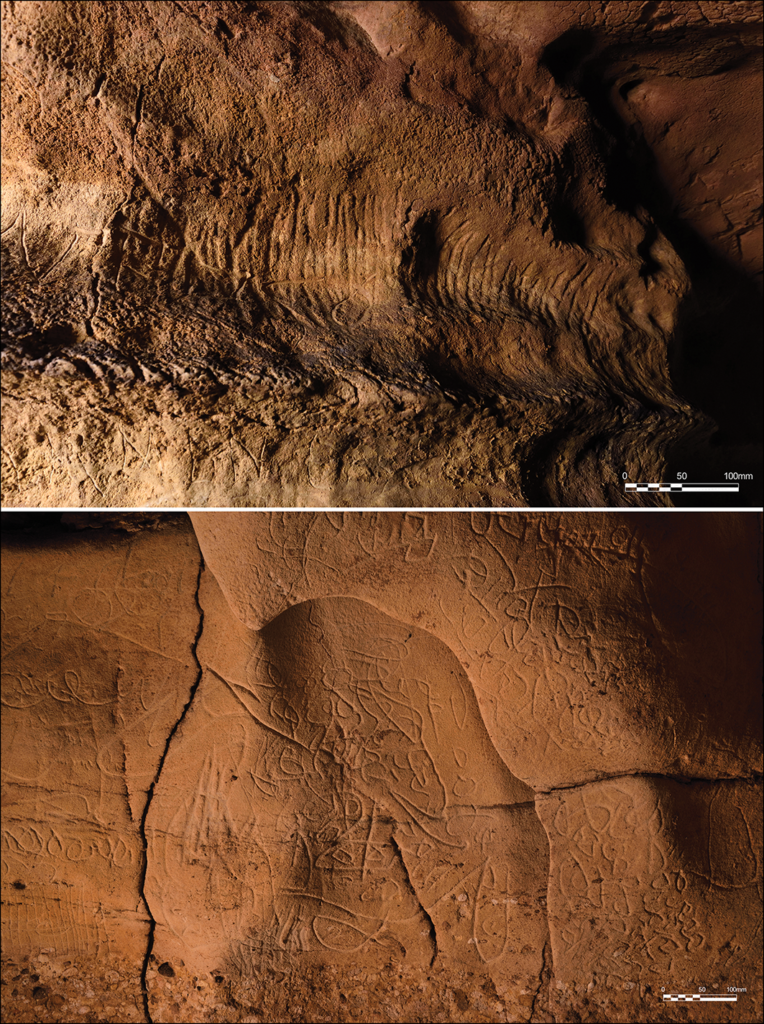
Parallel lines and loop-shaped engravings documented at Cova de la Font Major in Spain. Credit: Vergès Bosch & Salas-Altès / Antiquity (2026).
How Old Are the Engravings?
Determining the precise age of the artwork remains one of the study’s main challenges. Researchers have not yet directly dated the engravings, so they rely on archaeological context, radiocarbon evidence, and comparisons with other Paleolithic art.
Radiocarbon dates from the deeper galleries indicate human activity between approximately 40,800 and 25,900 years ago. The shapes of certain animal figures, including distinctive limb and head conventions, also resemble examples associated with periods before the Magdalenian.
Together, these findings support the interpretation that many engravings belong to earlier phases of the Upper Paleolithic. However, the researchers do not rule out the possibility that some figures originated during the Magdalenian or later periods.
The team hopes to establish a more precise chronology through future investigations. One animal engraving lies beneath a calcite deposit that may allow uranium-series dating, potentially providing an important chronological constraint for that particular figure.
A Discovery That Changes Catalonia’s Prehistoric Art History
Before the identification of the Font Major engravings, researchers knew of only two cave representations tentatively attributed to the Upper Paleolithic in Catalonia. This apparent scarcity contrasted sharply with the abundant prehistoric art documented in northern and southern Spain.
The newly studied collection substantially changes that picture. With 55 animal representations, Cova de la Font Major now ranks as the third-largest known Paleolithic cave art assemblage along the Mediterranean side of the Iberian Peninsula, surpassed only by Ardales and La Pileta in southern Spain.
The comparison becomes particularly striking when considering other regional sites. Approximately 75 percent of the known Paleolithic cave art assemblages along the Iberian Mediterranean contain five or fewer animal figures, while more than 90 percent contain no more than 20.
The discovery also raises questions about how archaeologists identify prehistoric art. For years, researchers considered the cave’s irregular walls unsuitable for extensive engraving, while modern graffiti and damage from visitors further complicated the recognition of ancient figures.
Cova de la Font Major demonstrates that important prehistoric artwork can survive in places that scientists and tourists have examined repeatedly. Subsequent investigations in other Catalan caves, including Cova Simanya, have already identified additional evidence of Paleolithic graphic expression, suggesting that the region’s artistic record may be richer than previously understood.
Vergès Bosch, J. M., & Salas-Altès, M. (2026). Filling gaps: the Palaeolithic rock art of the Cova de la Font Major on the north-east Iberian Peninsula. Antiquity, 1–22. doi:10.15184/aqy.2026.10447
