
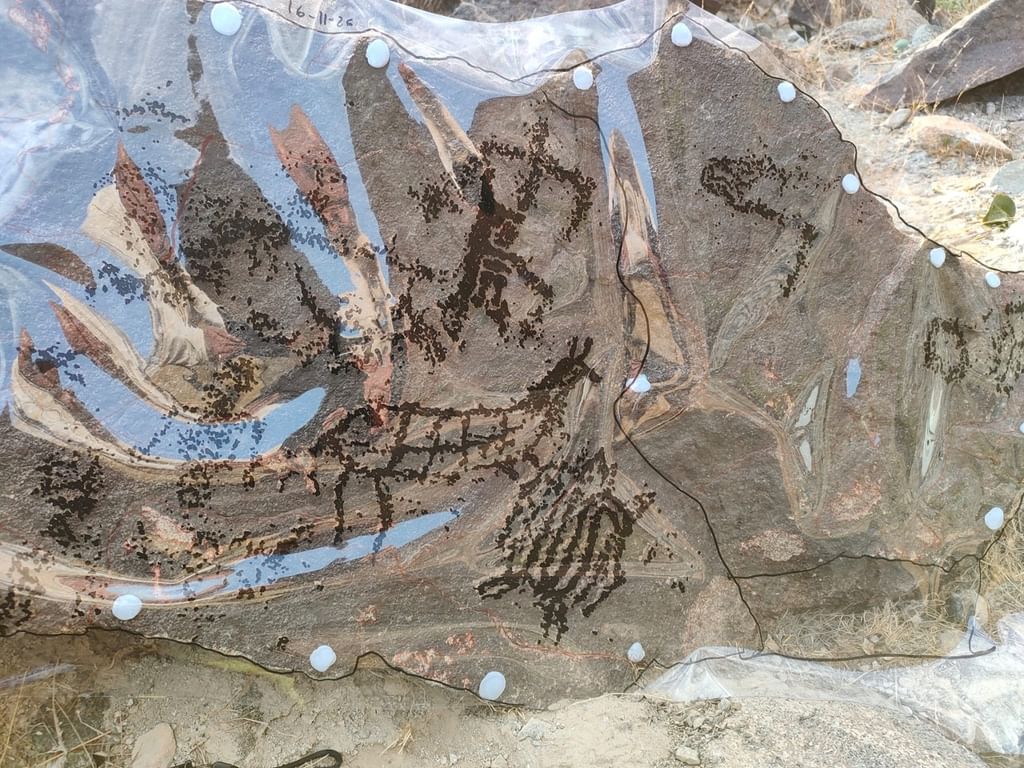
Archaeologists in the United Arab Emirates have discovered five rare sea turtle engravings deep within the mountains of Wadi Al-Helo in Sharjah. Researchers believe the carvings date back approximately 7,000 years, and four of the five appear to depict leatherback turtles, the world’s largest living sea turtle species. Their presence far from the coastline suggests that prehistoric communities in southeastern Arabia maintained connections between mountainous and coastal regions.
The Sharjah Archaeology Authority announced the discovery through the Emirates News Agency (WAM) on November 26. Local residents first brought the area to the attention of archaeologists in 2022, and researchers identified the previously undocumented rock art panel during their 2026 fieldwork.
Archaeologists know of only two other locations with comparable sea turtle engravings across the Oman Peninsula. The discovery at Wadi Al-Helo brings that number to three, making it an unusual addition to southeastern Arabia’s prehistoric rock art record.
Prehistoric Artists Captured the Anatomy of Sea Turtles
One of the most intriguing aspects of the discovery is the anatomical detail of the engravings. Four figures resemble leatherback sea turtles (Dermochelys coriacea), a species distinguished by its leathery shell and prominent longitudinal ridges running along its back.
Unlike other sea turtles, leatherbacks lack a hard shell covered with large scales. The prehistoric artists incorporated lines into their engravings that closely resemble the ridges of this species, allowing researchers to identify the animals with greater confidence.
The anatomical details suggest that the artists possessed considerable knowledge of marine turtles. Whether they acquired this knowledge through direct encounters with the animals, journeys to the coast, or exchanges with coastal communities remains unknown.
Researchers also consider the possibility that prehistoric people valued sea turtles for medicinal purposes or attached symbolic significance to them. Neither interpretation has conclusive archaeological support, leaving the original purpose of the engravings open to investigation.
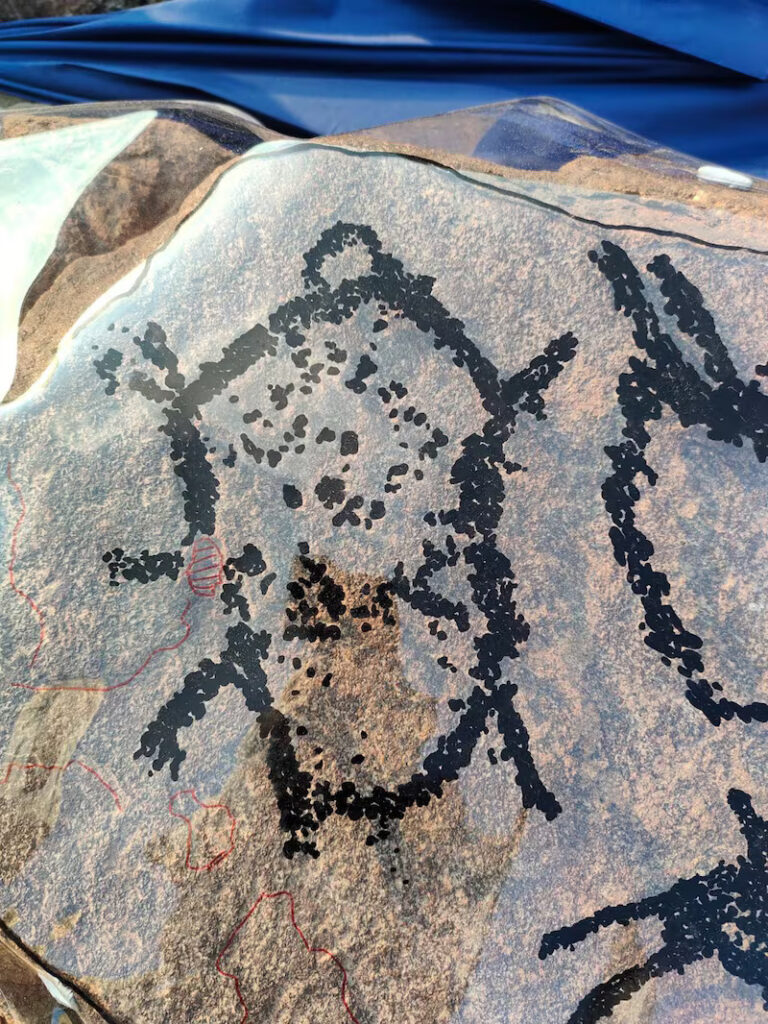
A tracing of a prehistoric sea turtle engraving discovered in the mountains of Wadi Al-Helo, Sharjah, United Arab Emirates. Photo: Sharjah Archaeology Authority
The Animals Carved into Wadi Al-Helo’s Rocks
Situated within the Hajar Mountains, Wadi Al-Helo contains numerous examples of rock art depicting animals associated with the region’s natural environment. The Sharjah Archaeology Authority has documented several panels through photography and three-dimensional recording techniques, creating a digital archive of the valley’s archaeological heritage.
Among the previously documented engravings are representations of wild asses and ibexes. These animals formed part of the terrestrial environment familiar to the communities that inhabited southeastern Arabia.
The sea turtle engravings stand apart from these representations of mountain and desert wildlife. Their presence suggests that the subjects prehistoric artists chose extended beyond the animals they encountered in their immediate surroundings.
Elsewhere in Sharjah, the rock art sites of Khatm Al Melaha, near Kalba, and the surrounding eastern coastal region preserve further evidence of Arabia’s ancient engraving traditions. Together, these sites document the diversity of animals, human activities, and environments that inspired prehistoric rock art.
From Neolithic Communities to Bronze Age Copper Producers
Wadi Al-Helo’s archaeological history extends far beyond its rock engravings. A 2018 study published in Arabian Archaeology and Epigraphy documented evidence of Neolithic activity at the archaeological site of HLO1-south, adding to knowledge of the valley’s early inhabitants.
Thousands of years later, the valley became an important center of copper production in southeastern Arabia. Archaeologists have identified Early Bronze Age copper-smelting workshops, settlement remains and a watchtower, documenting a later chapter in the region’s economic and technological development.
The United Arab Emirates included Wadi Al-Helo on UNESCO’s World Heritage Tentative List because of its significance in the history of copper production. Although these metallurgical remains belong to a much later period than the proposed age of the turtle engravings, they demonstrate the valley’s importance across different stages of Arabian prehistory.
Ancient Connections Between the Mountains and the Sea
Researchers provisionally date the turtle engravings to around 5000 BCE, a period when Neolithic communities inhabited southeastern Arabia. The engravings’ precise age remains uncertain, and archaeologists have yet to establish the nature of the connections between the artists and coastal populations.
Travel, the exchange of knowledge, and access to marine resources may explain why people engraved sea turtles on rocks far from the coast. The discovery also raises questions about whether Wadi Al-Helo formed part of a wider network linking inland communities with settlements along the Arabian coastline.
For archaeologists, the challenge now lies in determining whether the engravings record firsthand encounters with marine animals or reflect stories, beliefs, and knowledge that traveled between communities. Either explanation would broaden our understanding of how prehistoric inhabitants of southeastern Arabia experienced the world beyond their mountain settlements.
