
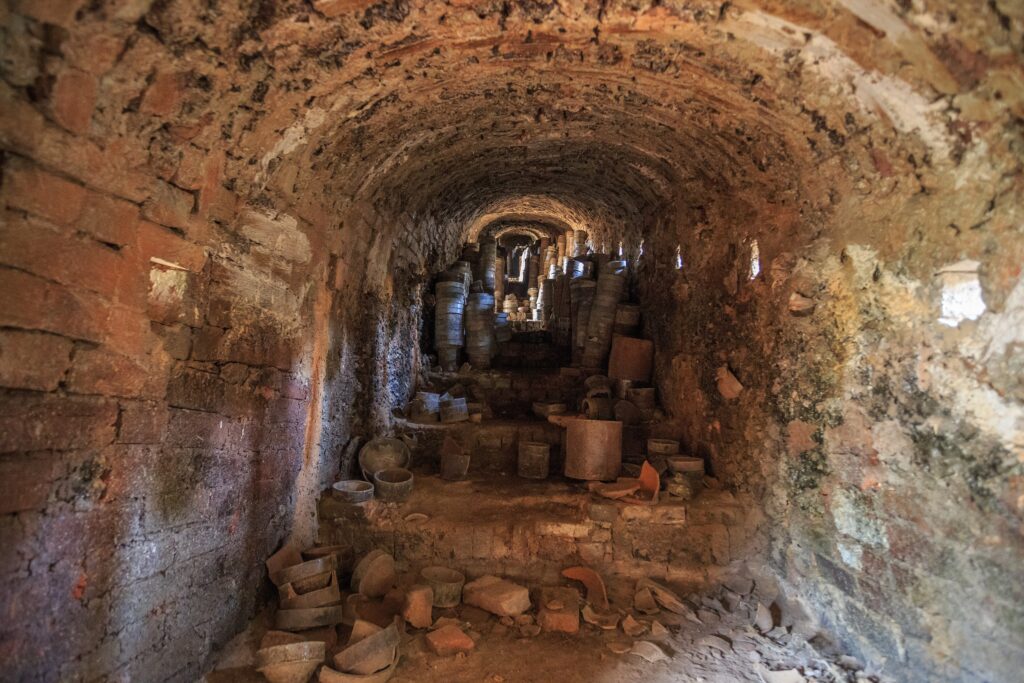
Dragon kilns approximately 3,700 years old, found in China’s southeastern Fujian province, reveal how ancient ceramic masters improved production technologies and laid the foundations for Chinese porcelain. Researchers examining nine kilns at the Kuzhaikeng archaeological site documented a technological transformation extending from traditional ceramic production to the more systematic production of high-temperature fired glazed vessels.
The research, published in the journal Antiquity, shows that this transformation, which took place between 1700–1300 BCE, covered different stages of production, from kiln architecture and glaze application to the stacking of vessels and firing techniques. The findings also indicate that early porcelain technology in China may have developed within different regional traditions rather than from a single production center.
An Ancient Production Center of Southeast China
The Kuzhaikeng production complex in the Yongchun–Dehua region of Fujian province consists of three closely located archaeological sites. Excavations in the region, which began in 2014, have provided important findings for understanding the development of early Chinese ceramic technology.
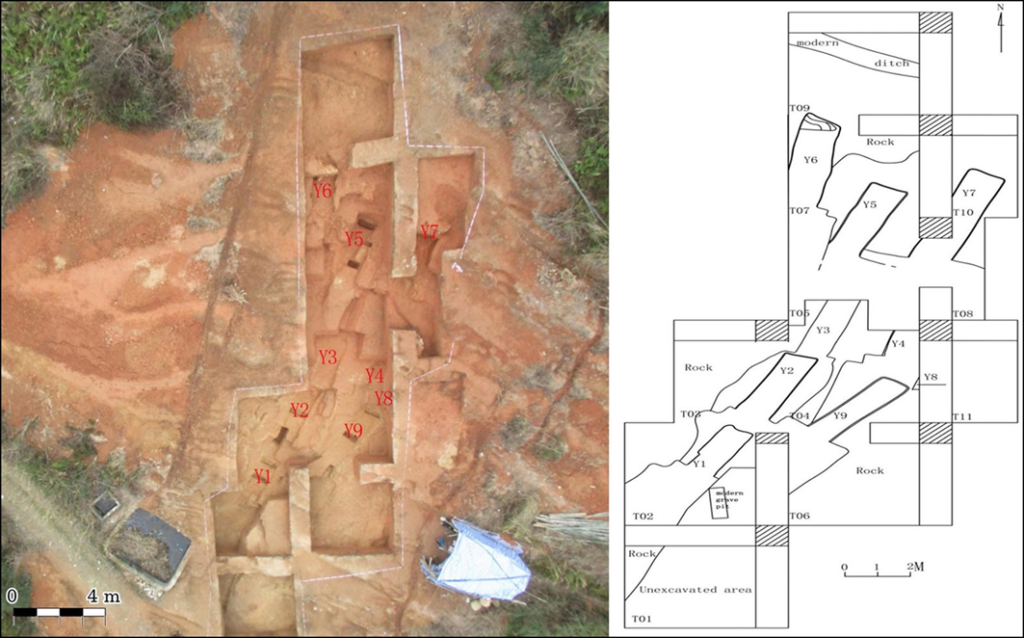
Archaeologists first identified four kilns on Mount Liaotianjian. In excavations carried out at Kuzhaikeng in 2015, nine underground dragon kilns, numerous proto-porcelain fragments, and disk-shaped clay supports used during firing were uncovered. Research continued at Mount Kengdao in 2017.
Surface surveys and soundings conducted from 2018 onwards showed that production activities were spread over a much wider area. Researchers identified the remains of more than 30 kilns in an area of approximately two square kilometers, as well as more than 10 kilns or settlement areas dating to the same period.
Archaeological layers and radiocarbon analysis at Kuzhaikeng date the primary production activities to between the Late Xia and Middle Shang periods, approximately 1700–1300 BCE.
The Technological Transformation of Dragon Kilns
Dragon kilns are structures in the Chinese ceramic production tradition characterized by long firing chambers extending along sloping terrain. Their architecture, rising along the slope, made it possible to utilize the movement of fire and hot air within the kiln.
Researchers divided the nine kilns at Kuzhaikeng into two production phases based on architectural features and the relationships between archaeological layers.
In the first phase, masters generally used kilns approximately three meters long and one meter wide. The fireboxes of these structures were relatively shallow. In the second phase, the kilns grew; the width of the firing chambers reached 1.3 meters, and the kiln designated as Y7 exceeded four meters in length.
Wider firing chambers allowed for the orderly stacking of vessels, while deepening fireboxes may have enabled better management of the combustion process and heat transfer.
These architectural changes did not occur in isolation. Ceramic finds show that masters reorganized their production methods while improving their kilns.
The Ancient Masters’ Path to Porcelain
Proto-porcelain is a type of ceramic made from refined clay, fired at high temperatures, and carrying a thin, lime-rich glaze layer. It represents a significant technological stage between traditional unglazed hard ceramics and the advanced porcelains of later periods.
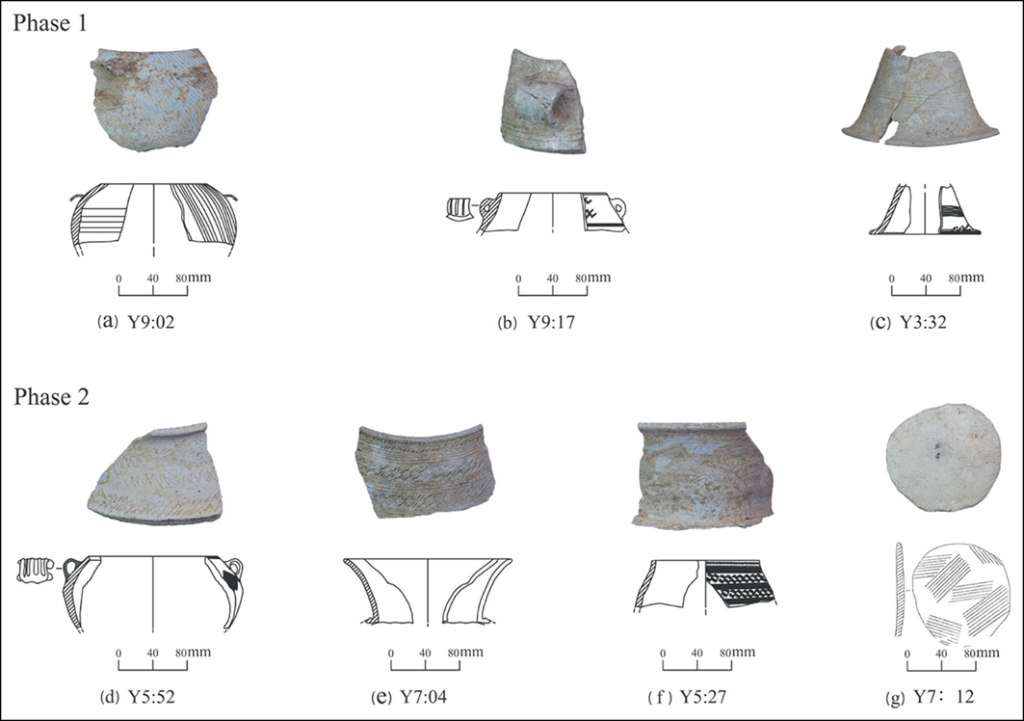
In the first production phase at Kuzhaikeng, masters were not yet able to apply glaze consistently. Irregularities, accumulations, and peeling were observed in the thin glaze layers applied mostly to the outer surfaces of the vessels.
In the second phase, masters began applying glaze to the inner surfaces of the vessels and, in some examples, to the interiors of ring-shaped bases. However, glazing wider surfaces brought a new production problem: vessels could stick to each other or to the kiln floor at high temperatures.
To reduce this risk, producers made more frequent use of disk-shaped clay supports called dianbing. These small objects ensured that the vessels remained separate during firing.
Numerical Evidence of the Production Transformation
Analysis of ceramic fragments reveals the scale of the technological change at Kuzhaikeng with concrete data.
Of the 2,175 vessel fragments classified by researchers in the first production phase, 483 consisted of proto-porcelain. In the second phase, 1,416 of the 4,011 vessel fragments were proto-porcelain samples.
Thus, the share of proto-porcelain in the examined ceramic community rose from 22.2% to 35.3%. The frequency of use of firing supports showed a similar increase.
When growing kilns, wider glaze applications, and the increased use of firing supports are considered together, it is understood that ancient masters made the production of high-temperature glazed ceramics increasingly systematic.
However, traditional hard ceramic production did not disappear. Similar geometric decorations, scraping, and stamping techniques continued to be used in both types of ceramics.
Could Chinese Porcelain Have Multiple Birthplaces?
Previous research considered Zhejiang province as the primary center of early proto-porcelain production. Radiocarbon analysis and archaeological layers at Kuzhaikeng document the existence of an early and developing production tradition in the neighboring Fujian province as well.
Similar kiln architectures, ceramic forms, and firing supports are also seen in other regions of Fujian. However, it is not yet known how the transfer of knowledge and commercial relations between these production centers occurred.
The new research provides important evidence for evaluating the development of Chinese porcelain not as the result of a single technological leap, but as a product of production improvements carried out by masters in different regions over generations.
Chen, Z., Yu, G., Song, P., He, Y., Lu, P., & Yang, Z. (2026). An early proto-porcelain kiln complex in south-eastern China: new evidence from Kuzhaikeng, Fujian. Antiquity, 1–8. doi:10.15184/aqy.2026.10481
