
23 June 2026 The Future is the Product of the Past

Ming-era two shipwrecks found in South China Sea

In the South China Sea, two ancient shipwrecks that date back to the middle of the Ming Dynasty (1368–1644) were discovered at a depth of about 1,500 meters.

In October, a scientific research team from the Chinese Academy of Sciences’ Institute of Deep-sea Science and Engineering discovered two shipwrecks on a continental slope. It’s also the first time China has discovered a large-scale ancient shipwreck in the deep sea.

The two are named by researchers as Northwest Continental Slope No 1 and No 2 Shipwrecks in South China Sea.

The research is part of a year-long mission to scientifically assess how to preserve and protect the two shipwrecks of “world-class archaeological importance”, the National Cultural Heritage Administration said, announcing the finds on Sunday.

They would also provide important clues to the maritime section of the Silk Road, the ancient trade route connecting China to other Asian countries and beyond, the officials were quoted as saying by state-run China News Service.


📣 Our WhatsApp channel is now LIVE! Stay up-to-date with the latest news and updates, just click here to follow us on WhatsApp and never miss a thing!!


Photo: Weibo

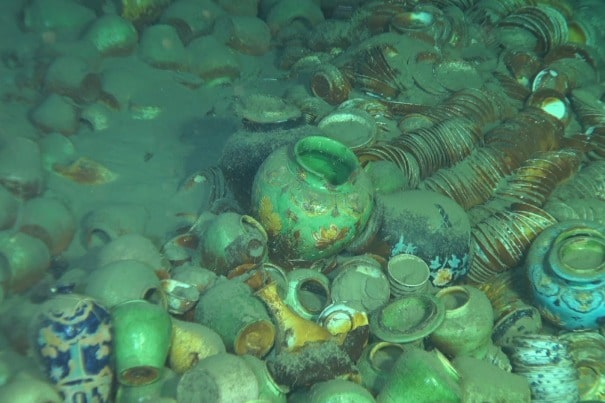
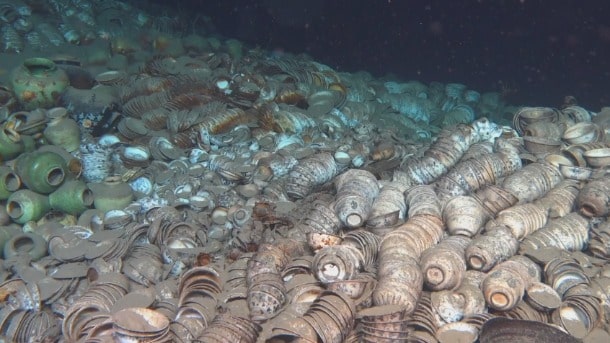
The ships, which date back to the late 15th and early 16th centuries when China was ruled by the Ming dynasty, were discovered by Chinese marine researchers about 1,500 meters (4,290 feet) below the surface in the South China Sea’s northwestern region. Both were heavily laden with cargo.

The first ship contained an estimated 100,000 items, mostly porcelain. The second, slightly older than the first, was filled with timber believed to be on its way to China, according to administration officials.

Both vessels were relatively well preserved, and archaeologists were quite certain about the era they belonged to.

“The well-preserved relics are of high historical, scientific, and artistic value,” said Yan Yalin, the director of the archaeology department of the National Cultural Heritage Administration. “It can be a world-class archaeological discovery in the deep sea. The findings are key evidence of ancient  Maritime Silk Road, and is a major breakthrough study for the history of Chinese overseas trade, navigation, and porcelain,” he added. Yalin is conducting a preliminary investigation on these finds.

Among the porcelain artifacts unearthed, various types were identified, including blue-and-white porcelain, celadons, and ceramics with green glaze.

The first thorough underwater investigation of the shipwreck sites started on Saturday and is scheduled to last until June. The locations of the shipwrecks have not been made public in order to protect the artifacts.

Related Articles

Israeli researchers have found evidence of cooking fish 780,000 years ago at Gesher Benot Ya’aqov

14 November 2022

14 November 2022

Hominins living at Gesher Benot Ya’akov 780,000 years ago liked their fish to be well cooked, Israeli researchers revealed Monday,...

The 6th-Century “Türk-Kagan” Coin Discovery in Uzbekistan Could Rewrite History as the Oldest Known Record of the Name “Türk”

15 May 2025

15 May 2025

A remarkable archaeological find in Uzbekistan has unearthed a 6th-century coin bearing the inscription “Turk-Kagan,” a discovery that could significantly...

Gold Roman Fidelity Ring: A 2,000-Year-Old Symbol of Love Discovered in Bulgaria

10 January 2026

10 January 2026

Archaeological excavations in Ancient Bononia, located in modern-day Vidin, Bulgaria, have revealed a remarkable discovery that sheds new light on...

Evidence of a Roman shrine dating back was discovered during dig at Leicester Cathedral

7 March 2023

7 March 2023

Excavations by the University of Leicester archaeologists for have uncovered evidence that the site of Leicester Cathedral has been used...

3D Technology Reveals 2,000-Year-Old Gladiator Graffiti and Love Messages in Pompeii

21 January 2026

21 January 2026

For more than two centuries, the walls of Pompeii have been studied, photographed, and catalogued. Yet new research shows that...

Discovery in Georgia Reveals How Bronze Age Smelters Sparked the Iron Age

1 October 2025

1 October 2025

A groundbreaking study from Georgia’s Kvemo Bolnisi site reveals that Bronze Age metallurgists were experimenting with iron oxides long before...

The Discovery of a Bronze Age Game Board in Azerbaijan Challenges the Origin of One of the World’s Oldest Games

30 August 2024

30 August 2024

A new archaeological study revealed that an ancient board of a game, known as “Hounds and Jackals” or the “Game...

A first-of-its-kind Ayyanar stone idol found in Vellore, India

25 June 2022

25 June 2022

An Ayyanar stone idol, the first of its kind in Vellore, was discovered at Thandalai Krishnapuram (TK Puram) in Tamil...

An extraordinary medieval belt loop found near Kamień Pomorski in Poland

18 March 2024

18 March 2024

A late medieval belt loop for hanging keys or a bag was found near the town of Kamień Pomorski in...

Drought unveils sunken basilica in Turkey

14 October 2022

14 October 2022

The sunken basilica remains discovered in 2014 became visible as a result of Lake Iznik’s water withdrawal. Climate change is...

Alexander the Great’s Bathroom Discovered at Greece’s Aigai Palace

11 May 2024

11 May 2024

Archaeologists say to have unearthed Alexander the Great’s bathroom at the Aigai Palace in northern Greece. The vast Aigai palace,...

Mosaics found in Türkiye’s Sinop belong to dining room of a wealthy family

24 June 2023

24 June 2023

The pebble mosaics unearthed during the excavation of a building complex in the province of Sinop on Turkey’s Black Sea...

A 1,500-Year-Old Roman Settlement Discovered in Bulgaria

21 March 2025

21 March 2025

In a remarkable turn of events, a team of archaeologists conducting preliminary excavations ahead of a transit gas pipeline project...

Inscription dedicated to Roman Emperor Hadrian found in ancient city of Blaundus

26 November 2024

26 November 2024

An inscription dedicated to the Roman Emperor Hadrian was discovered during the ongoing excavations at the ancient city of Blaundus...

Britain’s first Roman funerary bed is discovered in central London after 2,000 years

7 February 2024

7 February 2024

Archaeologists excavating a construction site in London have unearthed the first Roman “flat-packed” funerary furniture – a fully intact Roman...