
12 November 2025 The Future is the Product of the Past

Urfa Castle Yields Mysterious Rock-Cut Tomb Possibly Tied to Abgar Dynasty—Early Christian Allies of Jesus

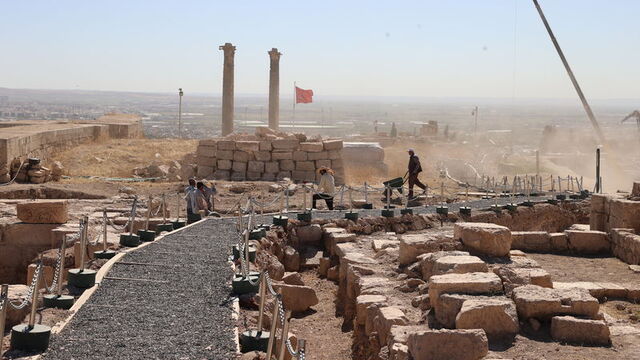
A recent archaeological breakthrough in southeastern Turkey has stirred excitement in the academic world. Deep within the inner citadel of Urfa Castle, researchers have unearthed a mysterious rock-cut tomb — the first ever discovered in this part of the fortress. Early findings suggest the tomb may be linked to the ancient Kingdom of Osroene — also known as the Abgar dynasty — raising the possibility of a royal burial site lost for centuries.

The discovery, led by Prof. Dr. Gülriz Kozbe and her team, marks a significant moment in the ongoing exploration of Şanlıurfa’s layered past — from Roman and Byzantine to Islamic and Ottoman eras.

A Forgotten Christian Kingdom at the Crossroads of Rome and Parthia

The Kingdom of Osroene, with its capital in Edessa (modern-day Şanlıurfa), was a culturally rich and strategically important state that thrived between the 2nd century BCE and the early 3rd century CE. Initially emerging as a semi-independent kingdom during the decline of the Seleucid Empire, Osroene was generally allied with the Parthian Empire, benefiting from its position along the key trade routes of Mesopotamia.

Despite its Parthian ties, Osroene gradually came under increasing Roman influence. In 114 CE, it was absorbed into the Roman Empire as a semi-autonomous vassal state, maintaining a degree of internal autonomy. A century later, in 214 CE, it was officially incorporated into the empire as a standard Roman province, ending its royal lineage.
Credit: Anadolu Agency (AA)

Osroene is especially notable for being among the first states to adopt Christianity as a ruling faith. Its royal family, the Abgars, are closely associated with early Christian traditions, including legendary correspondence with Jesus of Nazareth, as recorded in apocryphal sources. The kingdom became a major center for Syriac Christianity, leaving a deep cultural and religious imprint on the region.


📣 Our WhatsApp channel is now LIVE! Stay up-to-date with the latest news and updates, just click here to follow us on WhatsApp and never miss a thing!!


Rare Rock-Cut Tomb Could Reveal Royal Secrets

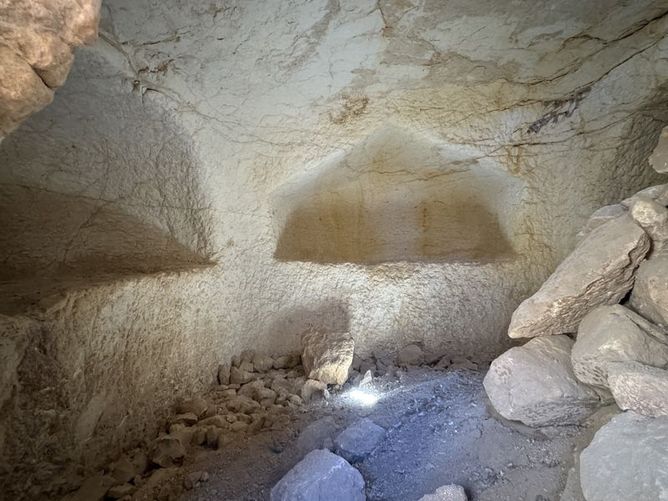
Though rock-cut tombs are common across the region, this is the first to be found within Urfa Castle’s inner walls. The tomb’s features — including a sealed circular stone entrance and a Syriac inscription — suggest a high-status burial.

Prof. Kozbe emphasized that the tomb likely dates back to the Late Antiquity period, between the 3rd and 8th centuries CE, based on architectural features and regional burial traditions. However, if the tomb is indeed connected to the Abgar dynasty of Osroene, the date could be pushed further back.

“If this tomb truly belongs to the Abgar royal family, it may date as early as the 3rd century,” she noted. “At this stage, we can generally place it between the 3rd and 8th centuries. Only after examining the interior — especially if we uncover mosaics, inscriptions, or grave goods — can we establish a more precise chronology.
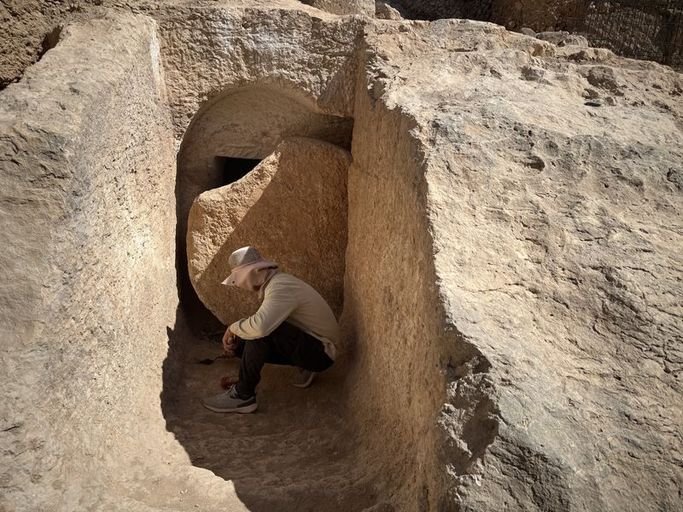
Though rock-cut tombs are common across the region, this is the first to be found within Urfa Castle’s inner walls. Credit: Anadolu Agency (AA)

“If this tomb does indeed belong to a member of the Osroene royal family, it could reshape our understanding of the region’s transition from paganism to Christianity,” said Prof. Kozbe.

Further exploration is underway to access the interior and uncover potential mosaics, human remains, or additional inscriptions that could reveal the tomb’s true identity.

Cover Image Credit: Anadolu Agency (AA)

Related Articles

Excavations at a 4th millennium BC settlement uncover evidence for the emergence and rejection of the earliest state institutions in Iraq

6 December 2024

6 December 2024

New excavations of the 4th-millennium B.C settlement at the archaeological site of Shakhi Kora, located in the Iraqi Kurdistan region...

A 2900-year-old collection of fossilized shark teeth found in the City of David, one of Jerusalem’s oldest Parts

5 July 2021

5 July 2021

Scientists discovered an inexplicable collection of fossilized shark teeth at a 2900-year-old archaeological site in Jerusalem’s City of David, one...

Hoysala temples inch closer towards UNESCO recognition

7 February 2022

7 February 2022

The Indian Union government recently proposed the Somanathapura temple in Mysuru district and Chennakeshava and Hoysaleshwara temples in Belur and...

Unearthed in Perthshire: GUARD Archaeologists Discover Hidden Iron Age Settlement

1 November 2025

1 November 2025

A vanished community that once thrived on a windswept hilltop near Perth, Scotland, has resurfaced after lying buried for over...

A Symbol of Elite Roman Luxury: Frescoed Villa with Fish Pond Discovered in Tripolis

19 July 2025

19 July 2025

A newly uncovered 1,600-year-old Roman villa in the ancient city of Tripolis dazzles with its colorful frescoes, sophisticated architecture, and...

Prehistoric Cave Art Handprints With Missing Fingertips Point to Ritual Amputation

3 January 2024

3 January 2024

Researchers who examined prehistoric cave art in France and Spain, a new interpretation of Paleolithic cave art proposes that prehistoric...

One Of The Largest And Most Significant Iron Age Hoards Ever Discovered In The UK Has Been Unveiled

26 March 2025

26 March 2025

In a remarkable archaeological breakthrough, the Melsonby Hoard has emerged as one of the most significant Iron Age discoveries in...

3,000-year-old Treasure on the Iberian Peninsula made with material from a meteorite

7 February 2024

7 February 2024

Scientists have recently discovered that some of the pieces in the amazing Bronze Age collection known as the Villena Treasure,...

8,500-year-old marble statuette found in Çatalhöyük

28 December 2021

28 December 2021

In the 29th season of the excavations in Çatalhöyük, one of the first urbanization models in Anatolia, in the Çumra...

Well-Preserved Hittite “Bird Omen Text” Discovered at Kayalıpınar–Samuha, a Key Religious Hub of the Ancient Empire

24 July 2025

24 July 2025

Archaeologists working at the ancient Hittite settlement of Kayalıpınar, located in Türkiye’s Sivas province, have uncovered a remarkably well-preserved clay...

The first Bull Geoglyph discovered in central Asia

29 September 2021

29 September 2021

Archaeologists from the Russian Academy of Sciences’ Institute of History of Material Culture (IIMK RAS) and LLC Krasnoyarsk Geoarchaeology discovered...

An Elamite clay tablet has been discovered in Burnt City

6 January 2022

6 January 2022

An Elamite clay tablet was discovered within the Burnt City by a team of Iranian, Italian, and Serbian archeologists. Called...

Archaeologists have discovered the origins a Herefordshire Stone Age monument

22 August 2021

22 August 2021

Archaeologists have finally uncovered the mysterious origins of Arthur’s Stone, named after the mysterious legends of King Arthur, who inspired...

Detector finds rare Merovingian gold ring refers to a previously unknown principality

22 February 2024

22 February 2024

A metal detectorist has unearthed a very rare, 1,500-year-old Merovingian gold ring made of 22-carat gold at Emmerlev in Southwest...

According to researchers, the bones discovered underneath St. Peter’s Basilica may not be his

5 June 2021

5 June 2021

Three Italian researchers have voiced doubts about whether St. Peter’s bones are buried underneath the Rome basilica that bears his...