
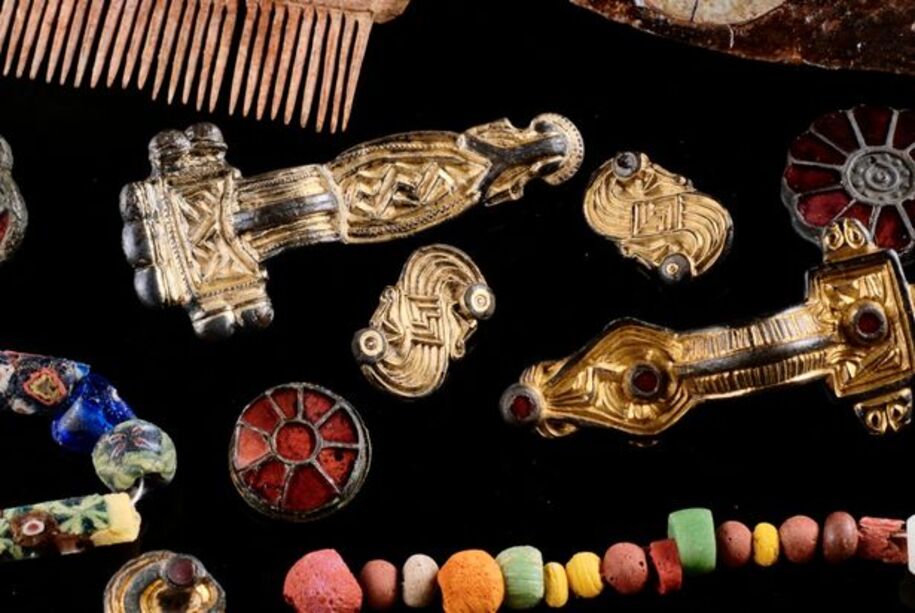
The Roman Empire did not simply disappear from Pannonia and leave an empty landscape for new arrivals to occupy. Ancient DNA from 314 people buried between the Roman and early medieval periods reveals a far more complicated transformation: northern migrants arrived in significant numbers, descendants of the Roman-era population remained, and the two became part of communities organized through very different systems of family, wealth, and power.
The research, published in Science, examined seven cemeteries in the Little Hungarian Plain, stretching east of Lake Neusiedl into northwestern Hungary. By combining ancient DNA with grave goods and isotope evidence relating to mobility and diet, researchers reconstructed the society that developed along Rome’s former Danube frontier between the third and sixth centuries AD.
The People Rome Left Behind
For centuries, Pannonia had been one of the Roman Empire’s most important frontier regions. Forts, roads and urban centres such as Carnuntum and Arrabona—modern Győr—connected the province to wider military and commercial networks.
The genomes of 68 individuals from two Roman-period cemeteries reflected that connected world. Most showed ancestry associated with southern Europe, but the researchers also identified genetic backgrounds linked to Asia and Africa. The result fits the image of Roman Pannonia not as an isolated frontier populated by a single people, but as part of a mobile and cosmopolitan empire.
Roman authority weakened around the beginning of the fifth century. Fortifications were abandoned, towns declined, and the region passed through periods of Hunnic, Gothic, Herulian and other forms of control.
Yet the population did not disappear with the administration. Some descendants of the Roman provincial inhabitants remained, even as communities north of the Danube began moving into the region.
Northern Arrivals Changed Pannonia—But Did Not Replace It
The greatest genetic change appeared among 246 people from five sixth-century cemeteries. Their remains contained a substantially larger proportion of northern European ancestry, indicating major movement into the former Roman province.
Historical evidence makes the expanding Lombard kingdom the most likely political context for this migration. The Lombards had established themselves north of the Danube before extending their power into Pannonia around AD 500. In 568, much of the Lombard population moved into Italy, where a new kingdom survived until the late eighth century.
But the genetic evidence does not resemble a single invading population arriving at one moment. Instead, it points to prolonged movement and continuing contact with communities farther north.
This distinction changes the familiar image of the Migration Period. Rather than complete peoples travelling across Europe as unified blocks and replacing everyone in their path, the evidence suggests repeated arrivals, smaller movements, local alliances and gradual mixing.
Pannonia’s population changed substantially, but it was not a clean demographic replacement.
Two Cemeteries Reveal Two Different Societies
Some of the study’s most revealing evidence came from Hegykő and Szeleste, two cemeteries that appear broadly similar at first glance. Both contained people with northern and southern European ancestry, and both belonged to the Lombard-era world of sixth-century Pannonia.
Their internal organization, however, was strikingly different.
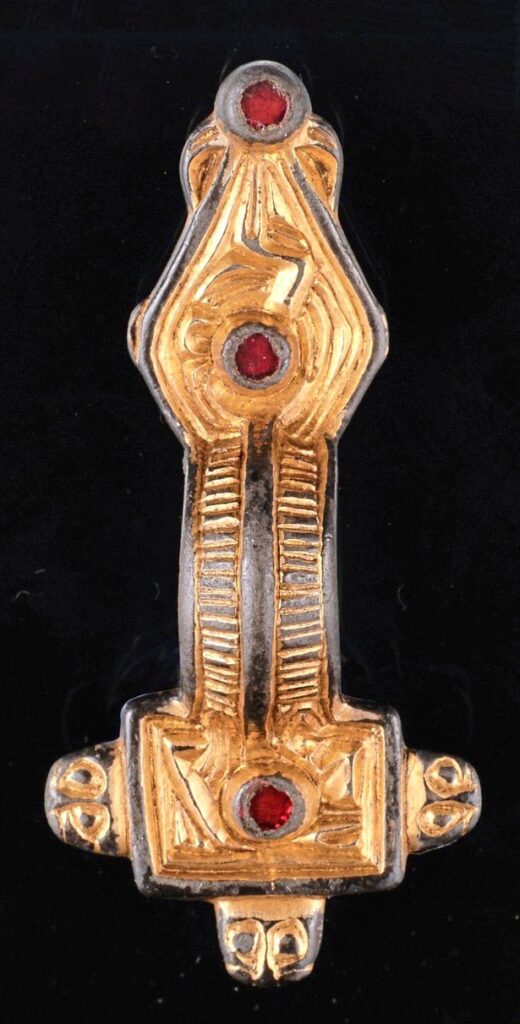
At Hegykő, people with predominantly northern European ancestry belonged to large, interconnected biological families. Several received richer burials containing weapons, brooches, and other prestigious objects. Isotope analysis also suggested access to a better diet.
Together, the evidence indicates that power at Hegykő was concentrated within elite kinship groups. Wealth and social position may have been transmitted through family connections, allowing a limited number of lineages to maintain authority over generations.
Szeleste followed another model. Researchers found fewer extensive biological relationships, while families included people with both northern and southern ancestry. Rather than an elite lineage standing apart from the local population, the cemetery records a community in which people of different backgrounds were becoming closely connected.
The contrast is crucial. Similar objects and burial customs did not necessarily represent identical societies. One settlement could be dominated by a tightly related warrior elite, while another nearby community organized itself through mixed families and looser social relationships.
There was no single Lombard social system.
Does the DNA Support the Scandinavian Origin Story?
Later medieval accounts claimed that the Lombards originally came from Scandinavia. Historians have often treated that story as an origin legend rather than a reliable memory of migration.
The new genetic results do not prove that the Lombards as a complete people travelled directly from Scandinavia to Pannonia. They do, however, make the tradition more difficult to dismiss entirely.
According to historian Walter Pohl, researchers detected a notable Scandinavian-related component among some of the northern newcomers, comparable to ancestry found in contemporary northern Germany. His interpretation is carefully limited: the evidence cannot establish that “the Lombards” collectively came from Scandinavia, but it suggests that many individuals associated with their expansion had Scandinavian ancestors.
That difference matters. DNA can trace biological relationships and geographical ancestry, but it cannot assign an ethnic identity. A person with northern ancestry was not automatically a Lombard, just as someone descended from Roman provincial inhabitants did not necessarily continue to identify as Roman.
A New Political Order Rose from the Roman Frontier
The study’s most important conclusion may therefore concern power rather than migration.
After Roman institutions collapsed, political order was not rebuilt by one homogeneous people. Incoming groups with northern ancestry, surviving provincial populations and individuals of mixed backgrounds formed communities whose internal structures varied from place to place.
At Hegykő, authority appears to have rested heavily on ancestry and elite family networks. At Szeleste, integration reached directly into households. Elsewhere, similar grave goods could conceal entirely different relationships.
This suggests that “Lombard” may have functioned partly as a political identity capable of incorporating people from multiple backgrounds, rather than describing a biologically uniform population. It also explains why archaeology and genetics do not always produce matching maps: objects, burial customs and political loyalties could travel without entire populations moving in the same way.
The world east of Lake Neusiedl was neither simply Roman nor simply “barbarian.” It was a society being assembled from the remains of an empire, incoming military power, family alliances and gradual intermarriage.
The cemeteries of Pannonia show that the end of Rome was not only a story of collapse. It was also the beginning of a new and unexpectedly complex European society.
Yijie Tian et al., Unveiling the complexity of post-Roman polity formation in Pannonia using ancient DNA.Science392,eaec2634(2026).DOI:10.1126/science.aec2634
