
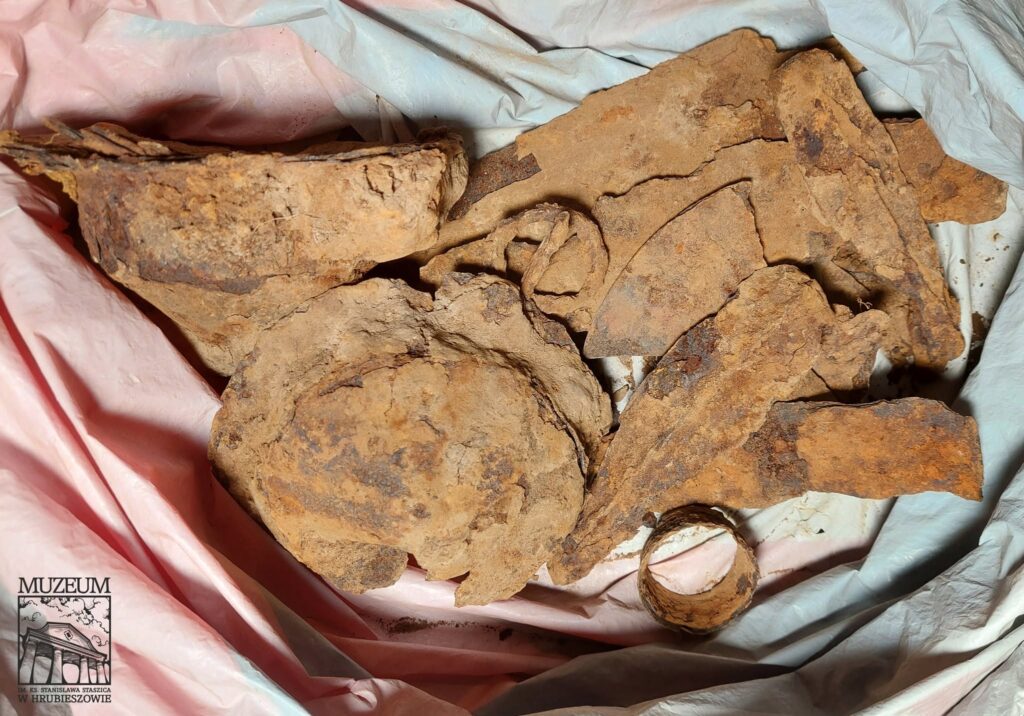
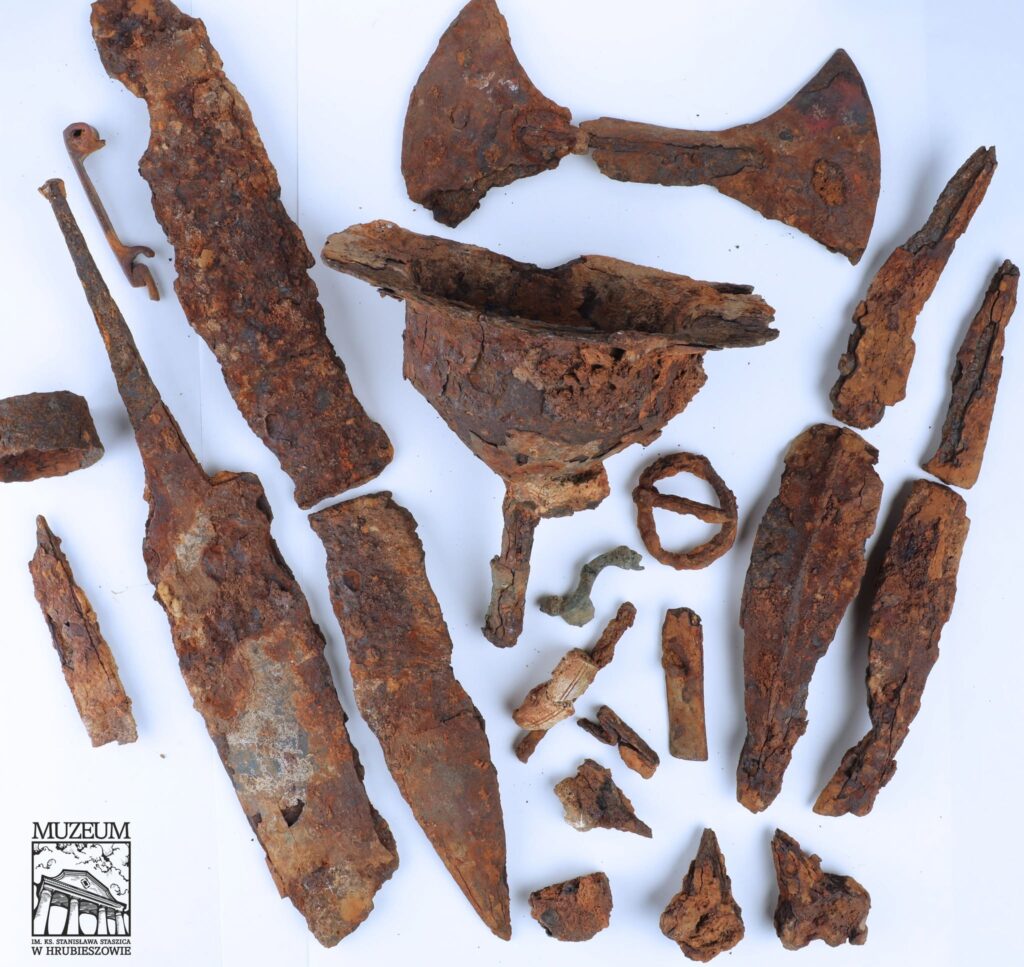
A striking collection of weapons and gear, believed to belong to a warrior cremated approximately 2,000 years ago, has arrived at a museum in the Hrubieszów region of eastern Poland. The assemblage, including a sword, spearheads, shield fittings, spurs, and a bronze brooch, may represent one of the richest Vandal warrior burials known from the region.
According to a statement released on November 2 axios by the Father Stanisław Staszic Museum in Hrubieszów, the finds originate from a cremation grave noticed in a farmland field several years ago. However, the artifacts only reached the museum recently. Museum officials stated that they do not know who discovered the items or the identity of the person who left them to be delivered anonymously.
Swords, Spearheads, and Spurs Point to a Mounted Warrior
Among the artifacts delivered to the museum, an iron sword broken into three pieces and its corresponding scabbard fittings stand out. The collection also includes two tips—one from a spear and the other from a javelin—a shield boss with a sharp protrusion, a shield handle, a belt buckle, a knife fragment, two spurs, bone comb fragments, and a bronze fibula used to fasten a cloak.
The museum emphasized the particular importance of the sword and the two spurs. These two elements suggest that the grave may belong to a high-status cavalry warrior. However, researchers are not yet definitively stating whether the deceased was male or female. Consequently, the possibility of a “Vandal warrior woman” is not excluded, alongside that of a “Vandal warrior.”
Most of the items were exposed to funeral pyres approximately two thousand years ago. According to the museum, the spear and javelin tips may have been intentionally bent and broken in antiquity. Such practices align with funeral rituals observed in various warrior burials across Europe.
Grave Disturbed Years Ago, Artifacts Now Recovered
The story of the finds is nearly as remarkable as the objects themselves. The museum noted that the grave emerged in an agricultural area within the boundaries of the Werbkowice municipality several years ago. However, over the intervening time, the context of the grave was significantly damaged, and the artifacts were only now able to be delivered to the institution.
While this situation does not entirely erase the scientific value of the finds, it makes interpretation more difficult. Researchers have not yet been able to examine the exact location, structure, and the presence of other burials in the vicinity on-site. Nevertheless, it is believed that the group of finds belongs to the same cremation grave and represents a quite wealthy warrior’s equipment.
The museum also explained that the items are in poor condition and require urgent preservation. Officials have handed over all pieces to relevant specialists for restoration and conservation work, a process expected to take at least several months.
Possibility of More Graves Around Werbkowice
The Hrubieszów Museum believes the cemetery is located in the Werbkowice municipality and aims to confirm the exact location through archaeological work planned for the summer of 2027. According to officials, other similar burials, potentially damaged by agricultural activities, may be found in the region.
The museum stated that it is coordinating this process with the Zamość delegation of the Lublin Voivodeship Office for the Protection of Monuments. The statement also mentioned that Artur Troncik, a member of the metal detector community, was one of the individuals who mediated the recovery of the finds. While officials expressed regret that the artifacts could not be documented at the moment of discovery, they view the arrival of this important group at the museum—before it was lost entirely—as a major gain.
A New Window into Vandal Burial Traditions
The Hrubieszów region has long drawn the attention of archaeologists regarding Late Roman Period and Migration Period communities. Burials associated with Vandal communities provide vital information, particularly regarding warrior identity, weapon use, and social status. This new collection is being evaluated within this framework.
Conservation work on the finds and the field research planned for next year may provide clearer results regarding the identity of this warrior and the extent of the cemetery.
