
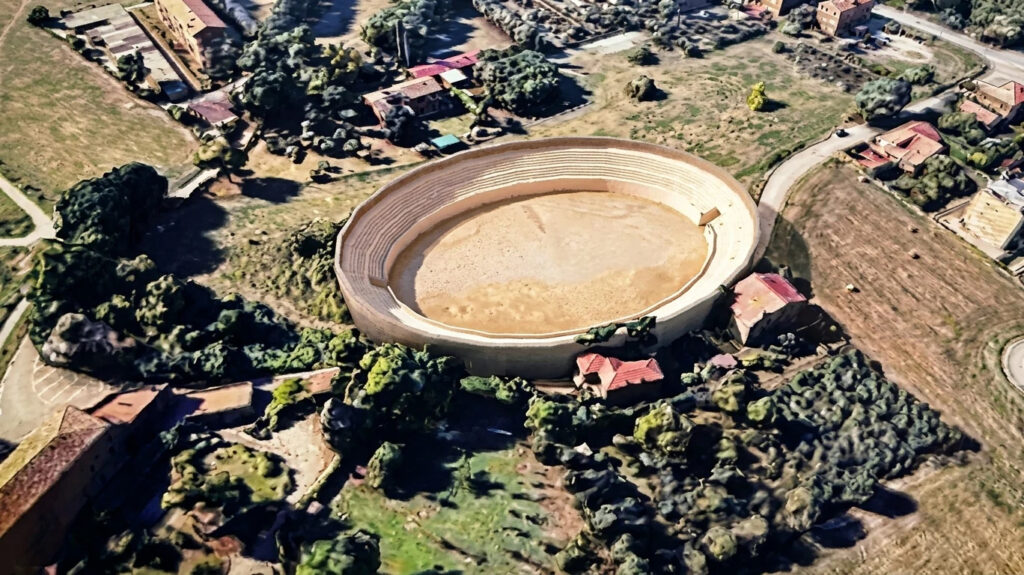
Archaeologists working in Foligno, in Italy’s Umbria region, have identified the full extent of a vast Roman amphitheater dating back approximately 2,000 years. Measuring around 120 meters in length, with an arena extending approximately 76 meters, the structure ranks among the largest known Roman amphitheaters in central Italy.
Three years of archaeological investigations have established both the impressive dimensions of the monument and its exceptional state of preservation. The findings also provide important evidence for reconstructing the urban landscape of ancient Fulginia, a Roman town whose architectural remains have largely disappeared beneath the modern landscape.
Archaeologists Roberta Taddei and Vincent Jolivet, emeritus research director at the French National Centre for Scientific Research (CNRS), lead the excavations at Santa Maria in Campis, east of modern Foligno. According to Artribune, the researchers announced their latest findings on November 29.
One of the Largest Roman Amphitheaters in Central Italy
Before the current excavation campaign began, visible masonry remains suggested that a substantial Roman building lay beneath the site. However, archaeologists had underestimated both its size and the extent to which its architectural features survived.
Recent investigations have enabled researchers to establish the outline of the amphitheater’s outer ring with greater certainty. Its dimensions are comparable to those of the Roman amphitheater at Otricoli, ancient Ocriculum, another important settlement in Umbria that prospered during the Augustan and Imperial periods.
The archaeological team is currently concentrating its efforts on the southern entrance, which extends for approximately 15 meters. Further investigation of this section could provide additional information about the building’s architectural organization and successive construction phases.
The scale of the amphitheater also offers a new perspective on Fulginia’s urban development. Although relatively few Roman structures remain visible in modern Foligno, the monument demonstrates the substantial investment that the ancient town made in public architecture.
An Amphitheater Mentioned in Records for Five Centuries
Historical references to the amphitheater date back to the mid-16th century. During the following century, local historians Ludovico Jacobilli and Fabio Pontano attempted to establish its location. Yet uncertainties surrounding the monument persisted into the early 20th century.
Rescue excavations in 1974, 1987 and 2006 provided the first substantial archaeological evidence for the structure. These investigations also documented Roman residential buildings, bath complexes, road sections, public drainage systems, honorific inscriptions and burial grounds.
In 2023, the Associazione Amici dell’Abbazia di Sassovivo launched the multidisciplinary Fulginia International Amphitheatre Excavation (FIAE) project to investigate the surviving masonry and establish the monument’s chronology and construction techniques.
According to the project description published by the International Association for Classical Archaeology (AIAC), the research also addresses a broader archaeological question: the location of Fulginia’s earliest Roman settlement and the subsequent development of its urban landscape.
Archival research, preliminary diagnostic investigations, and archaeological excavations are gradually clarifying the relationship between the amphitheater and the surrounding Roman town.
A Well-Preserved Human Skeleton and Evidence of Later Construction
Archaeologists date the amphitheater’s initial construction to the beginning of the Roman Imperial period. However, the building underwent architectural modifications in later centuries, including construction work involving cobblestone masonry during the Late Imperial period.
The team also recovered a Late Antique coin from a circulation surface that developed after the building began to fill with accumulated material. This discovery provides a chronological reference for investigating the monument’s later history.
Another notable find is a burial containing a remarkably well-preserved human skeleton. Researchers plan to conduct scientific analyses to determine its age. For now, the relationship between the burial and the amphitheater’s different phases of occupation remains unclear.
Uncovering the Amphitheater Could Take 15 Years
The project operates under the supervision of Umbria’s Superintendency for Archaeology, Fine Arts and Landscape, with contributions from the Université libre de Bruxelles, Sapienza University of Rome and the American Institute for Roman Culture.
Archaeologists estimate that fully excavating the amphitheater and making it accessible to the public could require another 10 to 15 years of work. The research team hopes to attract additional funding and institutional partners to expand its investigations.
For Foligno, establishing the dimensions and preservation of this monumental building represents a significant advance in understanding its Roman past. Future excavations could clarify not only how the amphitheater evolved over the centuries but also how public architecture shaped the development of ancient Fulginia.
