
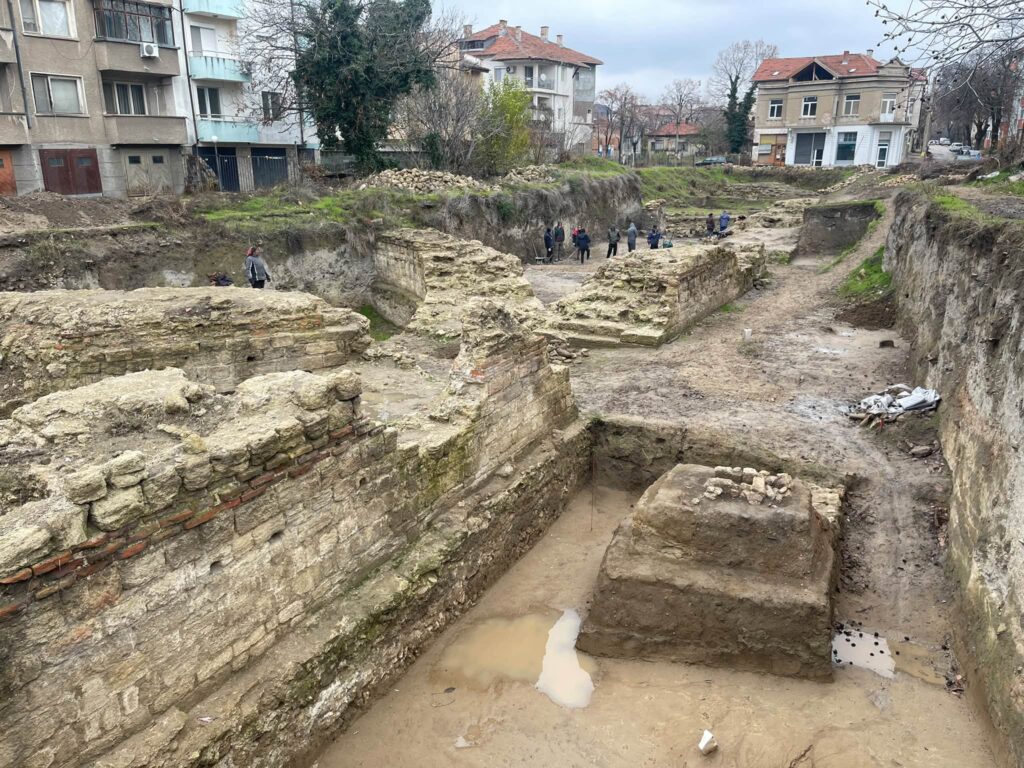
Archaeologists excavating the ancient city of Bononia beneath modern-day Vidin in northwestern Bulgaria have reached first-century AD archaeological layers associated with the city’s origins as a Roman military camp. The discovery marks the first time in more than a decade of systematic excavations that researchers have reached this early phase of the settlement. The team also completed its investigation of a section of the city’s monumental fourth-century fortifications.
Excavation director Zdravko Dimitrov of the National Archaeological Institute with Museum at the Bulgarian Academy of Sciences presented the results during a press conference on November 27, marking the conclusion of the 2026 archaeological season.
The project brings together researchers from the Bulgarian Academy of Sciences and the Regional History Museum of Vidin, with financial support from the municipality.
Reaching the Earliest Roman Layers
For more than a decade, archaeologists have investigated the remains of Bononia in Vidin’s Kaleto district, where centuries of construction have left archaeological deposits spanning multiple historical periods.
This year’s excavations reached the first-century layers associated with the earliest Roman military occupation. According to Dimitrov, researchers can now identify structures from this period in three separate locations within the excavation area.
Bononia occupied a strategically important position along the Danube, which formed one of the Roman Empire’s major European frontiers. Military installations along the river helped Rome maintain control over its northern territories, monitor movement, and protect important transport routes.
The discovery provides an opportunity to investigate the beginnings of Roman Bononia beneath the remains of its later fortifications. Further excavations may help researchers establish the layout and architectural characteristics of the early military camp.
Monumental Walls and Towers of the Late Roman Period
Another major achievement of the 2026 season involved the western defensive wall and two towers, identified as Towers 8 and 10. The team completed its investigation of this section of the fortifications, bringing it to a stage where the remains could potentially form part of a future archaeological exhibition.
Dating to the fourth century AD, the defensive structures demonstrate the scale of Bononia’s later development. According to the municipality’s account of the excavation results, the walls measure four metres in thickness, while the ten-sided towers exceed 20 metres in diameter.
The contrast between the early military structures and the monumental Late Roman defences offers archaeologists valuable evidence of Bononia’s transformation over several centuries. The settlement developed into a substantial fortified centre along the Danube, and its Roman architectural legacy survived into the medieval period.
Coins Shed New Light on Medieval Vidin
Beyond the Roman discoveries, the excavations have contributed to a historical debate concerning the final years of medieval Bulgarian rule in Vidin.
According to the Regional History Museum of Vidin, new archaeological and numismatic evidence supports the hypothesis that the Tsardom of Vidin survived beyond 1396, potentially until 1422.
Historian Nikolay Ovcharov highlighted the absence of early fifteenth-century Ottoman coins from the relevant archaeological contexts. Together with historical documents, this evidence supports his interpretation of the political situation during the reign of Constantine II Asen. However, the precise chronology of this transition remains a subject of historical research.
Numismatist Konstantin Dochev also emphasised Vidin’s importance as a medieval minting centre. During the reign of Ivan Sratsimir, the city produced more than twelve types of copper coins and one type of silver coinage.
The archaeological remains beneath modern Vidin therefore offer evidence of two particularly significant periods in the city’s history: its establishment as a Roman military settlement and the final stages of medieval Bulgarian rule. The 2026 discoveries bring researchers closer to understanding both ends of this remarkable historical sequence.
