
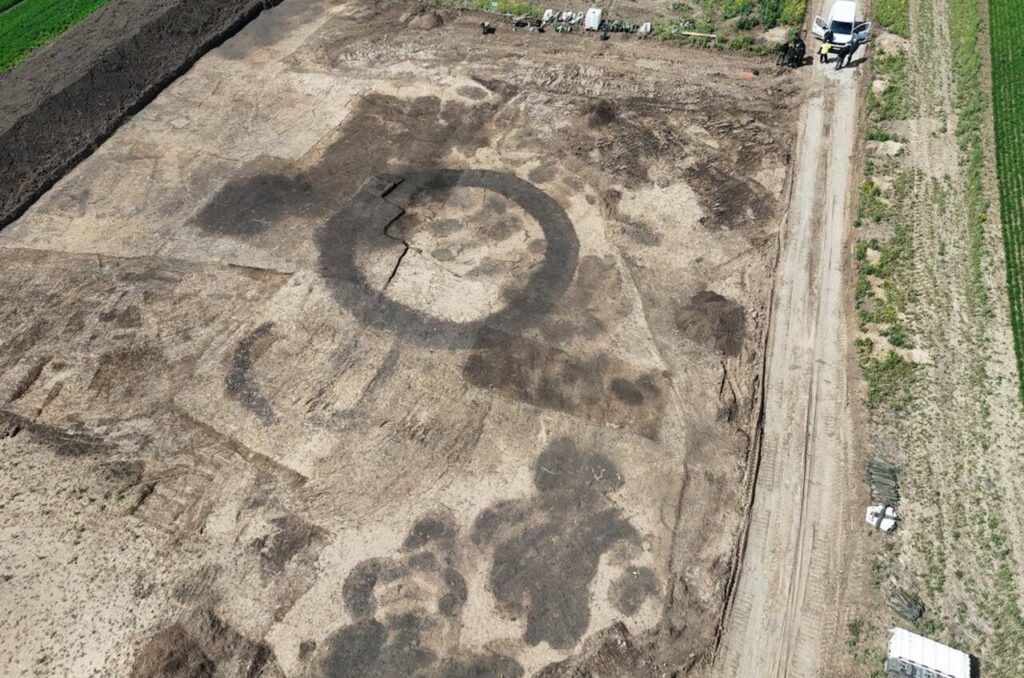
Archaeologists excavating ahead of wind farm construction in central Germany have discovered a rare Bronze Age sword, the remains of a man buried face down with an arrowhead still lodged in his chest, and the grave of a woman accompanied by unusual ornaments. The sword bears a striking resemblance to another weapon discovered nearby in 1931, raising the possibility that the same ancient craftsperson produced both weapons.
The Thuringian State Office for Heritage Management and Archaeology (TLDA) conducted the excavations north of Bothenheilingen, in the Unstrut-Hainich district, between July 2025 and November 2026.
The investigations covered construction areas for 14 wind turbines, access roads, temporary workspaces and cable trenches. Volunteer archaeological heritage officers had previously identified numerous archaeological sites across the surrounding landscape, with evidence of human activity spanning the Neolithic period to the Middle Ages.
A Rare Bronze Age Sword with a Possible Connection to a 1931 Discovery
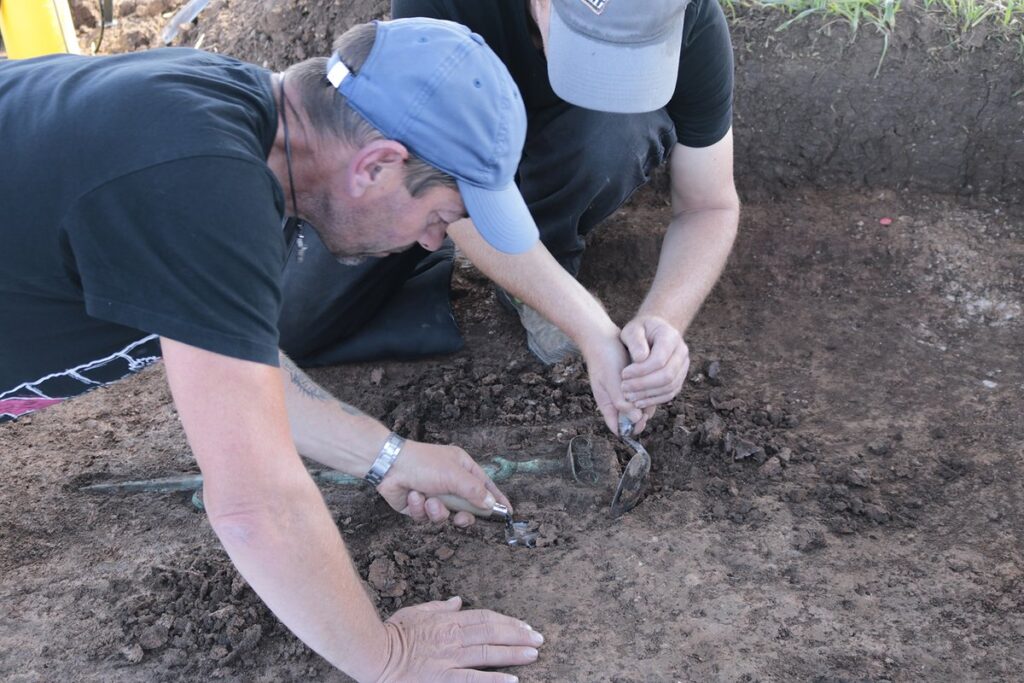
One of the most significant discoveries came from a Late Bronze Age grave associated with the Unstrut cultural group, which flourished between approximately 1300 and 750 BC. Archaeologists recovered a sword, an arm ring, and a spearhead from the burial.
The sword belongs to a distinctive type featuring a solid metal hilt with antenna-like terminals. Such weapons rarely appear in the archaeological record of Thuringia, making the discovery particularly important. Moreover, looters disturbed most previously documented graves from this period in the region, leaving archaeologists with relatively few surviving examples of their original contents.
Researchers suspect that the newly discovered grave may originally have contained additional objects. Agricultural activity and soil removal during cable trench construction could have destroyed some of these items before archaeologists examined the burial.
An earlier discovery adds another dimension to the find. In 1931, a Late Bronze Age hoard containing six swords came to light only a few hundred metres from the newly excavated grave. One of those weapons closely resembles the sword recovered during the latest investigations.
The archaeological team suggests that the similarities could indicate a relationship between the burial and the hoard or even point to the work of the same craftsperson. Further examination of the weapons may help clarify whether this resemblance reflects shared manufacturing traditions or a more direct connection.
A Man Buried Face Down with an Arrowhead in His Chest
The excavations also revealed the remains of a burial mound that centuries of agricultural activity had flattened. Although the mound itself had disappeared, its surrounding circular ditch allowed archaeologists to identify the monument.
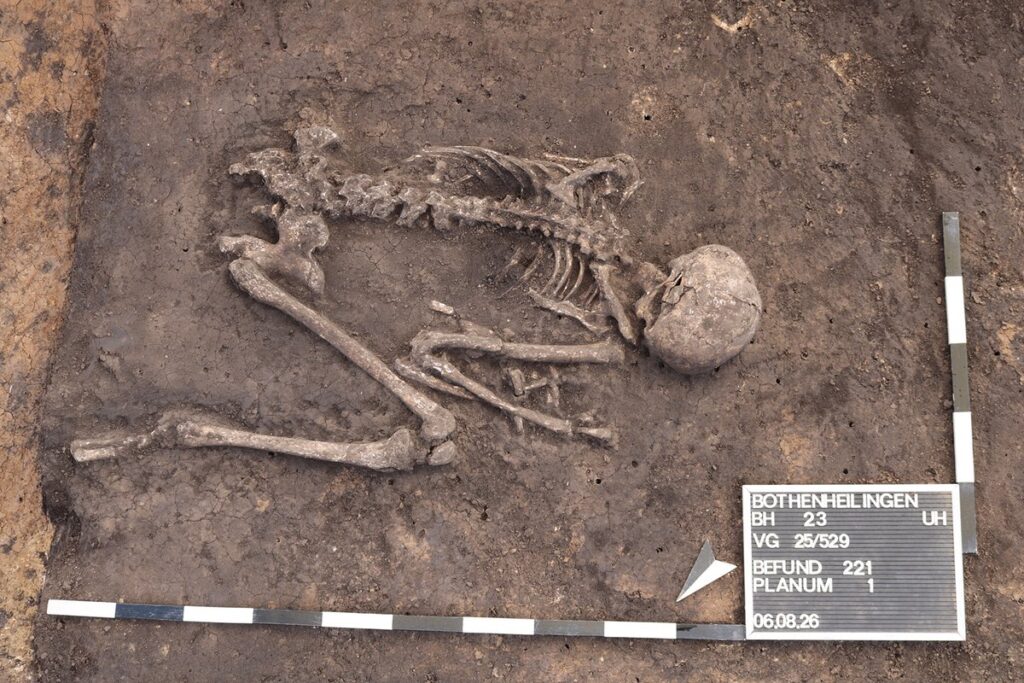
Researchers uncovered numerous burials within the ditch, including the remains of a man whom ancient communities had buried face down. An arrowhead still lodged in his rib cage provides evidence of his violent death.
According to the TLDA, both the unusual burial position and the circumstances of the man’s death distinguish this grave from other regional examples. Researchers have not yet established why the community buried him in this manner or under what circumstances he sustained the fatal injury.
The original construction date of the burial mound also remains unknown. Its central graves, which would have represented the earliest phase of the monument, did not survive.
A Bronze Age Woman with Rare Clothing Ornaments
Immediately beside the man’s burial, archaeologists discovered the grave of a woman dating to the Middle Bronze Age. Her grave contained two spiral arm ornaments and two distinctive wheel-shaped dress pins.
These pins served a practical purpose by securing clothing while also providing decoration. Archaeologists rarely encounter such accessories in Thuringia, making the burial a valuable source of information about Bronze Age clothing and personal adornment.
The proximity of the two graves is noteworthy, although researchers have not established whether the individuals shared any familial or social relationship. The official announcement does not assign a specific date to the male burial.
Thousands of Years of Human Activity
Beyond the remarkable Bronze Age graves, the investigations documented settlement remains from the Neolithic period, dating to approximately 4600–4450 BC, and the Bronze Age, spanning roughly 2200–750 BC.
Burial sites accounted for most of the archaeological discoveries. The majority belong to the Corded Ware culture, a Late Neolithic cultural tradition that extended across large parts of Europe between approximately 2800 and 2200 BC.
Together, these discoveries demonstrate the archaeological richness of the landscape surrounding Bothenheilingen and provide new evidence of its changing funerary and settlement traditions over several millennia.
Conservators at the TLDA’s restoration workshops in Weimar are currently examining and restoring the recovered artefacts. Once they complete this work, the institution plans to present the discoveries to the public.
Thuringian State Office for Heritage Management and Archaeology (TLDA)
