
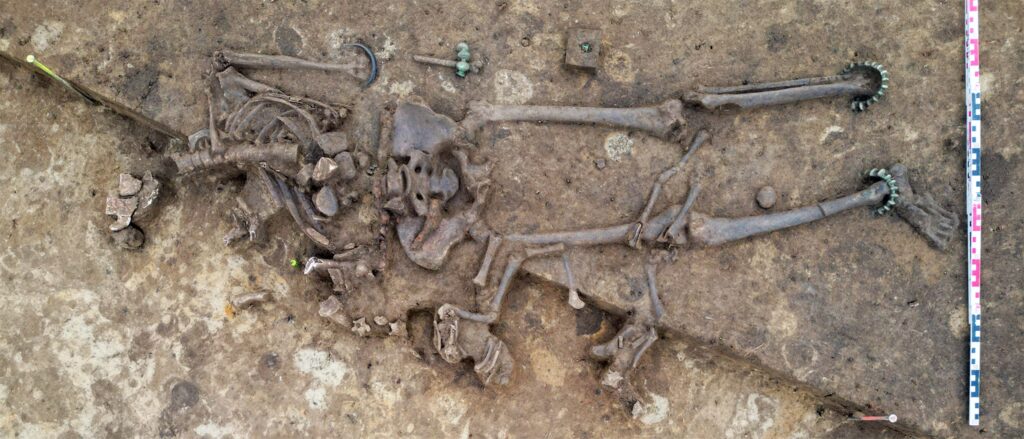
In a grave dating back approximately 2,300 years, archaeologists in Bavaria, Germany, have uncovered the remains of a Celtic woman buried with an array of heavy bronze jewelry, a dark bracelet, and the bones of what is believed to be a lamb or young goat.
The animal bones were found near the woman’s hip, alongside an unusually rich collection of jewelry. Their presence has prompted archaeologists to examine the burial practices of Iron Age communities in southern Germany.
Archaeologists discovered the grave in 2024 during excavations on St.-Florian-Straße in Senden. The Bavarian State Office for Monument Preservation (BLfD) presented the findings at the Archäologie in Bayern conference, held from October 30 to November 1, 2026.
A Celtic Woman Buried with Bronze Jewelry
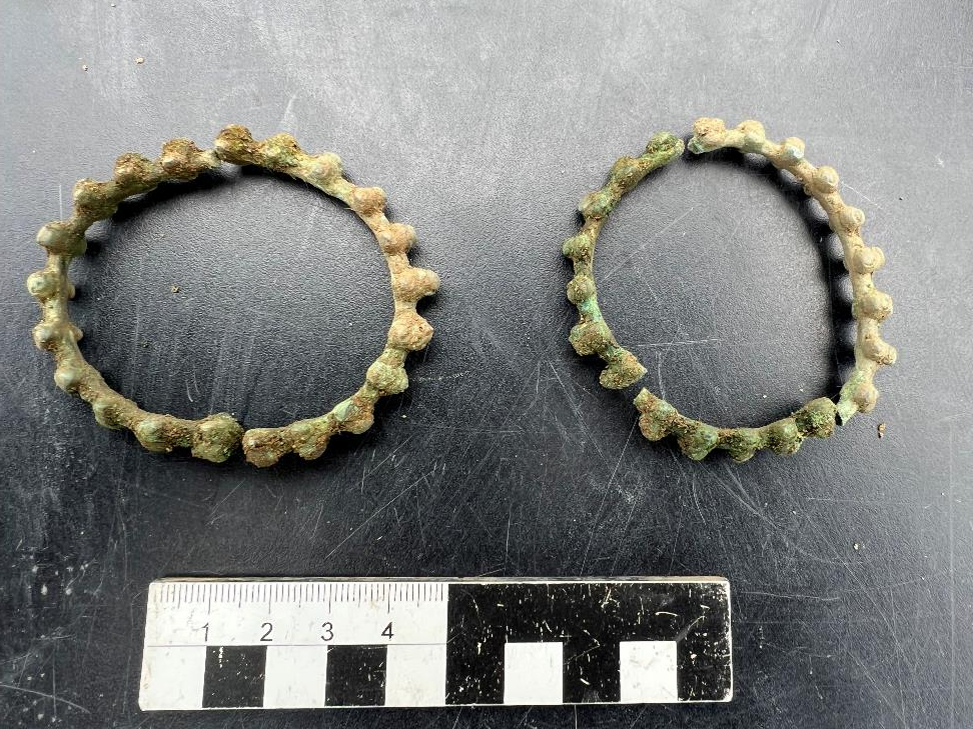
Dating to around 250 BCE, the grave contained an impressive collection of jewelry that had remained with the woman for more than 2,300 years. Large bronze rings adorned her ankles, while other ornaments were found near her arms. Among the objects was a dark bracelet made from sapropelite, an organic-rich sedimentary material that Iron Age craftspeople used to produce jewelry.
The bronze ornaments are particularly striking. Two of the rings feature raised, knot-like decorations, giving them a distinctive appearance. Together with the garment clasp and other personal adornments, they provide a picture of how the woman may have been dressed for burial. The combination of bronze and dark sapropelite also suggests that different materials and decorative styles were deliberately brought together.
Such an elaborate collection of ornaments may indicate that the woman enjoyed a privileged position within her community. Jewelry could express wealth, personal identity and social standing in Iron Age societies, although the precise meaning of these objects remains uncertain. What the grave does show is that considerable care was taken in preparing her burial, with her personal adornments forming an important part of the ceremony.
Why Was a Lamb or Goat Buried with Her?
The most unusual find in the grave was the bones of a small animal placed near the woman’s hip. Excavation leader Dr. Matthias Leicht has suggested that the remains likely belong to a lamb or young goat, though the exact species has not yet been confirmed.
BLfD classifies this as a Speisebeigabe—a food offering left for the deceased. However, Leicht has previously noted that the animal could also represent a ritual offering or even have had a personal connection to the woman. The rarity of similar finds makes it difficult to draw definitive comparisons.
The position of the bones and whether the animal was buried whole or only in part could help explain its presence in the grave. For now, researchers have yet to establish why it was placed beside the woman.
A New Perspective on Iron Age Funerary Traditions
The Celtic woman’s grave was part of a much larger archaeological landscape in Senden. Excavations in the northern part of the town uncovered traces of settlements, buildings and burials from different periods, showing that communities returned to the same area over many centuries.
Among the discoveries were the remains of a Roman villa rustica, a rural estate used for farming and other economic activities, along with an associated cemetery. Archaeologists also identified evidence of later settlement and burial activity dating to the early Middle Ages.
Dr. Stefanie Berg, Head of the Archaeological Heritage Protection Department at BLfD, notes that these findings reveal that the Senden area was used for settlement purposes over a long period.
