
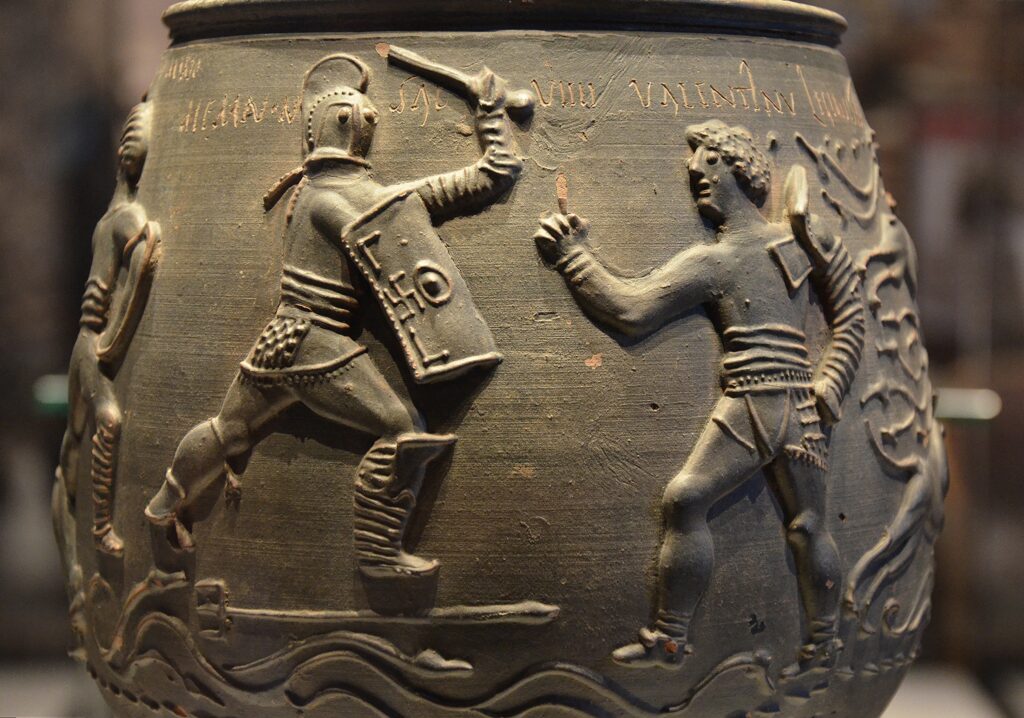
In 1853, archaeologists discovered an unusual Roman burial in Colchester, England. Inside an elaborately decorated pottery vase lay the cremated remains of a man who had died nearly 1,800 years earlier. Gladiators fought across the vessel’s surface, their names carefully inscribed beside them. Now, new chemical analysis suggests the man may have grown up in Italy or Spain before ending his life in Roman Britain.
The research, published in Royal Society Open Science on November 4, 2026, examined 22 Roman-era cremation burials from Colchester. Its findings offer new evidence of migration within the Roman Empire while reopening a particularly intriguing question: Why did someone choose a vase celebrating gladiatorial combat as this man’s final resting place?
A Vase That Preserved the Names of Gladiators
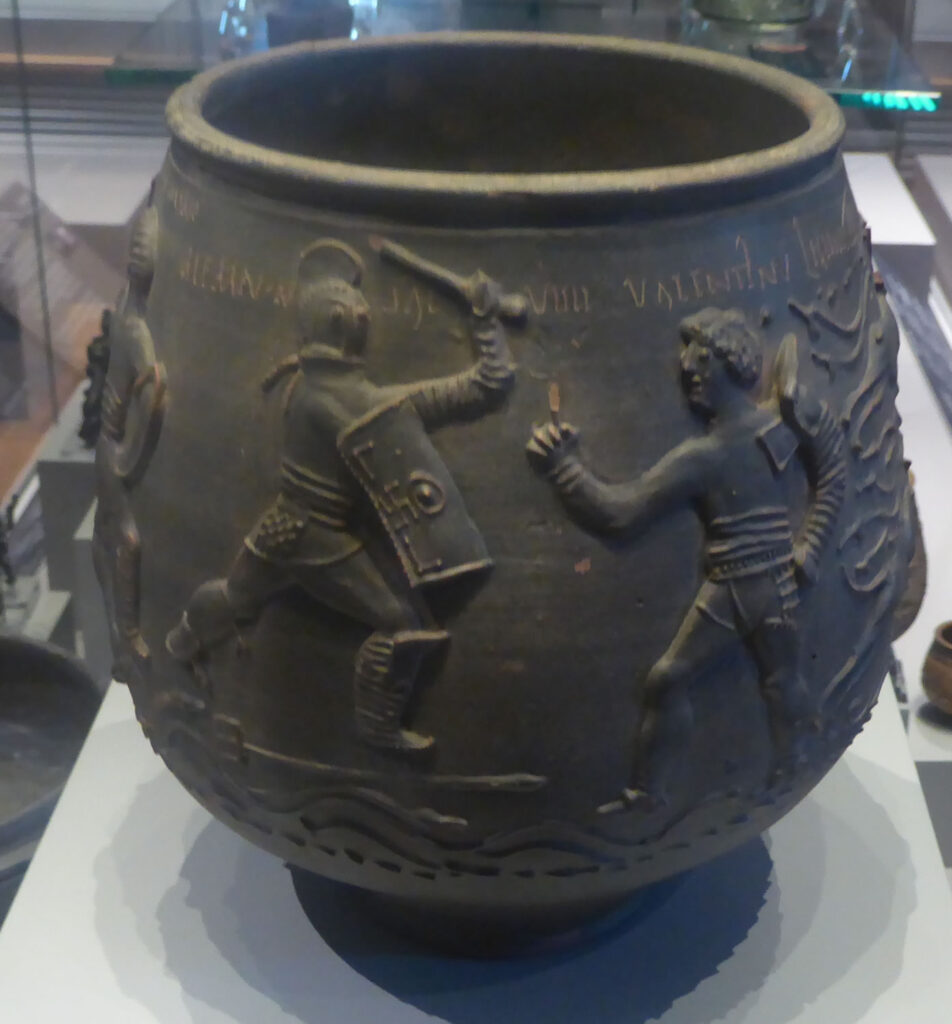
Local potters produced the Colchester Vase sometime between AD 160 and 200. Its elaborate decoration depicts gladiatorial contests and encounters with wild animals, complete with the names Memnon, Valentinus, Secundus and Mario.
These details may record an actual spectacle held in Roman Colchester. A 2024 study published in Britannia argued that the inscriptions were added before firing, suggesting that a customer commissioned the vessel to commemorate a particular event rather than purchasing a generic decorative object.
The figures themselves provide unusually specific details. Memnon appears to fight left-handed, while Valentinus raises a hand in a gesture associated with the conclusion of a contest. Their equipment, poses, and names suggest that the potter intended to portray identifiable performers.
The vase may originally have served as a souvenir or display piece. At some point, however, it acquired an entirely different purpose. Someone placed a man’s cremated remains inside it and buried the vessel in Colchester’s western cemetery.
Who Was the Man Inside?
Examination of the remains established that the deceased was a man older than 40. Beyond that, his identity remains uncertain. Nothing directly connects him to any of the gladiators pictured on the vase.
Could he have been one of the fighters? Researchers consider that unlikely, although cremation makes it difficult to identify injuries that might reveal a violent occupation.
Another possibility is that he had some connection to the organization of gladiatorial spectacles. He might have trained fighters, financed performances, or belonged to a wealthy household with an interest in public entertainment. None of these explanations has direct archaeological support.
What makes the burial unusual is the apparent care involved in selecting the container. Rather than an ordinary funerary urn, the mourners used a vessel decorated with named combatants and scenes of public spectacle. Whether that choice reflected the man’s occupation, personal interests, or social connections remains unknown.
Chemical Clues Point Toward the Mediterranean
Earlier research had already suggested that the man did not grow up in Colchester. The new study takes that investigation further by combining strontium and lead isotope measurements to explore his geographical origins.
These chemical signatures reflect elements that enter the body through food, drinking water, and environmental exposure. Their proportions vary between geological regions, allowing scientists to compare human remains with patterns recorded elsewhere.
The researchers focused on dense bone from the inner ear region, which can preserve chemical information established during early childhood. Even after cremation, certain isotope signals can survive the intense heat of a funeral pyre.
The man buried in the Colchester Vase stood out because both his strontium and lead isotope values indicated a childhood outside Britain. The closest geographical comparisons included parts of Italy and Spain, placing the Mediterranean among the most plausible regions of origin.
The evidence cannot establish exactly where he was born, when he traveled to Britain or what brought him to Colchester. It does, however, strengthen the possibility that his life began far from the city where his ashes eventually came to rest.
Other Strangers in Roman Colchester
The wider study offers another perspective on life in Roman Britain’s first provincial capital.
Among the 22 individuals examined, two others displayed lead isotope signatures compatible with Mediterranean regions. One was a woman older than 40. Their strontium results, however, could also fit local conditions, making their geographical origins less certain than those of the man in the gladiator vase.
The analysis revealed an unexpected complication. Some cremated remains had been stored in metal containers containing lead, which gradually contaminated the bones and altered their chemical signatures. The researchers therefore excluded lead isotope results from five individuals to avoid misleading geographical interpretations.
This distinction matters because identifying ancient migrants requires more than finding an unusual chemical value. Different regions can produce similar isotope signatures, while burial conditions may change the evidence long after death.
Together, the results reveal a population whose life histories were not necessarily confined to the place where they were buried.
From Public Spectacle to a Private Farewell
Roman Colchester, known as Camulodunum, attracted soldiers, merchants, administrators and other inhabitants from across the empire. Its public buildings and entertainment venues reflected the influence of Roman urban culture, while the city’s cemeteries preserve evidence of the people who lived and died there.
Britain’s only securely identified Roman circus stood in Colchester, although gladiatorial contests may have taken place in other venues. The vase suggests that local audiences knew particular fighters well enough for their names and appearances to become the subject of a specially decorated object.
For the man whose ashes it held, the connection remains elusive. He may have witnessed the spectacle himself, supported its performers, or simply owned an object that mattered to him.
Nearly two centuries after its discovery, the Colchester Vase still cannot tell us his name or explain why his mourners chose it. But the bones inside now offer a clearer picture of the journey that may have brought him from the Mediterranean world to Roman Britain.
A vessel that once celebrated the lives of gladiators ultimately became the resting place of someone whose own story is only beginning to emerge.
Moore J, Davis GJC, Eckardt H, Nowell GM, Montgomery J. Decoding the dead: new combined application of strontium and lead isotope analysis to Romano-British cremations from Colchester (UK). R Soc Open Sci. 2026 Nov 4;13(11):260591. doi: 10.1098/rsos.260591.
Davis, G. J. C., Pearce, J., Carroll, E., Moore, J., Nowell, G., & Montgomery, J. (2024). Gladiators at Roman Colchester: Re-interpreting the Colchester Vase. Britannia, 55, 3–24. https://doi.org/10.1017/S0068113X24000187
