
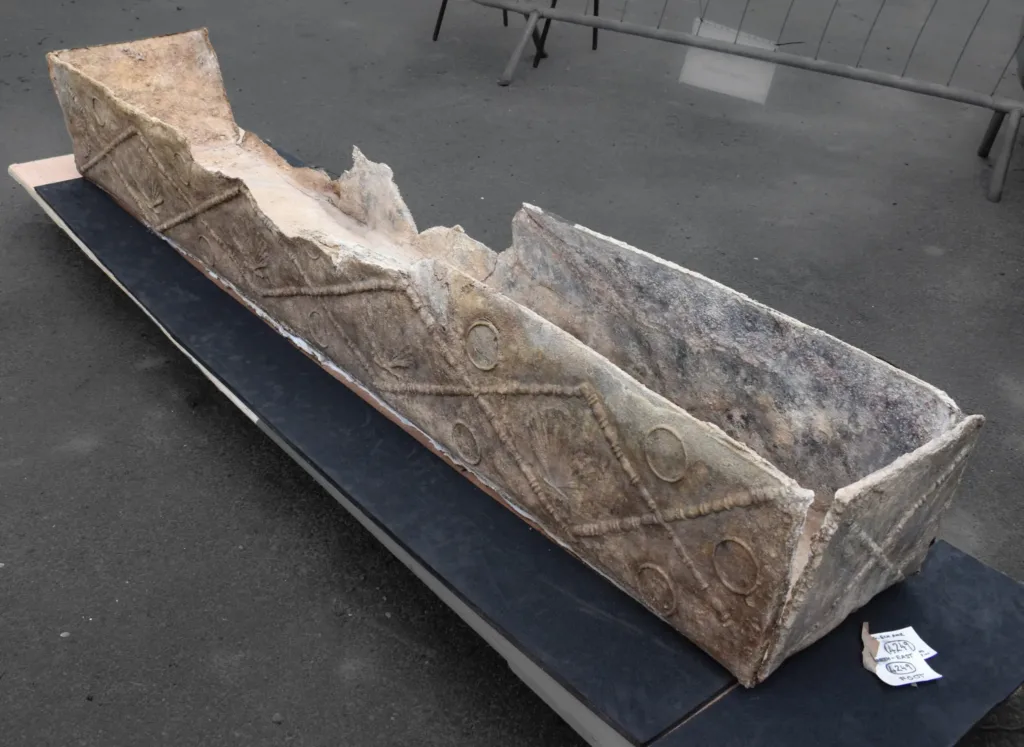
A richly furnished late Roman burial discovered in Colchester is offering a rare look at how wealth, ritual, and identity were expressed in death during the final centuries of Roman Britain.
The burial, excavated by Colchester Archaeological Trust at the former Essex County Hospital site, contained the remains of a high-status woman placed inside a decorated lead coffin. The coffin, grave goods, and scientific analysis of residues found with the body are now going on public display at the Roman Circus Visitor Centre in Colchester.
Archaeologists say the woman was probably in her late 20s or 30s when she died. Preliminary scientific work suggests she may have grown up locally in Colchester, giving the discovery an unusually personal connection to the people who lived in one of Roman Britain’s most important towns.
A carefully staged Roman burial
The woman was buried in a decorated lead coffin that had originally been placed inside an outer wooden coffin. The wood itself did not survive, but soil staining around the lead coffin and surviving iron nails show that the lead container was once enclosed in a larger timber structure.
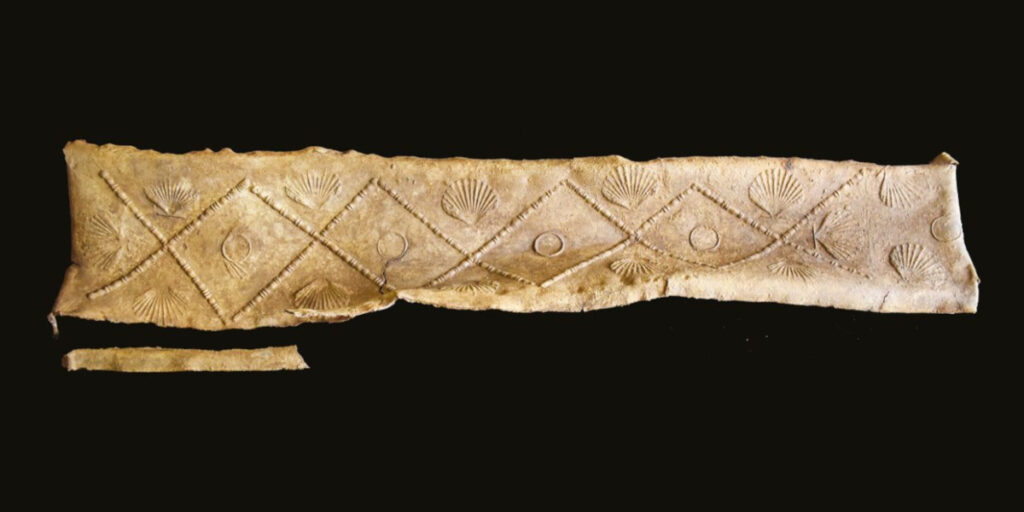
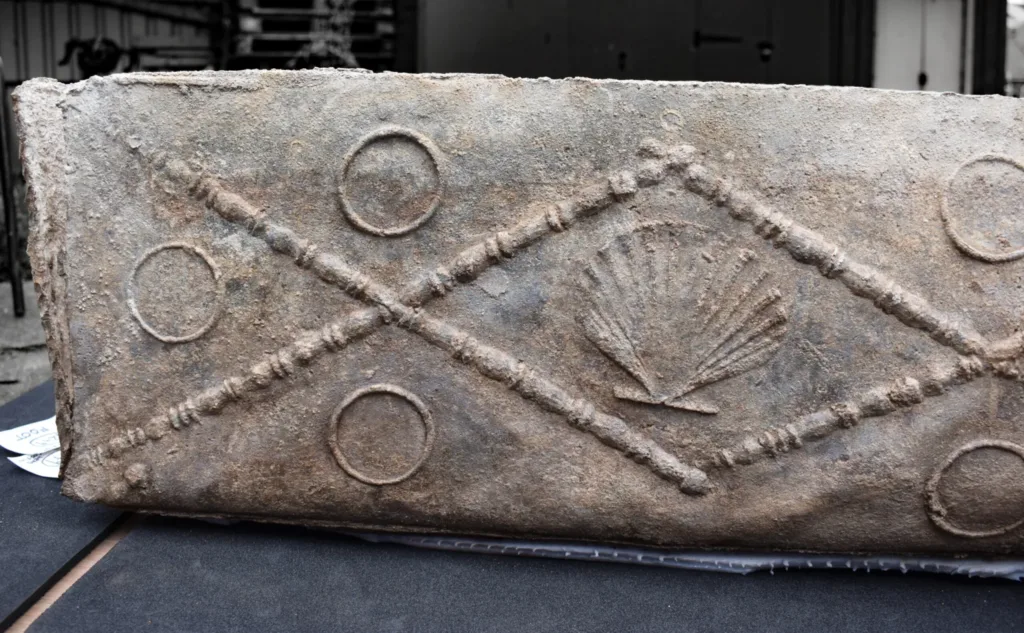
The inner coffin was decorated with a bead-and-double-reel linear motif arranged in a diamond pattern. Scallop shells and circular designs were also included in the decoration. In Roman funerary symbolism, scallop shells are often interpreted in connection with the soul’s final journey, while circular motifs may have referred to celestial imagery such as the sun or moon.
The burial was not a simple interment. The body had been treated with substances associated with preservation, scent, and ritual care. Residue analysis identified gypsum and frankincense inside the coffin, while one of the glass vessels contained exotic resins. These materials were valuable and, in some cases, imported from long-distance trade networks.
The grave goods also included jet hairpins, a group of rare glass flasks, a ceramic vessel, and a headless chicken placed as a burial offering. Five hairpins found behind the skull suggest that the woman’s hair may have been arranged carefully before burial.
Taken together, the evidence points to a funeral shaped by both wealth and ritual performance.
Why lead coffins mattered in Roman Britain
Lead coffins were among the rarest forms of burial in Roman Britain. They account for only a small fraction of known inhumation burials, and only around 400 examples have been recorded across Britain. Many others were likely lost, recycled, or sold for scrap in the 19th and early 20th centuries.
The use of lead was expensive. An adult lead coffin could weigh as much as two adult men, even before the body and outer wooden coffin were added. Moving such a coffin into a grave would have required considerable labour, planning, and resources.
For that reason, archaeologists generally associate lead coffins with people of elevated social status. They were used for men, women, children, and infants, and appear in both pagan and Christian burial contexts. In this case, the orientation of the burial and the associated grave goods suggest that the woman was probably buried according to pagan Roman traditions.
Decorated lead coffins are especially associated with southeast England, including Colchester, London, and Kent. Other examples from Roman Britain include motifs such as Minerva heads, Bacchic figures, vases, rosettes, and geometric designs.
From Roman mines to a Colchester workshop
The lead used to make coffins in Roman Britain came from ore known as galena, mined in limestone-rich regions such as the Mendips, Derbyshire, Durham, North Wales, and Northumberland. For this Colchester coffin, the lead may have originated in the Mendips, possibly from the Charterhouse-on-Mendip mining area in Somerset.
Roman lead production was a major industry. Miners extracted ore with iron tools, washed and crushed it, and then smelted it in furnaces using wood or charcoal. The molten lead was cast into ingots, commonly known as “pigs,” which could weigh around 75 kilograms each. Some were stamped with inscriptions naming emperors or mine owners.
The earliest inscribed lead pigs from the Mendips date to AD 49, only a few years after the Roman conquest of Britain. From mining districts, lead could be moved by road or sea to major towns and workshops.
Lead coffins themselves were probably made by specialist craftspeople known as plumbarii. The modern word “plumber” derives from the Latin word for lead, plumbum. These craftspeople also made pipes, tanks, weights, and other lead objects.
To create a coffin, molten lead was poured into prepared sand moulds to make large sheets. Decorative patterns were impressed into damp sand before casting. Wooden formers created the bead-and-reel designs, while real scallop shells could be pressed into the sand to leave shell-shaped impressions. Once the metal cooled, the sheets were trimmed, folded, and soldered into a box and lid.
The decoration on the Colchester coffin may indicate that it came from a regional workshop, possibly one operating in or near Colchester.
A late Roman woman from a changing city
Colchester, known to the Romans as Camulodunum, was one of the most significant urban centres in Roman Britain. It began as the site of a Roman colonia and retained political, military, and symbolic importance across the Roman period.
By the late Roman era, burial customs had changed. Cremation had been more common in the early Roman period, but inhumation became increasingly widespread from the late 2nd century onward. Lead coffin burials belong to this later funerary tradition and continued into the early 5th century.
The woman’s burial shows that, even in the later Roman period, some families in Colchester still had access to expensive materials, imported substances, and specialist funerary services. The combination of glass vessels, perfumes, resins, gypsum, jet hairpins, and an elaborately decorated lead coffin suggests a family or community willing to invest heavily in the treatment of the dead.
Adam Wightman, Director of Archaeology at Colchester Archaeological Trust, described the burial as one of the most fascinating Roman burials the trust has worked on in Colchester in recent years. He noted that while the decorated coffin is striking in its own right, the full significance of the find lies in the combination of the coffin, grave goods, and scientific evidence.
For visitors, the exhibition presents more than a rare Roman object. It brings together the body, the coffin, and the materials placed around the woman to reconstruct a moment of care, belief, and social display in late Roman Colchester.
The decorated lead coffin and associated finds will be on display at the Roman Circus Visitor Centre in Colchester until May 2027.
Colchester Archaeological Trust
Cover Image Credit: The decorated Roman lead coffin found in Colchester, England. Colchester Archaeological Trust
