
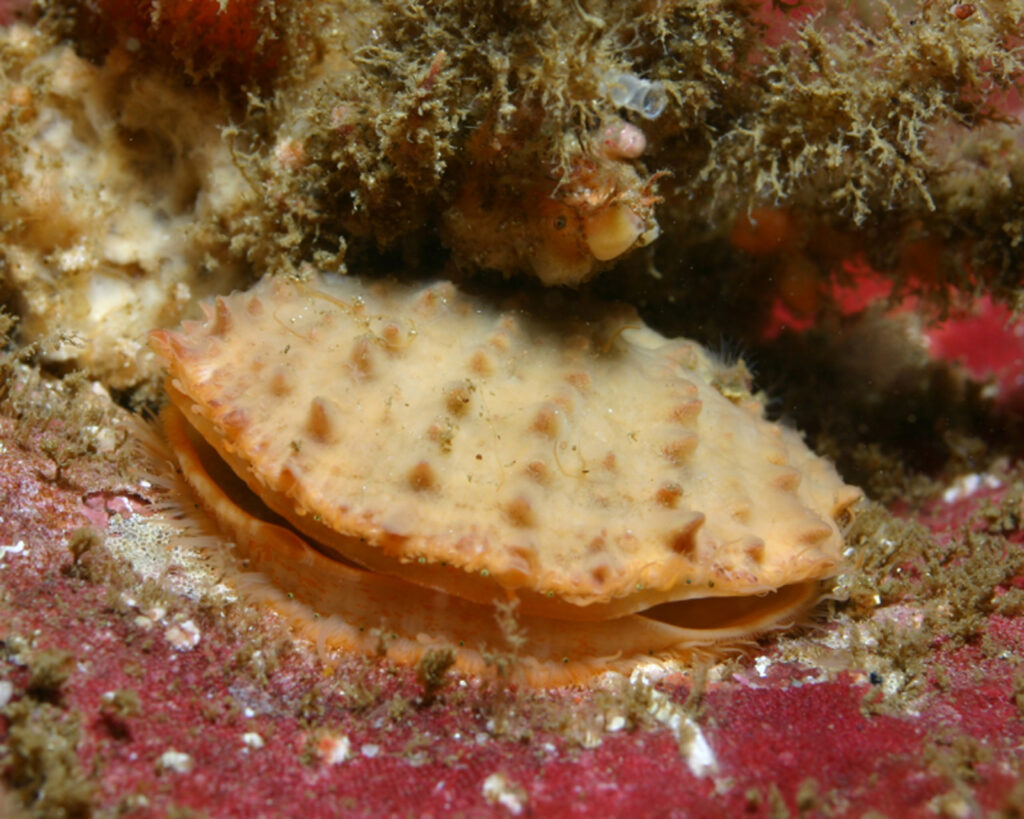
Sometimes the smallest objects carry the biggest stories. Buried deep in the hills of California’s interior, far from any ocean breeze, archaeologists uncovered a small, round bead carved from a giant rock scallop shell.
It doesn’t look like much: barely the size of a fingernail. But this unassuming little artifact has just pushed back the timeline of long-distance trade in ancient California by thousands of years.
A Discovery Far From the Sea
The bead was found at the Turkey Flat archaeological site in southeastern Monterey County, more than 42 miles (68 kilometers) from the nearest coastline. That distance alone makes the find unusual. The bead was carved from the shell of the giant rock scallop, Crassadoma gigantea, a species that doesn’t live in rivers or lakes: it clings to rocky seabeds in coastal waters, often around the Santa Barbara Channel and the Channel Islands. So how did a piece of one end up so far inland?
Researchers Barry A. Price, Simone M. Schinsing, and Jasmine B. Kidwell set out to answer exactly that question. Their findings, published in the journal California Archaeology, reveal a discovery that’s rewriting assumptions about how connected ancient California communities really were.
Older Than Anyone Expected
Radiocarbon dating placed the Turkey Flat bead at approximately 8,508 years old, with a possible range stretching from 8,846 to 8,228 years ago. That makes it the oldest known bead of its kind ever discovered: older than the pyramids of Egypt by several thousand years.
A second bead, found at a nearby site called Lichtenstein, turned out to be much younger, dating to roughly 3,674 years old. Together, the two beads hint at a tradition of shell ornament-making and trade that may have lasted more than 5,000 years.
Tracing the Shell’s Long Journey
Dating the beads was only the first piece of the puzzle. The bigger mystery was figuring out where the shells actually came from, and how they traveled so far from the sea.
To crack this, the research team analyzed the chemical composition of the shells. Different stretches of coastline leave subtly different chemical signatures in shellfish, shaped by the specific water conditions where the mollusk grew. Think of it like a geological fingerprint.
For the younger Lichtenstein bead, the results were inconclusive. But the older, 8,500-year-old Turkey Flat bead told a clearer story: it most likely originated in Southern California, possibly near the Channel Islands or the Santa Barbara coast, even farther from the discovery site than the closest shoreline.
According to Price, there’s a strong possibility the bead was crafted on the Channel Islands and then passed northward through extensive trade networks that could have stretched for hundreds of miles. Another possibility is that a person who had traveled from the coast simply carried the ornament with them.
Either way, the exact route the bead traveled can never be fully reconstructed. What’s clear is that it moved, likely changing hands multiple times — long before written history began.
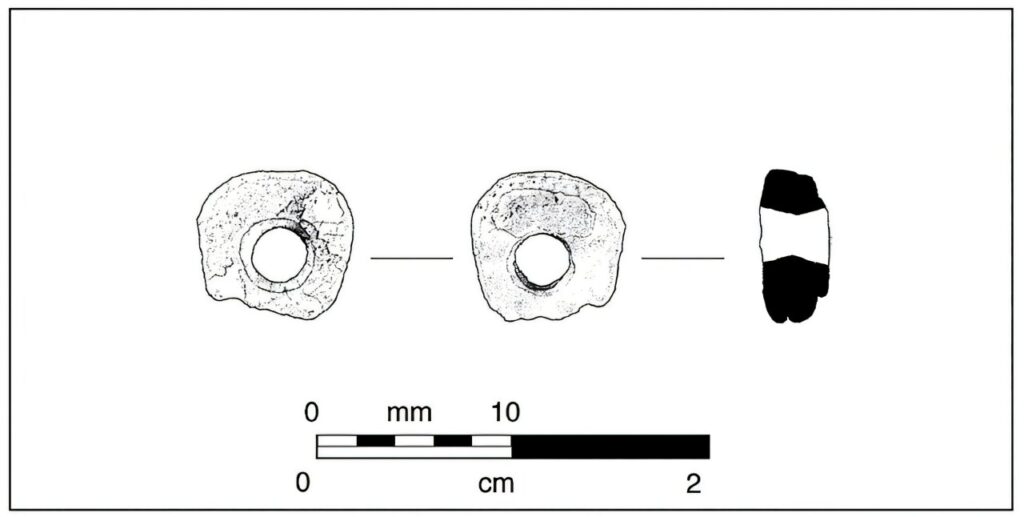
The oldest known giant rock scallop (Crassadoma gigantea) shell bead, excavated at the Turkey Flat site in Monterey County, California. Radiocarbon dating places the bead at roughly 8,500 years old, and isotope analysis traces its origin to the Southern California coast, hundreds of miles away. Credit: Price et al., 2026, California Archaeology.
Not Just a Trinket
Crafting a bead from a giant rock scallop shell wasn’t easy. These mollusks live below the tide line, making them hard to harvest, and their thick, tough shells require real skill and time to shape and drill. That difficulty may be exactly why the beads became so valuable.
In later periods of California history, shell beads like these carried serious weight in Indigenous communities. They served as symbols of social status, sacred objects used in ceremonies, personal adornments, grave offerings, and even a form of currency. Whether the newly dated bead held the same meaning 8,500 years ago is something researchers can’t say for certain, but its presence so far from the coast suggests it was already something special.
Rewriting the Map of Ancient Trade
Until now, similar beads found on San Miguel Island — dating back more than 8,000 years- were considered the earliest evidence of this craft. The Turkey Flat bead matches that age but stands out for one key reason: it wasn’t found on an island or along the coast. It was found deep inland.
That detail matters. It suggests that early Holocene California wasn’t a patchwork of isolated, disconnected settlements. Instead, people, objects, and possibly ideas were already moving across long distances nearly 8,500 years ago.
A Small Bead, A Bigger Picture
The researchers are careful not to overstate their findings. One bead can’t prove the existence of an organized trade route, and it’s impossible to know whether it was sold, gifted, or passed down through generations before reaching its final resting place. But its age and location offer a rare glimpse into just how far ancient connections between coastal and inland communities really stretched.
As Price put it, the significance goes beyond the artifact itself. These discoveries help us understand how people lived, adapted, and connected, offering a small but powerful window into a distant human story that still resonates today.
Price, B. A., Schinsing, S. M., & Kidwell, J. B. (2026). AMS Radiocarbon Dating of Giant Rock Scallop Beads from the Interior of California’s Southern Coast Range. California Archaeology, 1–16. https://doi.org/10.1080/1947461X.2026.2659482
