
Researchers from the University of Évora have documented 13 archaeological sites associated with Roman marble extraction and production in Portugal’s Alentejo region. Previously unpublished findings and newly identified quarrying surfaces provide important evidence of an ancient industry that supplied marble for some of the most prestigious monuments of Roman Hispania.
From monumental columns and sarcophagi to life-sized statues and reliefs depicting possible water deities, numerous marble objects remained at their production sites, many of them unfinished. Their preservation offers researchers an opportunity to examine Roman craftsmanship, reconstruct ancient manufacturing techniques and understand why stonecutters sometimes abandoned their work.
The University of Évora announced the findings on November 16, following the publication of a comprehensive scientific study in Boletín Geológico y Minero in July 2026.
Tracing the origins of Roman marble production
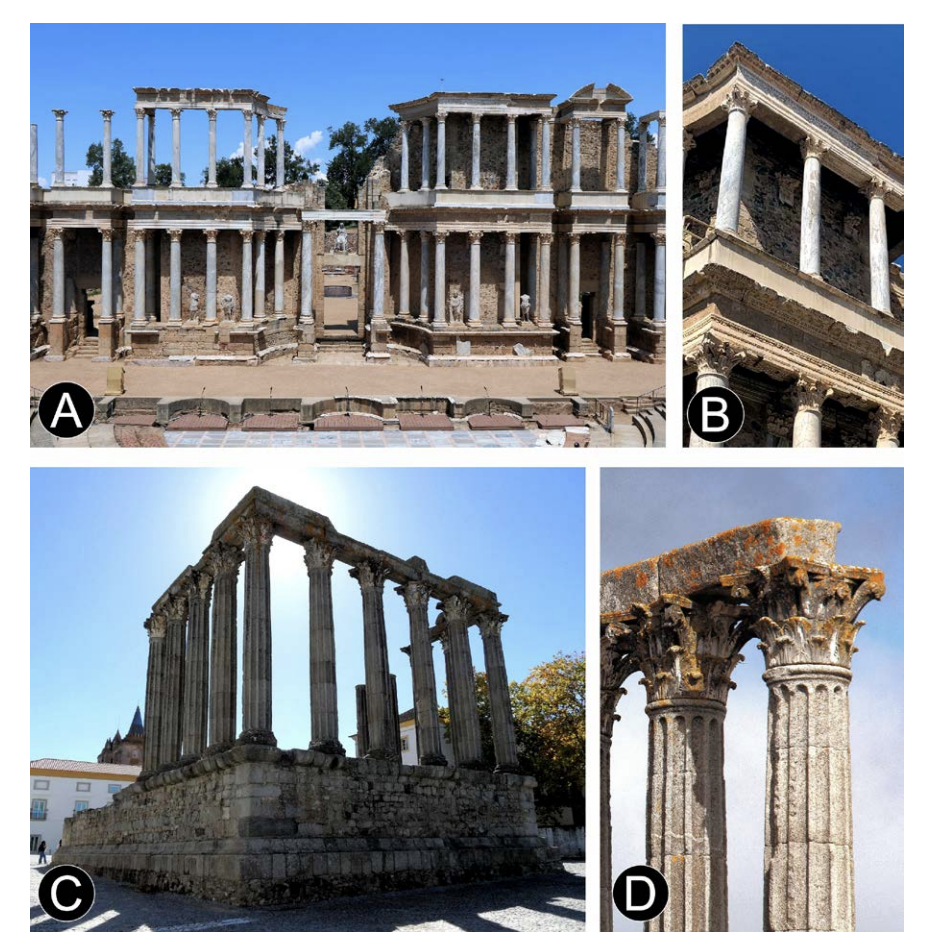
Historians already knew that the Romans exploited marble from the Estremoz Anticline through its use in monuments such as the Roman Temple of Évora in Portugal and the Roman Theater of Mérida in Spain. However, direct archaeological evidence of the industry that supplied these buildings remained comparatively scarce.
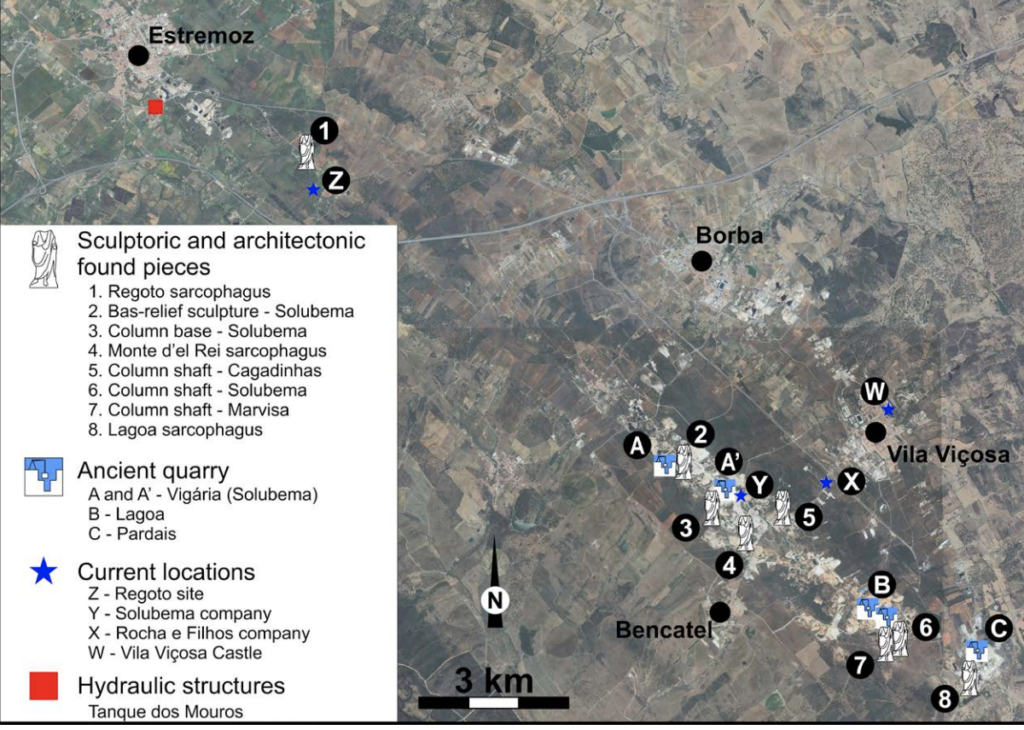
Extending approximately 42 kilometers across southern Portugal, the geological formation contains extensive deposits of white, cream, pink and dark gray marble. The municipalities of Estremoz, Borba and Vila Viçosa constitute the region’s best-known marble-producing area, commonly referred to as the Marble Triangle.
Intensive industrial quarrying during the twentieth century destroyed much of the evidence of ancient extraction. Paradoxically, the same activity also exposed archaeological remains that had lain beneath the surface for centuries. Several marble companies recognized their historical importance and preserved unfinished sculptures, architectural elements and sections of ancient quarrying surfaces.
Combining historical records, field investigations, geological analysis and three-dimensional documentation, the research team compiled the first comprehensive assessment of ancient marble extraction across the region. The 13 archaeological locations bring together previously known discoveries and evidence that researchers documented for the first time during this investigation.
A life-sized Roman statue that never left the quarry
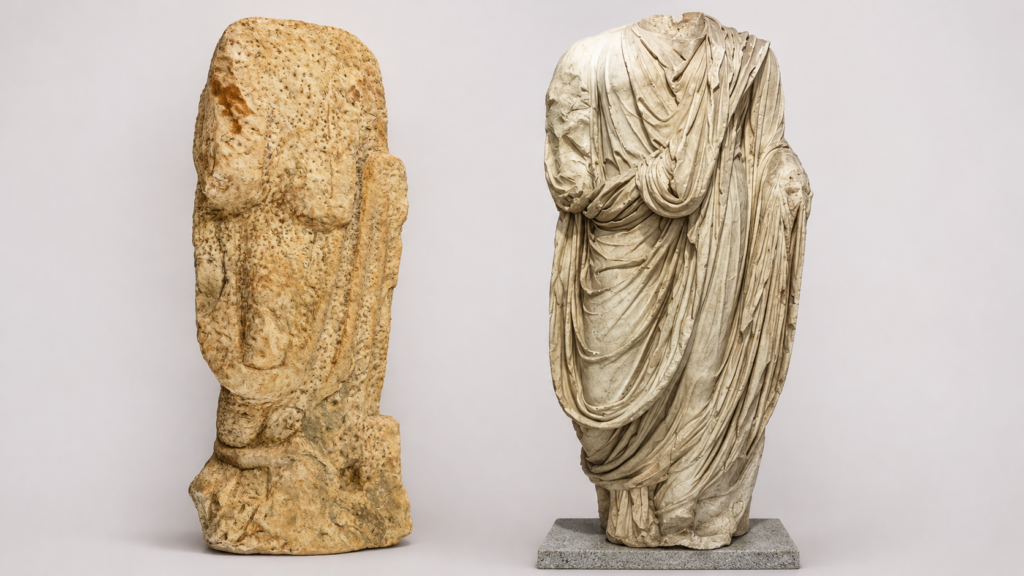
One of the most remarkable objects comes from the Vigária quarrying district near Vila Viçosa. Measuring approximately two meters long and 80 centimeters wide, the unfinished marble sculpture depicts a man wearing a toga, a garment closely associated with Roman citizenship and public life.
Ancient sculptors probably abandoned the statue after encountering a natural fracture near its base. The piece now forms part of the archaeological collection of the Solubema marble company.
Researchers compared the unfinished figure with a completed statue at the National Museum of Roman Art in Mérida. Its similar proportions and dimensions illustrate how the Portuguese sculpture might have looked had the craftsmen completed their work.
Previous mineralogical and isotopic analyses of sculptures from Mérida identify the Estremoz Anticline as one of the city’s principal marble sources. Although the intended destination of the unfinished statue remains unknown, the comparison highlights the artistic and commercial connections between the Portuguese quarries and the Roman provincial capital.
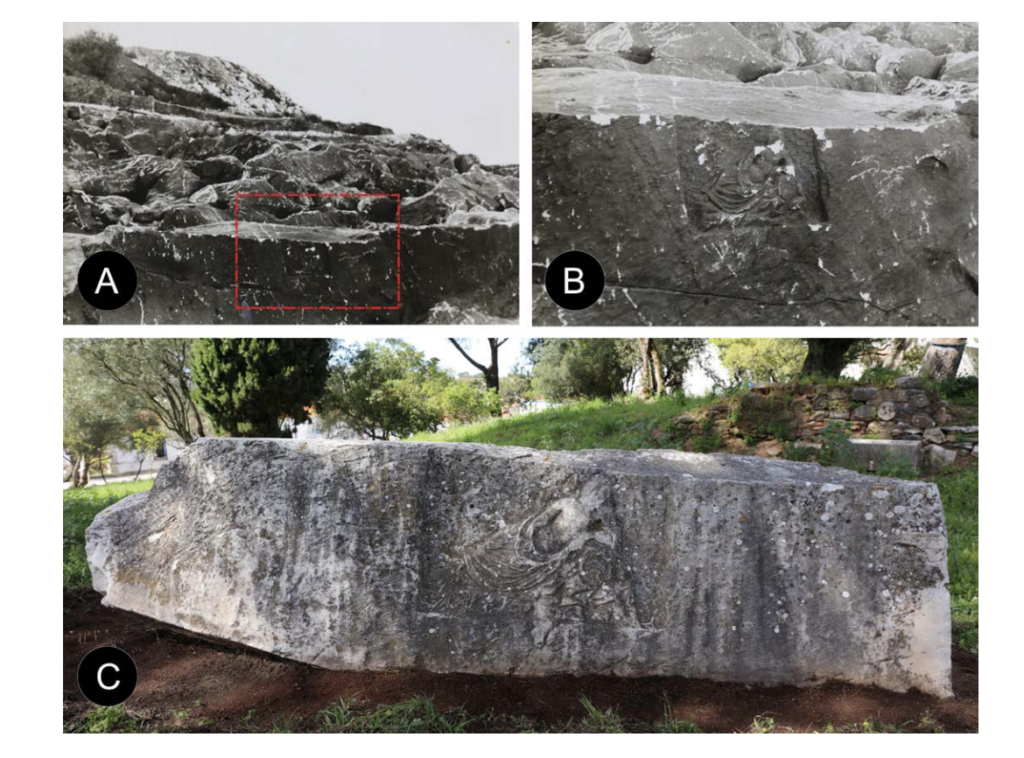
The Vigária district also produced a marble relief depicting a reclining figure, possibly an aquatic deity, dating to the first or second century AD. Visitors can now see the sculpture alongside other Roman architectural elements in the gardens of Vila Viçosa Castle.
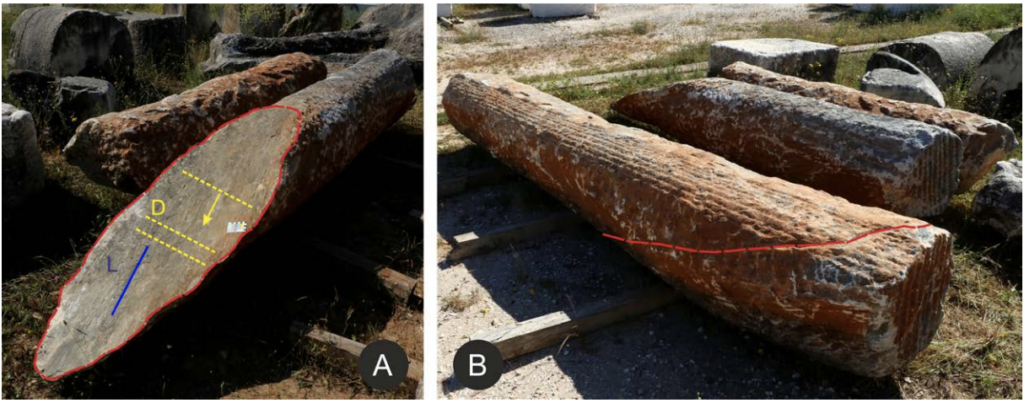
Three unfinished Roman marble columns from the Lagoa quarrying district, Portugal. Red markings highlight natural fractures that likely caused ancient craftsmen to abandon the pieces. Credit: Lopes et al. (2026), Boletín Geológico y Minero, Fig. 9 / CC BY 4.0.
Monumental columns and the techniques of Roman quarrymen
Three unfinished columns from the Lagoa district, measuring between three and five meters long, preserve marks left by chisels and wedges. Craftsmen worked them from a distinctive gray-veined marble known as Pele de Tigre, or tiger skin marble. Natural fractures probably prevented their completion.
These abandoned pieces support the argument that Roman craftsmen carried out much of their initial carving at extraction sites. Reducing the weight of architectural elements before transportation would have significantly lowered the cost of moving heavy stone.
At the Marmoz quarry, researchers documented rows of wedge holes, stepped extraction surfaces, and a large scar that may indicate the removal of a five-meter-long column or a block intended for a sarcophagus. Some wedge holes measure approximately 20 centimeters across and eight centimeters deep, illustrating how ancient workers exploited natural weaknesses in the rock.
During their investigations, the team also identified another ancient extraction area approximately 180 meters west of Marmoz. Its surviving wedge holes and cutting grooves add to the physical evidence of historical quarrying in the region.
At Fonte da Moura in Pardais, exceptionally smooth cuts indicate the use of stone saws. Remarkably, some cutting surfaces retained traces of marble dust. The quarrying company preserved the archaeological remains in three separate blocks for future museum display.
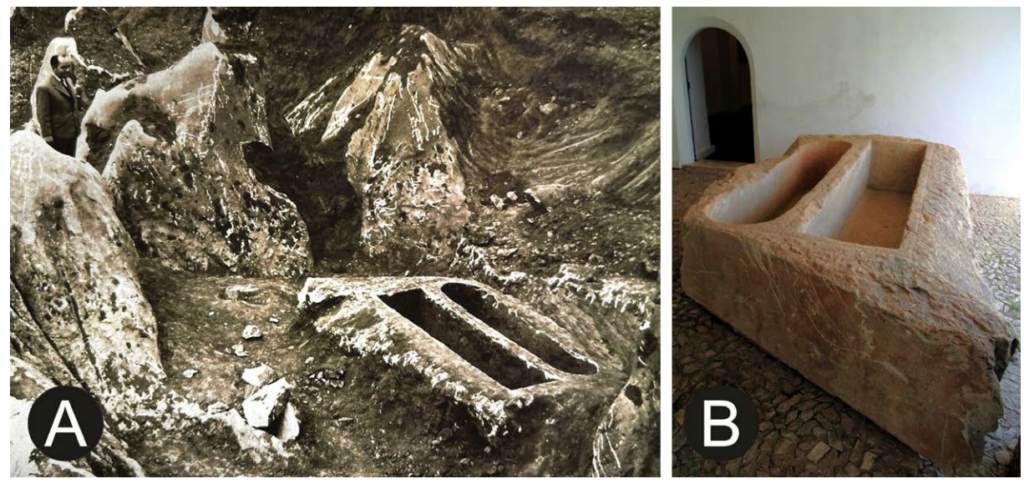
A Roman double sarcophagus carved directly into the marble bedrock at São Marcos, Pardais, shown at its original discovery site (A) and on display at the Vila Viçosa Hunting and Archaeological Museum (B). Credit: Lopes et al. (2026), Boletín Geológico y Minero, Fig. 12
Sarcophagi and marble destined for an empire
The Pardais district also yielded a double sarcophagus that ancient craftsmen carved directly into the bedrock. Guiding lines and an unfinished saw cut preserve evidence of their intention to separate the two burial containers.
Another unfinished double sarcophagus from the Estremoz area acquired an entirely different function centuries later, serving as a watering trough for sheep. A sarcophagus from Monte d’El-Rei, meanwhile, demonstrates the funerary use of the region’s pink marble.
Roman exploitation intensified during the first century AD as Augusta Emerita, modern Mérida and the capital of Lusitania, underwent an ambitious program of monumental construction. The quality of Estremoz marble and the region’s proximity to major urban centers encouraged the development of an extensive extraction and distribution network.
The stone reached cities across Roman Hispania, including Italica, Hispalis (Seville) and Caesaraugusta (Zaragoza). Archaeometric evidence also indicates its use in Volubilis, in present-day Morocco. During late antiquity, demand increasingly extended to luxurious rural villas, funerary monuments and Christian religious buildings.
Preserving an ancient industry and a scientific legacy
Despite the scale of Roman marble production, questions remain about quarry ownership, workforce organization and the settlements where specialized craftsmen lived. The research team recommends further archaeological surveys, ground-penetrating radar investigations and digital documentation of surviving artifacts.
Among its preservation proposals is the transformation of the Marmoz quarry into an open-air museum, where visitors could explore approximately two millennia of marble extraction history.
The study also holds particular significance for the University of Évora. It represents one of the final scientific contributions of Luís Lopes, a geologist and professor at the university, who passed away in July 2026 after dedicating much of his career to understanding the geology of the Estremoz Anticline.
His research leaves an enduring scientific and cultural legacy. May the continued preservation and study of Portugal’s historic marble quarries stand as a lasting tribute to his life, scholarship, and dedication.
Lopes, L., Moreira, N., Vilarinho, G., Martins, R., Carneiro, A., Kezirian, F., Silva, M., & Nogueira, P. (2026). Ancient quarries on the Estremoz Anticline (Ossa Morena Zone, Portugal): Exploitation, use and dispersion of Estremoz marbles during Roman times. Boletín Geológico y Minero, 137(1), Article 010. https://doi.org/10.21701/bolgeomin/137.1/010
