
Archaeologists in Gyeongju, South Korea, have uncovered a 1,600-year-old tomb containing iron helmets, several types of battle armor, and evidence of human sacrifice. The discovery dates to the early years of the Silla Kingdom, when its ruling elite developed elaborate burial customs that preceded the construction of its monumental royal tombs.
Inside one of the burial chambers, researchers discovered the teeth and lower jawbone of an individual believed to have been a teenager. The arrangement of the chambers and grave goods suggests that at least two people may have accompanied the deceased into the afterlife.
The discovery also marks the first time archaeologists in Gyeongju have found two distinct types of iron armor together in a relatively intact condition, offering valuable evidence of early Silla military equipment and metalworking technology.
Before Silla’s monumental royal tombs
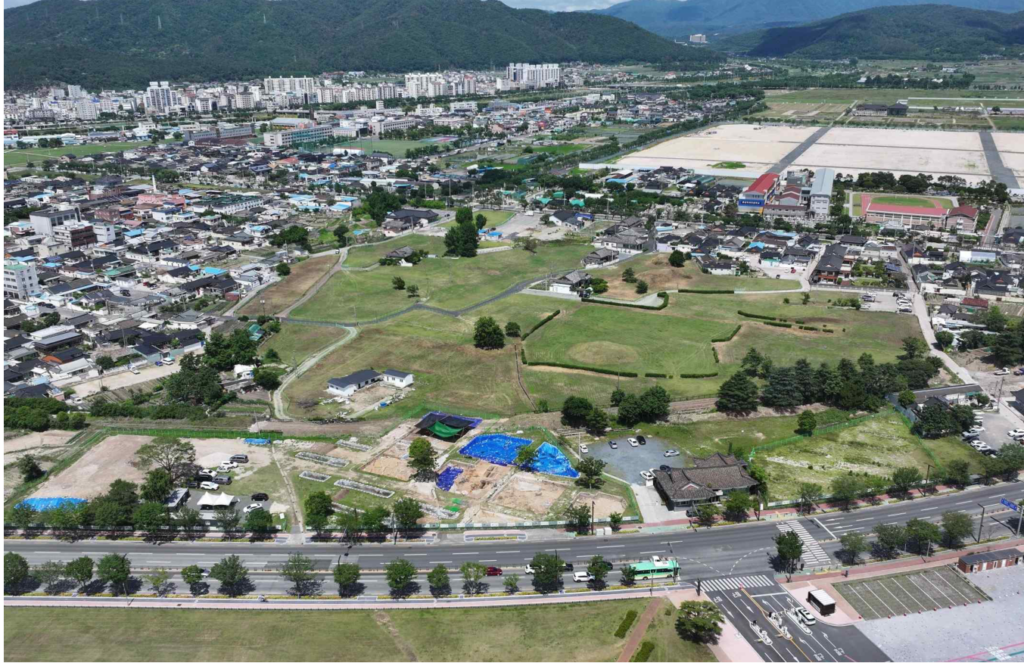
The National Gyeongju Research Institute of Cultural Heritage announced the discovery on November 20, following excavations in the Hwango-Inwang B district of Gyeongju. The area is renowned for its enormous fifth- and sixth-century burial mounds, including the Hwangnamdaechong and Cheonmachong tombs.
Traditionally founded in 57 BC, Silla was one of Korea’s Three Kingdoms, alongside Goguryeo and Baekje. With its capital at present-day Gyeongju, Silla eventually brought much of the Korean Peninsula under its control in the seventh century and survived until AD 935. Its rich archaeological heritage includes elaborate gold crowns, sophisticated metalwork, and richly furnished elite burials.
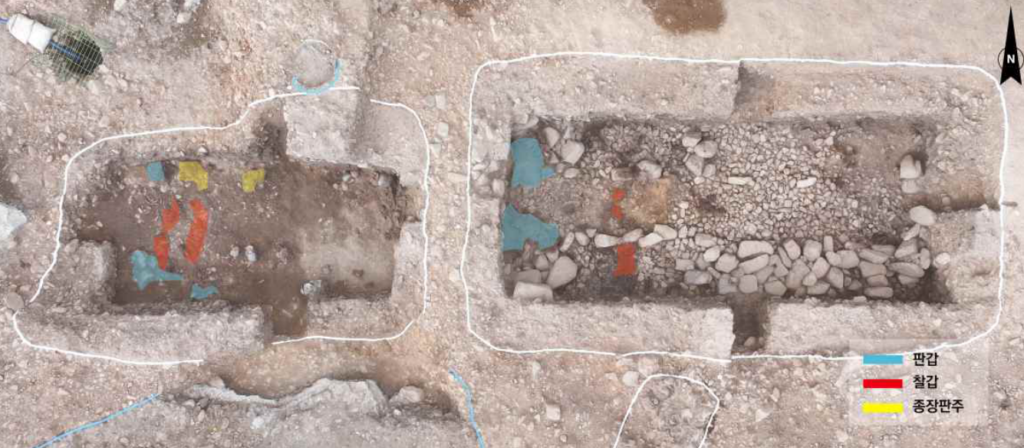
The newly discovered fourth-century tomb, designated Tomb No. 2, predates the emergence of Silla’s monumental stone-mounded wooden chamber tombs. It consists of two wooden burial chambers constructed in separate pits.
The main chamber measures 6.8 meters long and 3.8 meters wide, while the secondary chamber measures 5 meters by 3.3 meters. The tomb builders covered most of the main chamber’s floor with crushed stones and used larger stones to divide its interior into distinct spaces.
Archaeologists also identified clear differences in the distribution of grave goods between the eastern and western sections of both chambers, suggesting a carefully organized burial arrangement.
Two distinct technologies of ancient battle armor
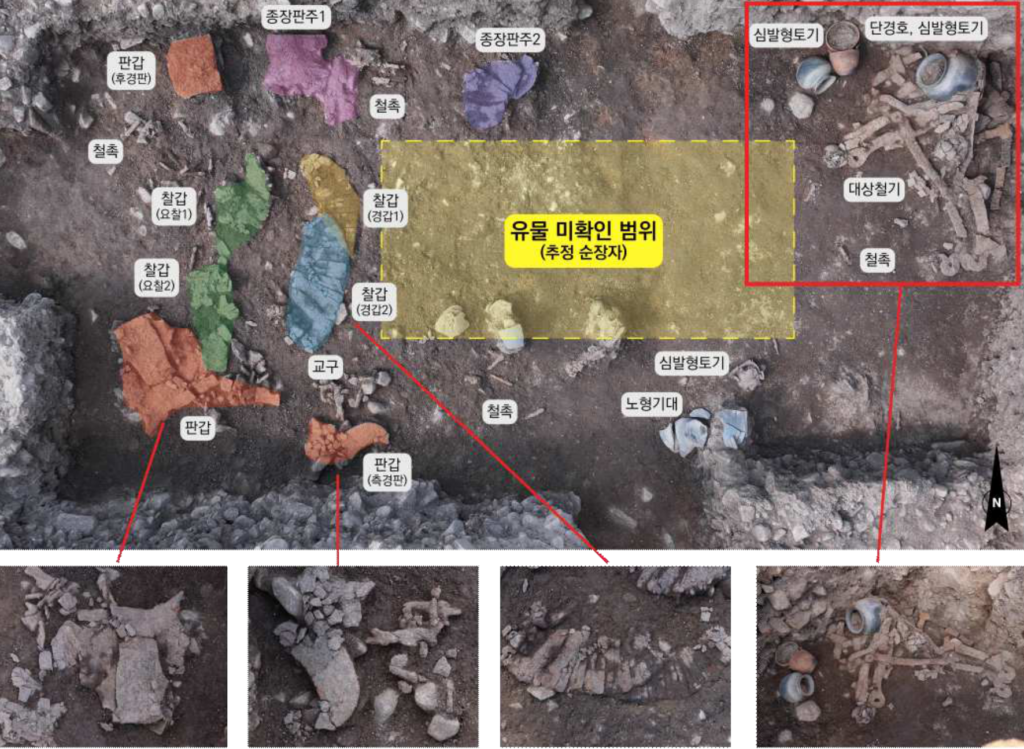
Among the most significant discoveries are two iron helmets, three sets of torso armor, two neck guards, and two waist guards. Much of the military equipment lay in the western section of the secondary burial chamber, where archaeologists identified both plate and lamellar armor.
Ancient armorers manufactured plate armor by joining relatively large iron plates to protect the body. Lamellar armor, by contrast, consisted of numerous small iron plates connected with leather cords or similar materials. The discovery of both types in relatively intact condition within a single tomb provides researchers with an opportunity to compare fourth-century Silla armor-making techniques and military equipment.
The secondary chamber also contained an unusual object made from interconnected strips of iron. Archaeologists had previously encountered only fragments of similar objects, which some researchers believe formed part of a horse saddle frame.
The newly discovered example is the first to survive in complete form. Further examination could help researchers establish its original function and reconstruct the techniques ancient metalworkers used to manufacture it.
Human companions for the afterlife
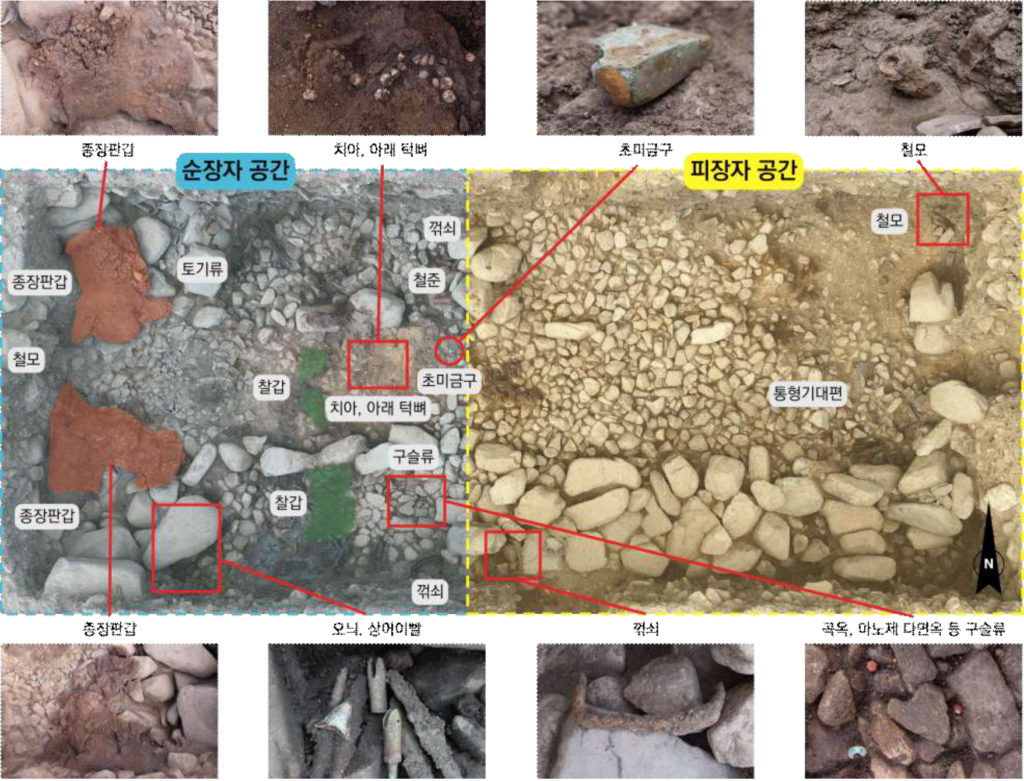
In the western section of the main chamber, archaeologists recovered arrowheads, a gilded bronze sword-scabbard fitting, armor fragments, curved beads and multifaceted agate beads. Near the center of this area, they discovered human teeth and part of a lower jawbone that preliminary observations suggest belonged to a teenager.
The center of the secondary chamber contained another distinct space without grave goods. Researchers believe this area may have accommodated an additional individual who accompanied the principal occupant of the tomb.
Based on the chamber layout, human remains, and distribution of burial objects, the excavation team estimates that at least two individuals may have accompanied the deceased into the grave. However, researchers have yet to establish how these individuals died.
Known in Korean archaeology as sunjang (순장), retainer burial involved interring other individuals alongside a deceased person. The practice, associated with elite funerary customs, provides evidence of the social hierarchies and beliefs surrounding death in ancient Korean society.
Deliberately breaking objects during funerals
The excavation also uncovered evidence of another distinctive funerary practice: the intentional destruction of objects during burial ceremonies.
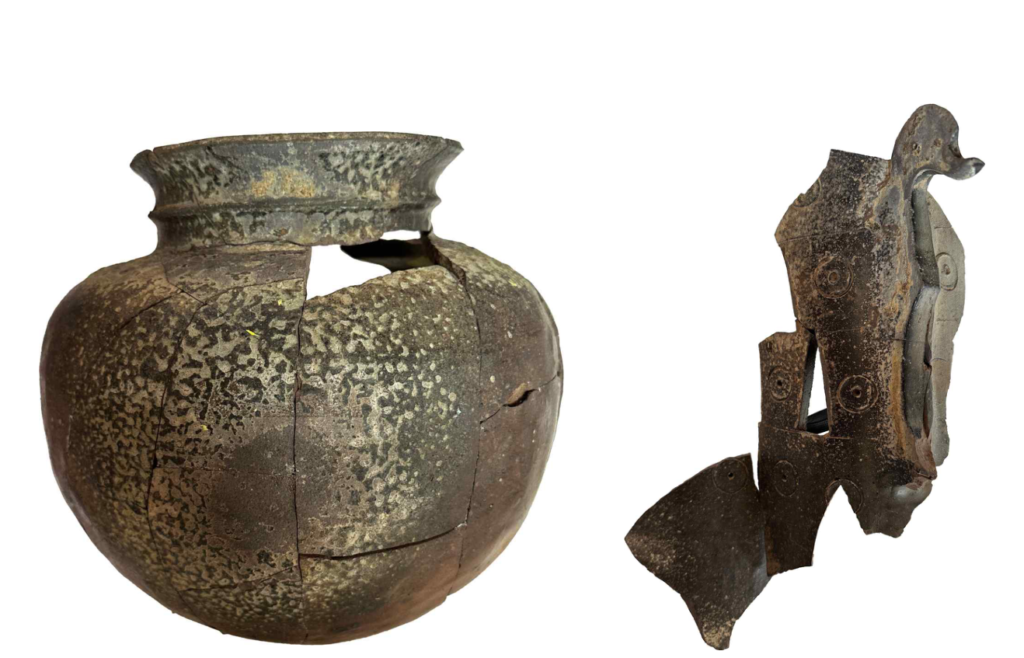
Archaeologists recovered fragments of short-necked jars, armor, and a cylindrical ceramic vessel stand decorated with a duck’s head from the upper section of the main chamber. They discovered similar fragments in collapsed deposits and across the chamber floor, suggesting that participants in the funeral may have deliberately broken these objects.
Known as hwegi (훼기) in Korean archaeology, this ritual involved intentionally damaging or breaking pottery, weapons, and other objects during ceremonies. The findings at Gyeongju suggest that the early Silla elite may have included military equipment in this practice, although its precise ritual significance remains uncertain.
Understanding the origins of Silla’s royal burials
The combination of military equipment, evidence of retainer burial, and ritual destruction makes Tomb No. 2 particularly valuable for understanding Silla society before the appearance of its enormous royal burial mounds.
By comparing the fourth-century wooden chamber tomb with later monuments such as Hwangnamdaechong and Cheonmachong, researchers hope to trace changes in burial architecture, ceremonial practices and the ways Silla’s ruling families expressed their status in death.
The National Gyeongju Research Institute of Cultural Heritage will open the excavation site to the public on November 23, presenting the tomb’s architecture, iron armor, and evidence of funerary rituals. Conservation work and further scientific analyses will help specialists investigate the manufacturing techniques behind the military equipment and the burial customs of Silla’s early ruling elite.
