
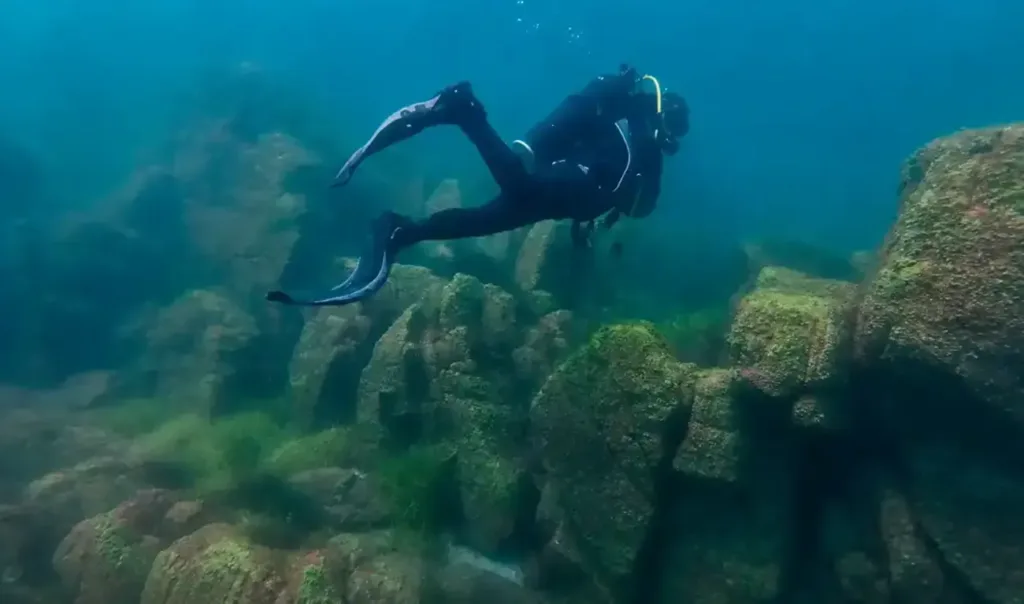
A stone formation resembling an ancient staircase or wall has been discovered beneath the waters of Lake Titicaca. The discovery could open the door to new archaeological investigations in one of South America’s most sacred lakes.
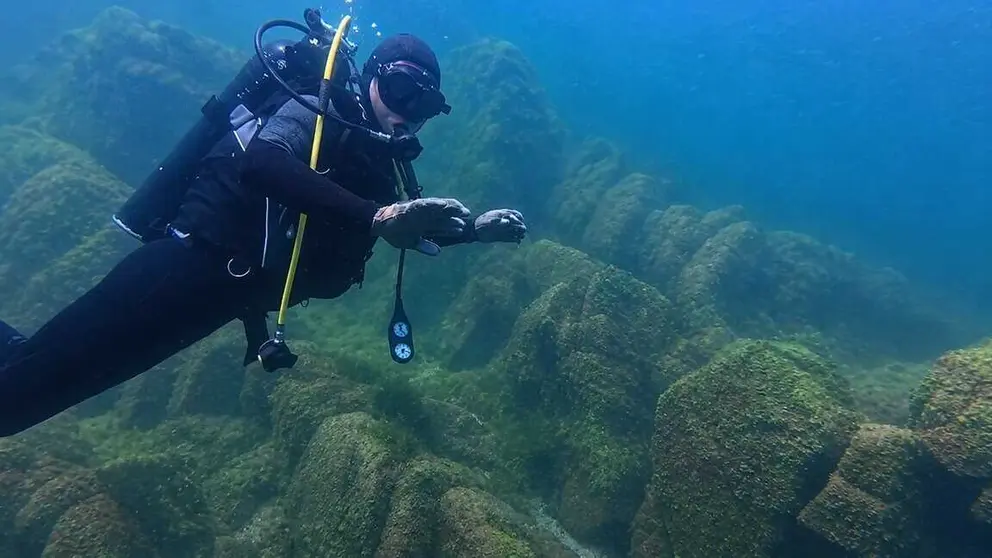
During a dive conducted in the first week of November near the Island of the Sun (Isla del Sol), the Bolivian Navy’s Sport Diving Club encountered striking rock formations. The arrangement of the stones, which resemble steps and an old wall, led the divers to believe they might belong to a structure built in the past. Nevertheless, a detailed archaeological examination to determine the origin of these formations has not yet been carried out in the region.
Origin of the Stone Formations Remains Unknown
Captain Max Álvaro Villarroel Muñoz, commander of the High Altitude Diving Training Center (CIBA) of the Bolivian Navy, stated to the Bolivian state news agency ABI that there are numerous rock formations in Lake Titicaca and that scientific research is required to determine whether they are archaeological remains.
Villarroel noted that the shapes encountered by the divers resembled a staircase or an old wall. However, he did not make a definitive assessment as to whether these are human-made structures or rock alignments formed through natural processes. According to the commander, archaeologists must determine if the finds belong to ancient ruins.
Stating that similar formations have been detected in other parts of the lake, Villarroel added that some of these had previously been examined by experts. As for the exact period to which the discovery may belong, no dating has yet been established.
Ceremonial Sites Beneath Lake Titicaca
One of the primary reasons the new find is drawing attention is that Lake Titicaca has hosted underwater archaeology research for many years. Bolivian and international research teams have documented numerous remains on the lakebed related to ancient settlements, human activity, and specifically ceremonial practices.
Comprehensive research beginning in 2012 involved more than 1,350 dives. According to data reported by UNESCO, these studies led to the identification of approximately 20 underwater archaeological sites and the documentation of over 20,000 archaeological objects. These finds span a wide time period, from the Tiwanaku era to the Inca Empire.
One of the most remarkable discoveries took place at the Khoa Reef near the Island of the Sun. Here, archaeologists investigated offerings left in the water by the Tiwanaku society during religious ceremonies. Gold ornaments, ceramic incense burners, objects made of seashells, and the bones of sacrificed young llamas demonstrated that the lake was not only a natural resource but also a significant ceremonial center.
A 2019 study published in PNAS by researchers Christophe Delaere, José M. Capriles, and Charles Stanish examined the role of these ceremonies in the development of the Tiwanaku state, which flourished in the Lake Titicaca region between AD 500 and 1100. The findings showed how rituals performed at specific locations in the lake between the eighth and tenth centuries helped reinforce political and religious authority.
The Inca Offering Box at the Bottom of the Lake
Another significant piece of evidence regarding Titicaca’s underwater past was found in 2014 at the K’akaya Reef. Archaeologists discovered a small stone box, preserved with its lid, at a depth of approximately six meters. Inside the box was a miniature lama or alpaca figure carved from a seashell and a thin, rolled gold sheet.
Having remained underwater for centuries, these objects serve as concrete examples of the ceremonial offerings the Inca society left in the lake. Researchers state that similar boxes and miniature figures have been found in other Inca ceremonial sites across the Andes.
In a study published in the journal Antiquity in 2020, Christophe Delaere and José M. Capriles examined the objects inside the box and their archaeological context in detail. The study shows that Lake Titicaca maintained its importance as a sacred site during the Inca period and that the tradition of leaving offerings in the water continued after the Tiwanaku era.
These discoveries reveal the religious significance the lake held for various Andean societies throughout different periods. However, no archaeological link has yet been established between the previously found ceremonial sites and the newly detected stone formations.
An Island with More Than 5,000 Years of History
The Island of the Sun has a history that stretches back long before the rise of the Tiwanaku and Inca civilizations. A study published in Latin American Antiquity in March 2026 traced human activity on the island back to at least 3500 BC, more than 700 years earlier than previous archaeological evidence had established.
Researchers Charles Stanish and Brian Damiata reached this conclusion by reexamining charcoal samples collected during excavations at Ch’uxuqullu in the 1990s. The site, located on a hillside overlooking Challa Bay, contained stone tools, obsidian fragments, and layers of human activity extending from approximately 3500 to 160 BC.
One of the study’s most interesting findings concerns how people reached the island. Although Lake Titicaca’s water level was considerably lower thousands of years ago, the researchers concluded that the Island of the Sun was accessible only by boat for most, if not all, of the past 5,000 years. This means people living in the region had developed watercraft capable of reaching the island much earlier than archaeologists previously believed.
The discovery of obsidian adds another dimension to this early history. Because the volcanic glass does not occur naturally on the island, its presence indicates that inhabitants maintained connections with communities on the mainland. Some of the material originated as far away as the Chivay region, suggesting that Lake Titicaca formed part of a wider exchange network thousands of years before the Inca Empire.
The newly documented underwater formations add another question to this long archaeological history. Whether they are natural rock formations or the remains of human construction is still unknown. For now, their discovery offers researchers another reason to investigate the waters surrounding an island where people have lived and carried out activities for thousands of years.
Stanish, C., & Damiata, B. (2026). A Fourth Millennium BC Occupation on the Island of the Sun, Lake Titicaca, Bolivia. Latin American Antiquity, 37(2), 309–318. doi:10.1017/laq.2025.10158
