
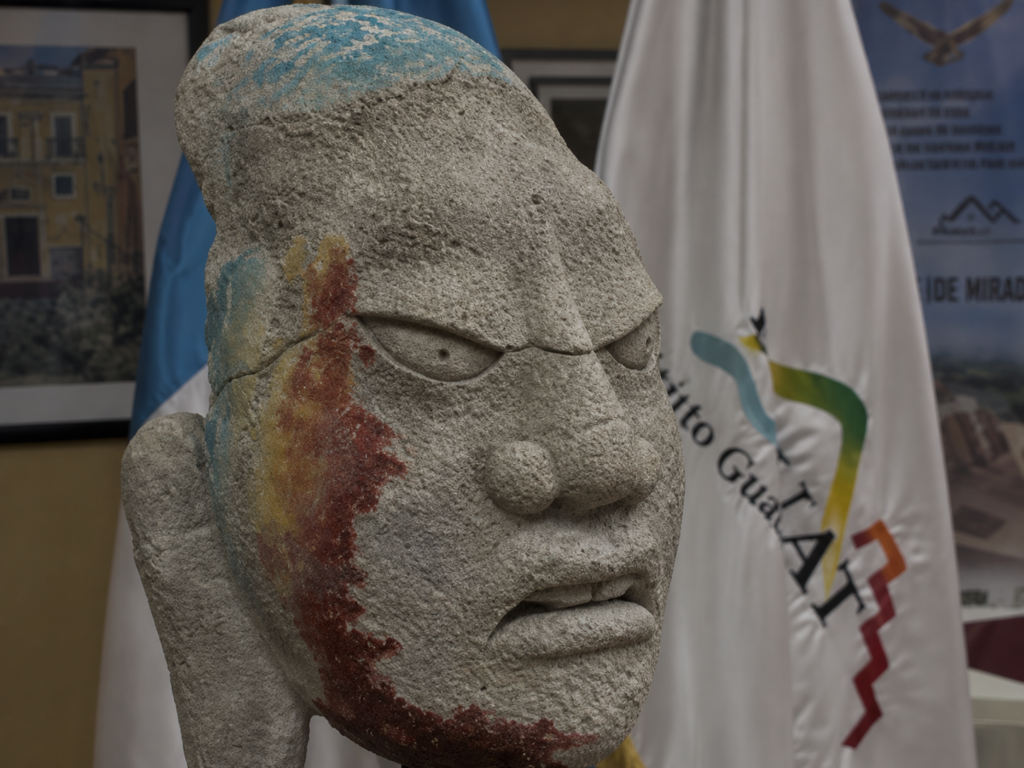
Archaeologists working at the ancient Maya city of El Mirador in northern Guatemala discovered three new sculptures during the 2026 excavation season. Made from stucco, a plaster-based material, the sculptures join a collection of colorful figures believed to represent gods, mythological beings, and prominent individuals.
According to research results presented in Guatemala on November 18, the new finds are among the latest discoveries from long-term excavations ongoing at El Mirador in the Petén region. Archaeologist Douglas Mauricio Martínez, a member of the excavation team, stated that about three more sculptures were unearthed during the 2026 season and that these require restoration. Detailed information regarding which figures these new works represent has not yet been published.
Faces Left Beneath a Looted Structure
The story of the sculptures dates back to research that began in 2012 at the Casa del Coral building group, near the monumental La Danta complex in eastern El Mirador. While mapping the area, archaeologists noticed numerous stucco fragments in a pit previously opened by looters. These finds led to a systematic investigation of a structure approximately 17 meters long, 10 meters wide, and 5 meters high.
Subsequent excavations at the structure, named Edificio de los Rostros (Building of the Faces), revealed more than 30 sculptures and various fragments. The faces were found not on the building’s facade, but in the rear section, among collapsed limestone blocks and architectural debris.
Furthermore, the works were not in their original positions. Looters had displaced soil, stone, and architectural elements. This destruction makes it difficult to determine exactly where and how the sculptures were displayed within the building.
Researchers believe the heads, modeled by applying stucco over stone projections, were once part of the structure’s architectural ornamentation. However, the original arrangement of the figures has not yet been definitively established.
The Death God, the Paddler God, and the Blue Princess
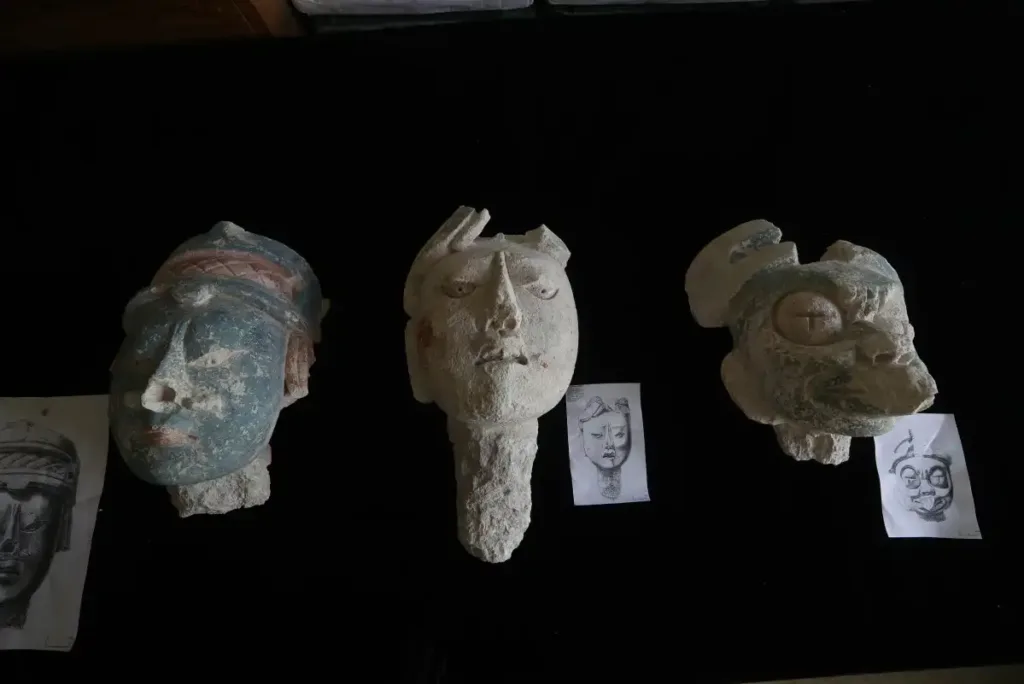
The most striking feature of the sculptures is their diverse facial expressions and mythological connotations. Some are thought to represent humans—likely rulers or elites—while others represent gods and supernatural entities.
A 2016 study published by Douglas Mauricio, Richard Hansen, and Stanley Guenter associates one of the figures with the Maya God of Death. Another depiction is noted as potentially representing the mythological Paddler God, who transports the dead to the underworld.
Mauricio’s 2022 study focuses on a figure referred to as La Princesa Azul (The Blue Princess). The feminine face, painted in Maya blue, is linked to water symbolism due to the water lily motifs on her headdress. Researchers evaluate that this may represent a member of the ruling family.
These interpretations suggest that the sculptures were not merely decorative elements. Deities, ancestors, and elites may have been brought together in a single architectural composition. Nevertheless, the identities of the figures have not yet been fully resolved.
#EnElPaísDCA | El Instituto Guatemalteco de Turismo y el Proyecto Arqueológico Cuenca El Mirador presentan la conferencia de prensa Los rostros del mirador, con el objetivo de compartir los hallazgos que han hecho en la segunda reserva de selva tropical más grande de América. Desde 1978, el doctor Richard Hansen, director del referido proyecto, y su equipo han investigado Tikal y El Mirador. No obstante, a partir del 2015 implementaron la tecnología LiDar, en español Detección de luz y su rango, que ha sido elemental en el descubrimiento de más de 964 sitios de la cuenca, pertenecientes al período maya preclásico (100 a.C. – 150 d.C.). Asimismo, la arqueóloga especialista en conservación, Lilian Vega, explicó que ha encontrado cabezas completamente disgregada y que ella las ha restaurado. Este proceso le ha llevado hasta un año en terminarlo. "Fue un honor que estas esculturas llegaran a mis manos. Me siento satisfecha de aportar a la cultura de Guatemala", expresó Vega. ✍️ Karen Alonzo 📷 @ccaljuDCA
— Diario de Centro América (@DiariodeCA) November 18, 2026
Could It Be a Ceremonial Space?
In addition to the sculptures, more than 35 ceramic vessels were found in the structure. These include vessels known as tecomate and bucul, which may have been used for storing or offering liquids. Researchers suspect some may be associated with fermented beverages.
These finds reinforce the view that the structure may have been used for ceremonies. Figures associated with death and the underworld suggest that rituals related to ancestors or funerary beliefs may have been performed here.
However, the ceramic vessels and sculptures alone do not reveal the definitive function of the building. Archaeologists continue to evaluate various interpretations.
Restoring a Maya Face
Lilian Vega de Zea, the restorer for the El Mirador excavation project, explains that most of the works were found broken, overgrown with roots, and in an extremely fragile state. Because stucco can crumble into powder if handled incorrectly, every piece must be stabilized before cleaning begins.
Restorers strive to remove adhered soil and roots without damaging the original material. Subsequently, cracks are reinforced, and interventions are made only where necessary.
To date, the restoration of more than 20 heads has been completed. Some works have been transferred to the National Museum of Archaeology and Ethnology in Guatemala, while others are still under examination in laboratories.
The new sculptures found in the 2026 season will also undergo this process. Each new piece may help in understanding the figured composition that once adorned the walls of the structure. However, reconstructing this integrity from the scattered remains of a looted building remains a significant challenge for archaeologists and restorers.
