
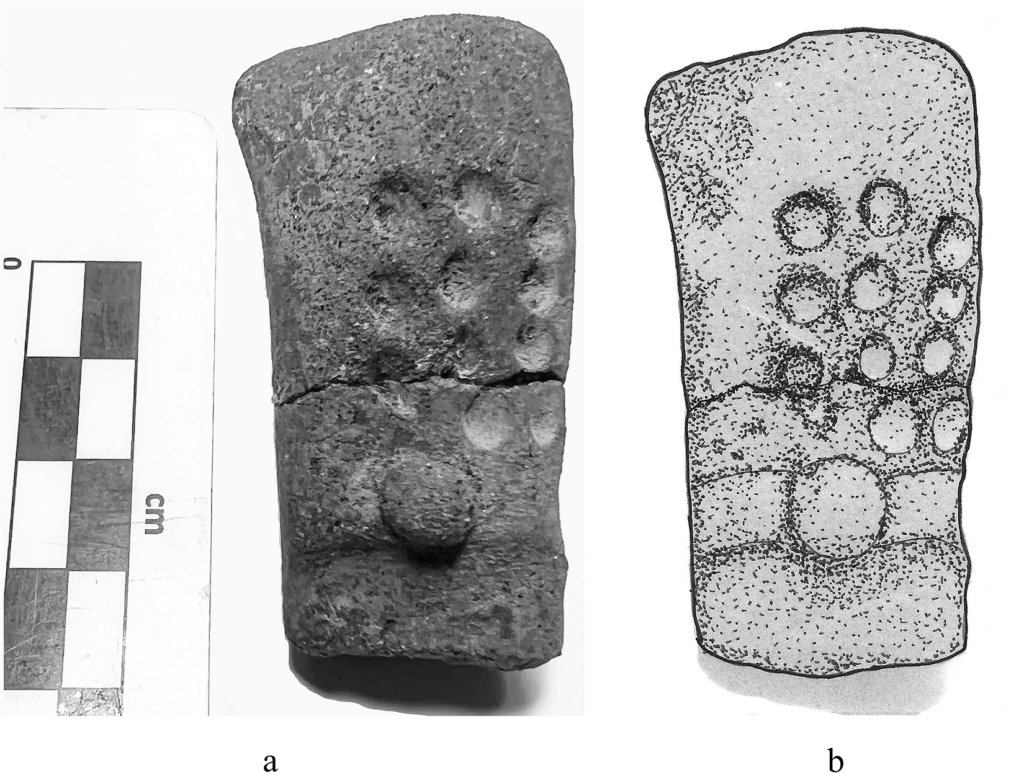
A small broken ceramic figurine from Guatemala may preserve one of the earliest known traces of numerical thinking in ancient Mesoamerica.
The object, found at the Preclassic site of La Blanca on Guatemala’s Pacific coast, carries eleven carefully impressed dots on the area where its head or headdress would have been. Researchers argue that the marks may represent a dot-based number system dating to roughly 750–650 BC, several centuries before the clearest known calendrical inscriptions in the region.
The study, published in Latin American Antiquity by Julia Guernsey, Stephanie M. Strauss, and Michael Love, does not claim that the case is closed. The authors are cautious. The dots could be decorative, symbolic, or numerical. But their arrangement, archaeological context, and position on the figurine make the object one of the most important pieces yet known for understanding how numbers, writing, identity, and the body began to converge in ancient Mesoamerica.
Eleven dots on a broken ceramic body
The figurine was recovered at La Blanca, an early urban center in San Marcos, Guatemala. It belongs to a type known as “tab” figurines, which have anthropomorphic lower bodies but lack naturalistic faces. Instead of a normal head, they carry a flat, tongue-like projection.
On this fragment, the upper tab is marked with eleven small clay circles. They were impressed before firing, which means the design was planned during manufacture rather than added later. The dots appear in three vertical columns: three on the left, four in the center, and four on the right.
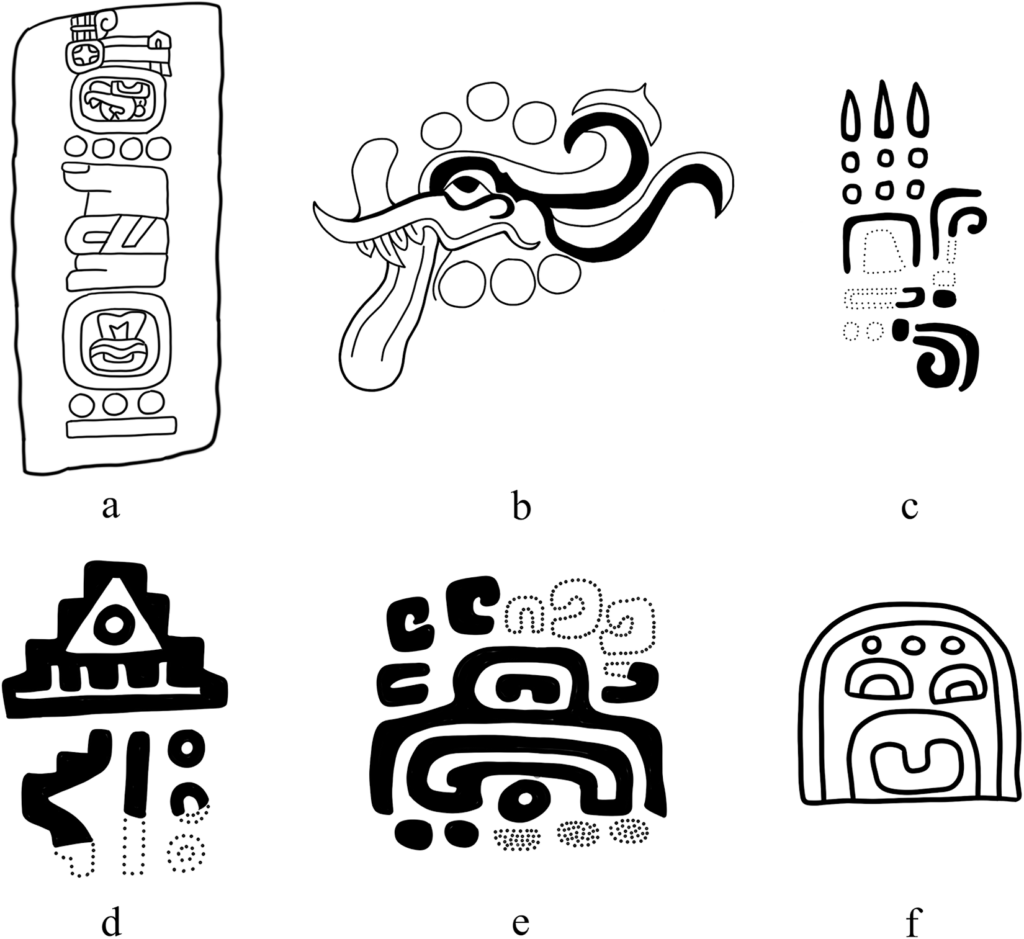
That order matters. In later Mesoamerican writing, dots commonly represented units of one, while bars represented five. The familiar bar-and-dot system appears widely in Maya, Zapotec, and Isthmian inscriptions, especially in calendar dates. The La Blanca figurine has no bars, only dots. Even so, eleven individual dots could plausibly be read as the number 11.
The unusual total strengthens the interpretation. If the marks were only decorative, a more balanced design with an even number of dots might be expected. Instead, the object presents an odd number arranged in a controlled pattern.
A possible number before formal writing
The find is important because numbers may have appeared in Mesoamerica before writing was fully developed. The researchers note that numerical notation and early writing often grew together in ancient societies. In some cases, counting systems may have come first.
In Mesoamerica, numbers became central to calendars, astronomy, divination, naming, and political record keeping. The 260-day sacred calendar, used across the region in different forms, combined 13 numbers with 20 day signs. This system shaped ritual life and could also be tied to personal names and destiny.
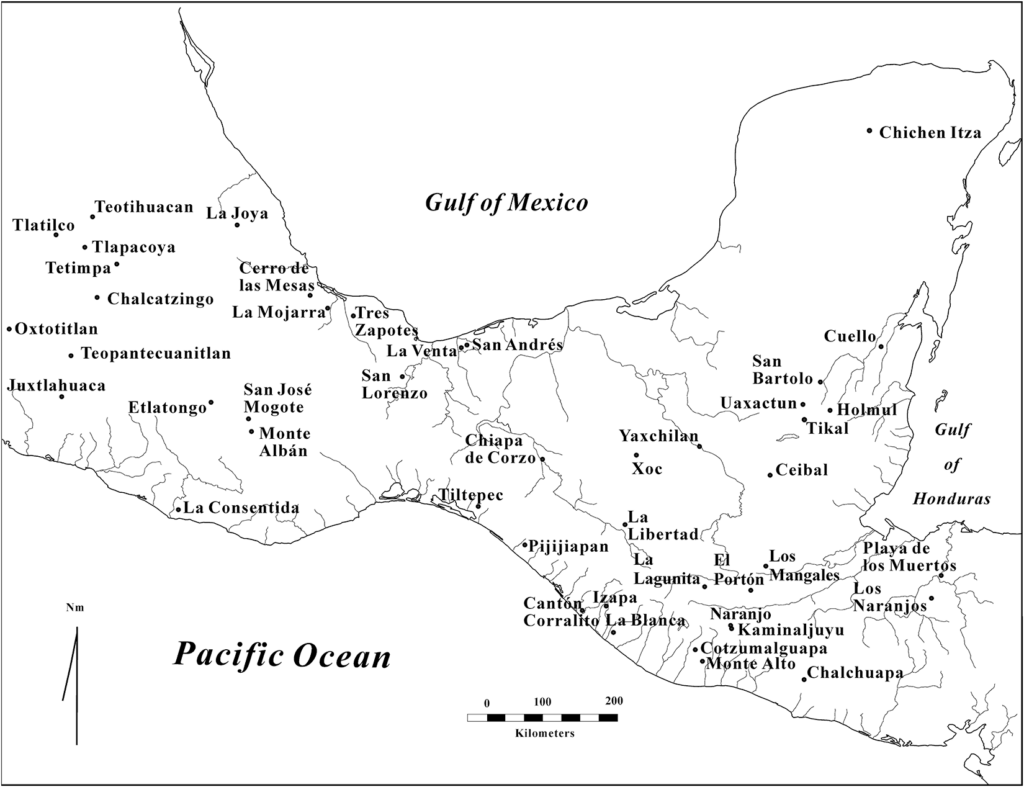
The earliest unambiguous Mesoamerican calendrical date currently comes from San Bartolo in Guatemala, where a painted stucco fragment records the date “7 Manik,” or 7 Deer, and dates to around 300–200 BC. Other earlier examples have been proposed, including dot groups in the Oxtotitlán cave paintings in Mexico and marks on a cylinder seal from San Andrés in Tabasco, but those readings remain debated.
The La Blanca figurine enters that debate from a different angle. It is not a monumental inscription. It is not a formal calendar text. It is a small, portable household object. That makes it harder to read, but also more revealing. It suggests that numerical signs may have circulated outside elite monuments, possibly in domestic or ritual settings.
La Blanca and its figurine tradition
La Blanca was one of the major Middle Preclassic centers on Guatemala’s Pacific coast. It rose to prominence between about 1000 and 900 BC and maintained regional power for nearly three centuries. Its architecture, household compounds, and material culture point to a society with clear social ranking.
Excavations have recovered more than 5,000 figurine fragments from the site. Most were found in household refuse deposits, indicating that figurines were not limited to palaces or ceremonial spaces. They appear to have played a role in shared domestic practices, possibly linked to ritual, ancestry, identity, or social memory.
The figurines were usually broken. Only two of the thousands found at La Blanca are nearly complete. This pattern suggests that fragmentation was not accidental in every case. Breaking and dispersing figurines may have formed part of their meaning.
The dotted figurine came from the Joyas Group, about one kilometer northwest of La Blanca’s ceremonial center. It was found at a depth of 70–80 centimeters near the edge of a household floor, in association with domestic architectural remains, obsidian, pottery, and other figurine fragments. The household appears to have belonged to the lower end of the local socioeconomic spectrum.
The context dates to the Conchas E subphase, around 650 BC, but the figurine itself was probably made earlier, during the Conchas D subphase, roughly 750–650 BC. This would place it around 2,700 years ago.
Numbers placed where a face should be
One of the most striking features of the object is not only the number of dots, but where they appear.
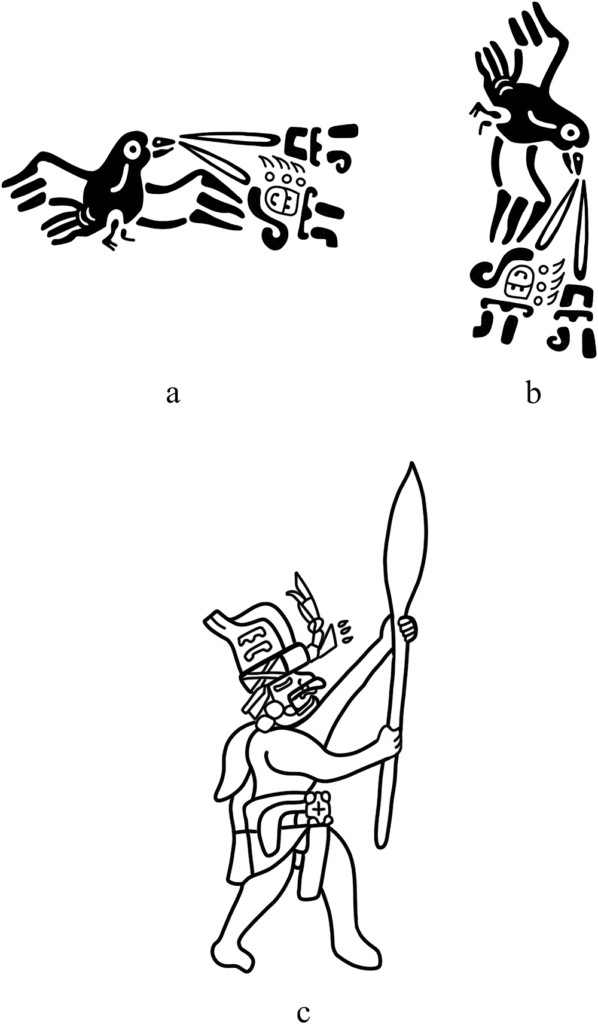
The dots occupy the head or headdress zone. In Mesoamerican art, this was often where identity was displayed. Rulers, ancestors, deities, and named persons could be distinguished by headdresses, head signs, or symbols placed near the face. The Olmec colossal heads of San Lorenzo, for example, each carry distinct headgear. Early figurines from sites such as Cantón Corralito also show head symbols centuries before later writing systems became standardized.
The La Blanca tab figurine is different because it has no face. Its blank head-like extension may have created a space where identity could be constructed through signs rather than facial features. If the eleven dots were numerical, they may have marked more than quantity. They may have referred to a name, a calendrical identity, or a concept of personhood.
The study connects this possibility with broader Mesoamerican ideas about the body and counting. In several Mayan languages, the concept of a “person” is closely tied to the number twenty, reflecting ten fingers and ten toes. The body itself became a model for counting. In that intellectual world, numbers were not abstract marks floating apart from human life. They could be tied to time, fate, naming, and the social body.
Decoration, writing, or something in between?
The researchers avoid overstating the evidence. Not every circle in ancient art is a number. Dots and round motifs can represent water, breath, beads, ornaments, or other symbolic elements. The same problem appears in several early Mesoamerican objects, where scholars still debate whether dot groups are numerical signs or iconographic details.
The La Blanca figurine is valuable precisely because it sits at that threshold. Its dots are ordered, deliberate, and positioned in a meaningful area of the body. The object is securely dated and comes from a controlled archaeological context. Yet it remains unique. No larger group of similar dotted figurines has been found at La Blanca or elsewhere.
For that reason, the safest conclusion is also the most interesting one: the figurine may be the earliest securely dated example of a possible dot-based numbering system in Mesoamerica.
It does not rewrite the history of writing by itself. Instead, it opens a narrow but important window onto the period before standardized scripts and calendar inscriptions became widespread. A few dots on a broken clay body may show that numbers were already being used to think about identity, time, and personhood long before the great inscriptions of the Maya, Zapotec, and other Mesoamerican traditions.
Guernsey, J., Strauss, S. M., & Love, M. (2026). Numbers and Bodies: Potential Early Numeration on a Middle Preclassic Figurine from La Blanca, Guatemala. Latin American Antiquity, 1–20. doi:10.1017/laq.2025.10146
Cover Image Credit: 2,700-year-old La Blanca ceramic figurine from Guatemala with eleven impressed dots that may represent early Mesoamerican numeration. Credit: Julia Guernsey
