
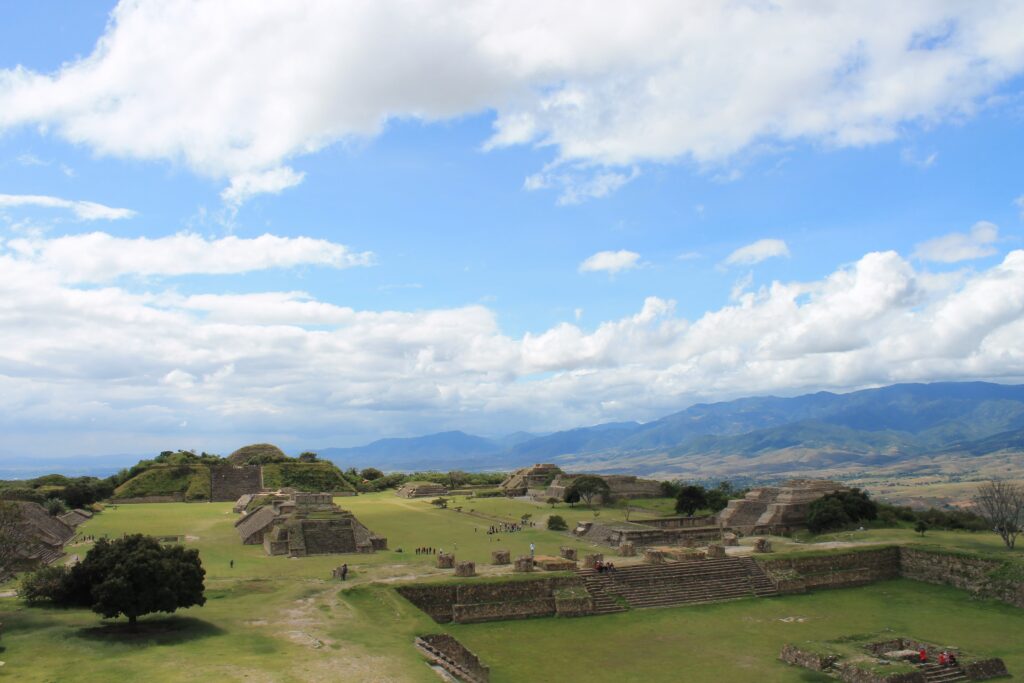
The oldest known lunar day count in Mesoamerica may have been hiding in plain sight on the carved stones of Monte Albán.
Researchers have decoded a long-debated Zapotec symbol known as “Glyph W,” revealing that it recorded the visible age of the moon more than 2,200 years ago. The discovery places a series of Zapotec calendrical records between 496 and 221 BCE, making them 857 years older than the earliest known Maya lunar count.
For nearly a century, scholars knew the sign mattered, but not exactly how. Now a study by John Justeson of the University at Albany, SUNY, and Justin Patrick Lowry of SUNY Plattsburgh argues that Glyph W counted the evenings since the first crescent moon appeared after the new moon. In doing so, it turns several stone inscriptions from Monte Albán into some of the earliest written evidence for lunar astronomy in the ancient Americas.
Glyph W Opens a Lunar Trail
Glyph W was first identified by Mexican archaeologist Alfonso Caso in 1928, but its meaning remained unresolved for nearly a century. Earlier explanations tried to connect the sign with the 260-day divinatory calendar or the 365-day Mesoamerican year. The new study argues that those interpretations do not fit the surviving data.
Justeson and Lowry reached a different conclusion after examining fully preserved inscriptions that combine three elements: a date in the 260-day divinatory calendar, a year name within the 52-year Calendar Round, and Glyph W followed by a numerical coefficient written with bars and dots.
The key was rhythm. When the researchers compared intervals between dated inscriptions, the numbers attached to Glyph W rose and fell in a cycle very close to 29.53 days, the mean length of a lunar month. In practical terms, W-1 marked the first visible evening of the crescent moon, and later numbers counted the evenings that followed.
This was not a lunar calendar in the modern sense. The Zapotecs did not replace their sacred 260-day count or the 365-day year. They added a third register, one that tied ritual or political events to the visible life of the moon.
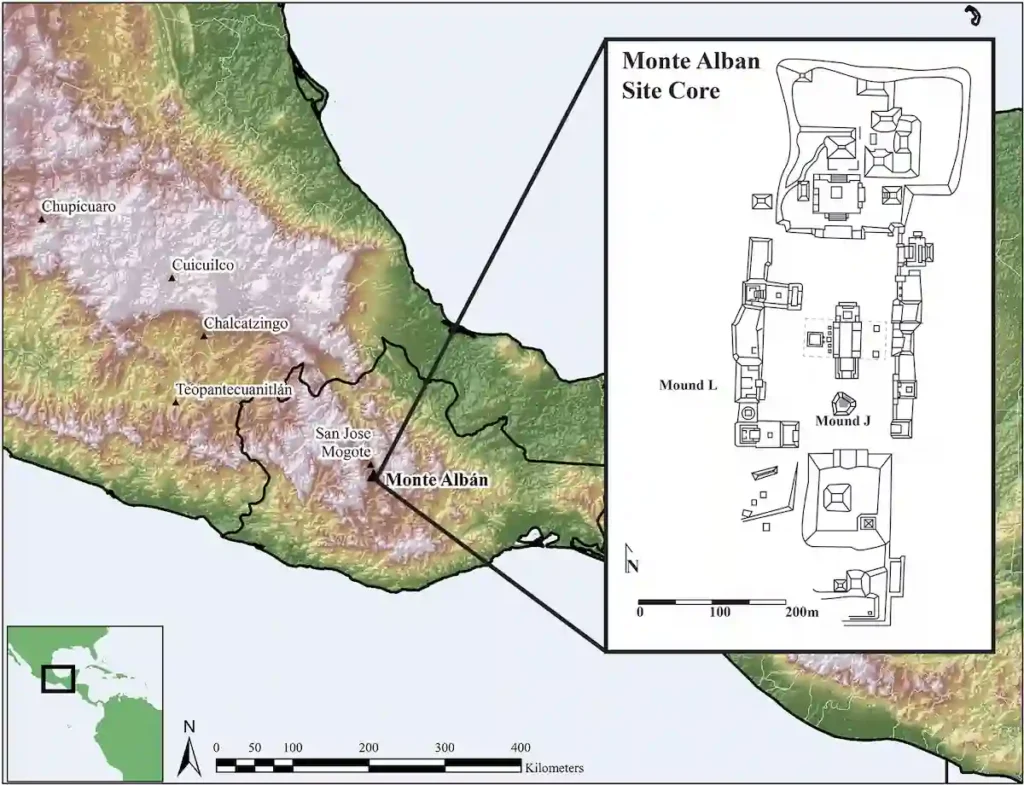
Map of Oaxaca showing the location of Monte Albán and the core of the ancient Zapotec site, including key plaza structures and Mound J. Based on Urcid (2001), Levine et al. (2021), and Urcid and Joyce (2014). Credit: J. Justeson, J.P. Lowry, 2026
Monte Albán and the Zapotec World
Monte Albán was not a marginal settlement. Founded on a flattened hilltop above the Oaxaca Valley, it became one of the earliest major urban centers in Mesoamerica. Its plazas, temples, tombs, carved monuments, and elite residences made it the ceremonial and political heart of Zapotec civilization for centuries.
The Zapotecs developed one of the earliest writing traditions in the Americas. Their inscriptions are not simple decorations. They record names, dates, titles, conquests, ritual actions, and political memory. The new lunar reading of Glyph W strengthens the idea that Monte Albán’s scribes were working with a sophisticated system of historical notation long before the Classic Maya cities reached their height.
That matters because public attention often treats Maya astronomy as the starting point for complex Mesoamerican sky knowledge. The Zapotec evidence shows a deeper and more geographically varied history. Oaxaca was not waiting for later Maya or Central Mexican traditions. It was already producing its own written astronomy in the Preclassic period.
Two Calendars, One Moon
Like other Mesoamerican peoples, the Zapotecs used a 260-day divinatory calendar and a 365-day year. The 260-day count combined 13 numbers with 20 named days, many associated with animals, natural forces, or ritual concepts. The 365-day year was divided into 18 units of 20 days, followed by five additional days.
These two calendars met in a 52-year Calendar Round. A particular day and year combination would repeat only after 18,980 days. That structure allowed Zapotec scribes to anchor events within a long cyclical framework.
The study shows that Glyph W added another layer. If a text recorded a divinatory date, a year name, and a lunar coefficient, researchers could calculate not only the relative interval between events, but also where those events might fall in real time.
Seven possible chronological sequences initially fit the astronomical visibility of the crescent moon at Monte Albán between 650 and 50 BCE. But only one sequence also matched what is known from the Zapotec calendar documented in the colonial period. That surviving fit places the inscriptions between 496 and 221 BCE.
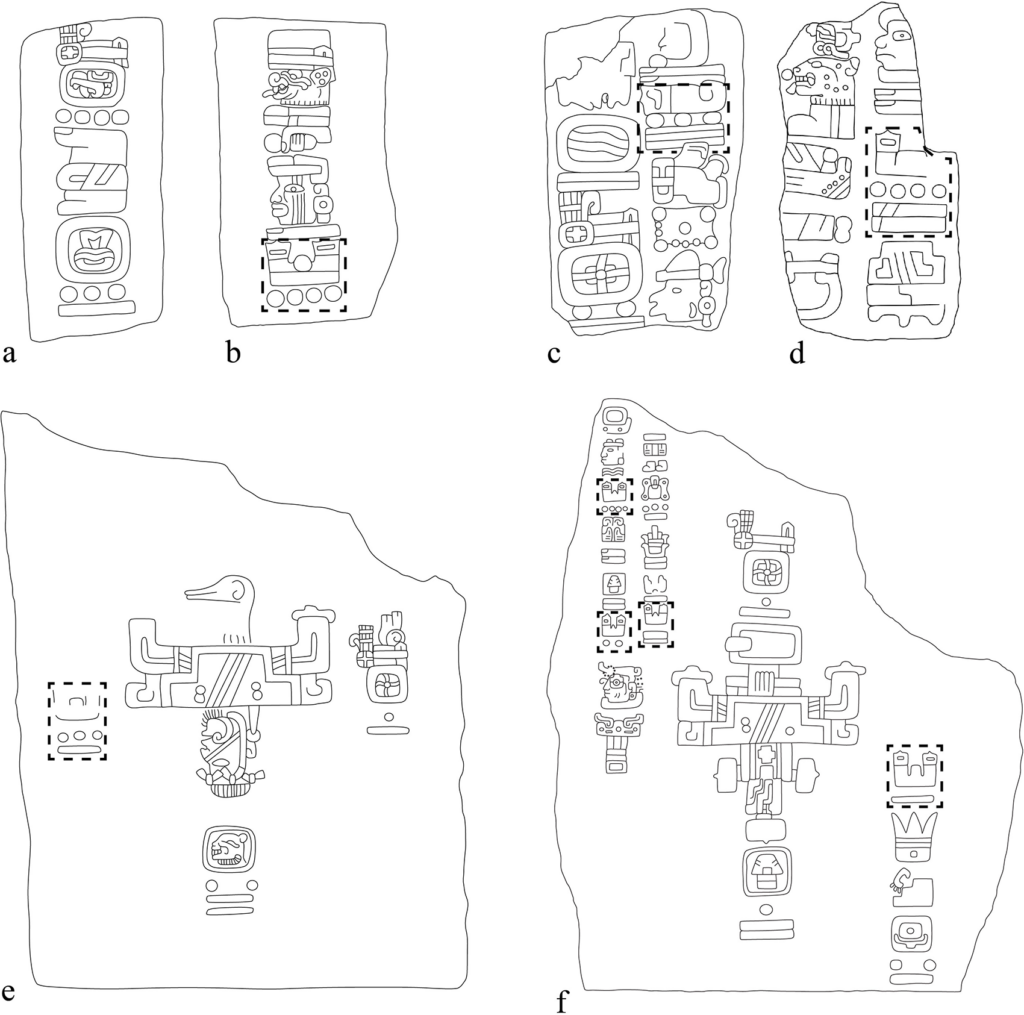
Credit: J. Justeson, J.P. Lowry, 2026
A Calendar That Began at Noon
One of the most striking details is not only what the Zapotecs counted, but when their day began. Colonial sources from the 16th century suggest that Zapotec divinatory dates began around noon. The new astronomical model indicates that this practice was already in use by at least the late third century BCE.
The logic is technical but important. The first crescent moon becomes visible shortly after sunset. If the divinatory day changed at noon, an event in the afternoon and an event the next morning could fall under different calendrical conditions in a way that affects the recorded lunar number. The researchers found that the offsets in the inscriptions make sense if the Zapotec day began around midday.
This also helps explain a ceremony connected with the “return of the year-bearer,” a key moment on the 261st day of the year. The evidence suggests that such a ceremony was being held in the afternoon around 222 BCE.
Older Than the Maya Lunar Series
The closest parallel to the Zapotec lunar count appears in Maya inscriptions, where the so-called Lunar Series became a standard feature of Classic-period texts. The earliest securely known Maya example dates to 361 CE at Naachtun in Guatemala.
The Monte Albán evidence is far older. If the earliest Zapotec lunar record in the study dates to 496 BCE, then Oaxaca preserves lunar day counting 857 years earlier than the Maya example. That does not mean Maya astronomy was copied directly from the Zapotecs, but it does show that the intellectual tools behind lunar record keeping were already present in Mesoamerica centuries before they appeared in Maya monumental writing.
The discovery also reframes Monte Albán’s inscribed monuments. The monoliths from Mound L and the orthostats associated with Building J were not only political records. They were also records of sky time, connecting rulership, ceremony, and the moon’s changing visibility above the Oaxaca Valley.
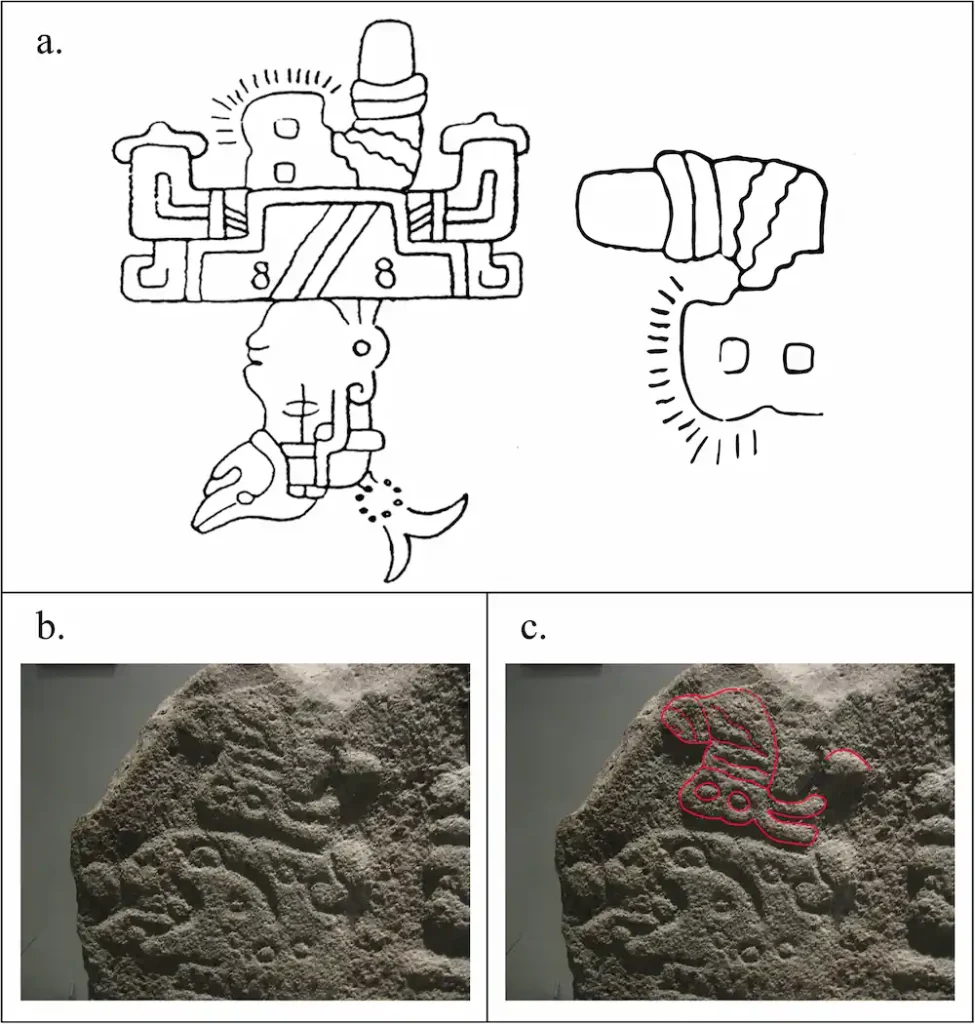
A Sharper View of Early Mesoamerican Astronomy
The decoded Glyph W system gives archaeologists something rare: a way to connect early Zapotec inscriptions to absolute time. Instead of treating the dates as isolated ritual notations, the study places them within a real chronological sequence across nearly three centuries.
It also restores some of the intellectual weight of Zapotec civilization. These were not passive observers of the sky. They tracked the moon carefully enough to embed lunar visibility into public inscriptions, alongside sacred dates and named years.
For readers today, the discovery is a reminder that ancient calendars were not abstract tables. They were instruments of authority. They told communities when ceremonies should occur, when rulers could be remembered, and how human events fit into a larger cosmic order.
More than 2,200 years ago, Zapotec scribes at Monte Albán were doing exactly that. With Glyph W, they left a lunar signature in stone, one that has only now been read with enough precision to change the history of Mesoamerican astronomy.
Justeson, J., & Lowry, J. P. (2026). A Lunar Day Count at Monte Alban and the Chronology of Early and Middle Preclassic Zapotec Hieroglyphic Texts (ca. 496–221 BCE). Latin American Antiquity, 1–23. doi:10.1017/laq.2025.10148
Cover Image Credit: Monte Alban’s panorama. David ConFran – Wikipedia Commons
