
Archaeologists have unearthed a monumental marble statue believed to be roughly 2,500 years old at Sardis Ancient City in Turkey’s Manisa province — the legendary capital of the Lydian Kingdom, a civilization so associated with wealth that the phrase “rich as Croesus,” named after its most famous king, is still used today.
Sardis is credited by historians as the place where the world’s first coined money was struck in the 7th century BCE, an innovation that transformed trade across the ancient world. The city later became the satrapal capital of the Achaemenid Persian Empire’s western province and sat at the western end of the Royal Road, the great highway linking Anatolia to the Persian heartland.
Centuries afterward, Sardis was also named among the seven churches of Asia in the Book of Revelation, a testament to how many layers of history the site has passed through. Today it remains one of Turkey’s richest archaeological centers, and the newly discovered statue is already being called one of the most significant finds in Anatolian archaeology in recent years.
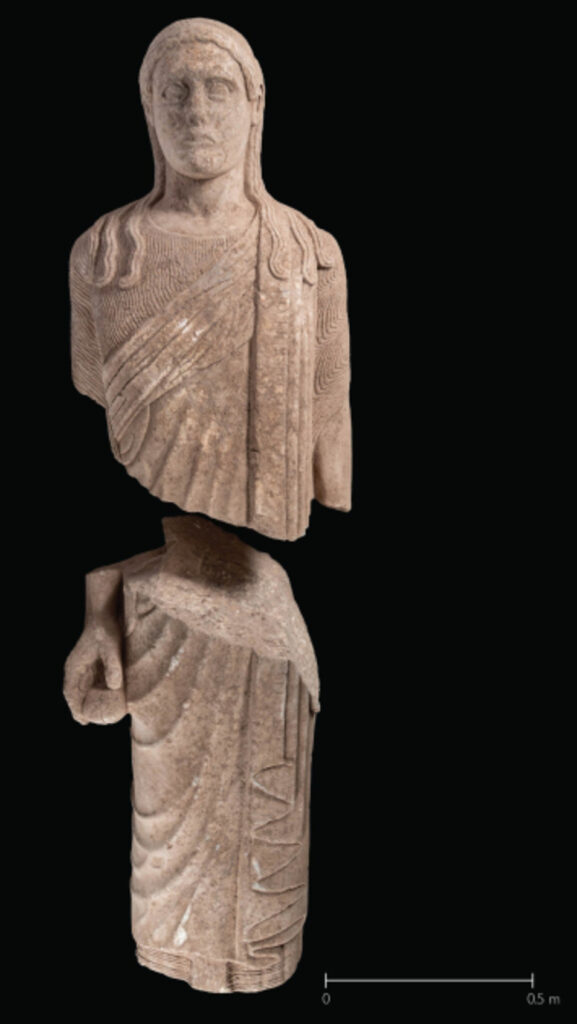
Standing 2.2 meters (about 7.2 feet) tall, the statue depicts a standing young man and dates to the first half of the 5th century BCE. Turkey’s Minister of Culture and Tourism, Mehmet Nuri Ersoy, announced the find on social media, describing it as a discovery that will shed new light on the ancient culture of the region. The excavation itself was carried out in the Salihli district under the coordination of the General Directorate of Cultural Heritage and Museums.
An Unusually Well-Preserved Figure
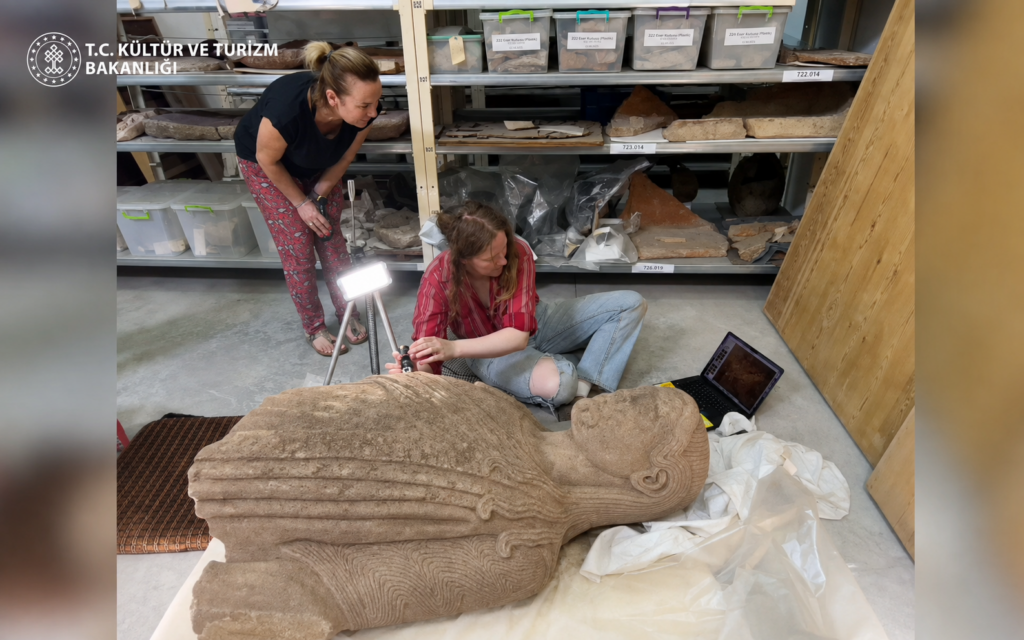
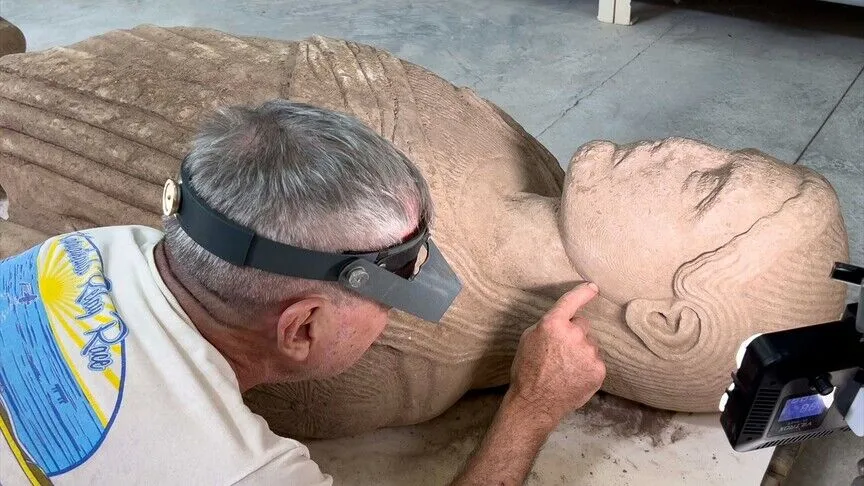
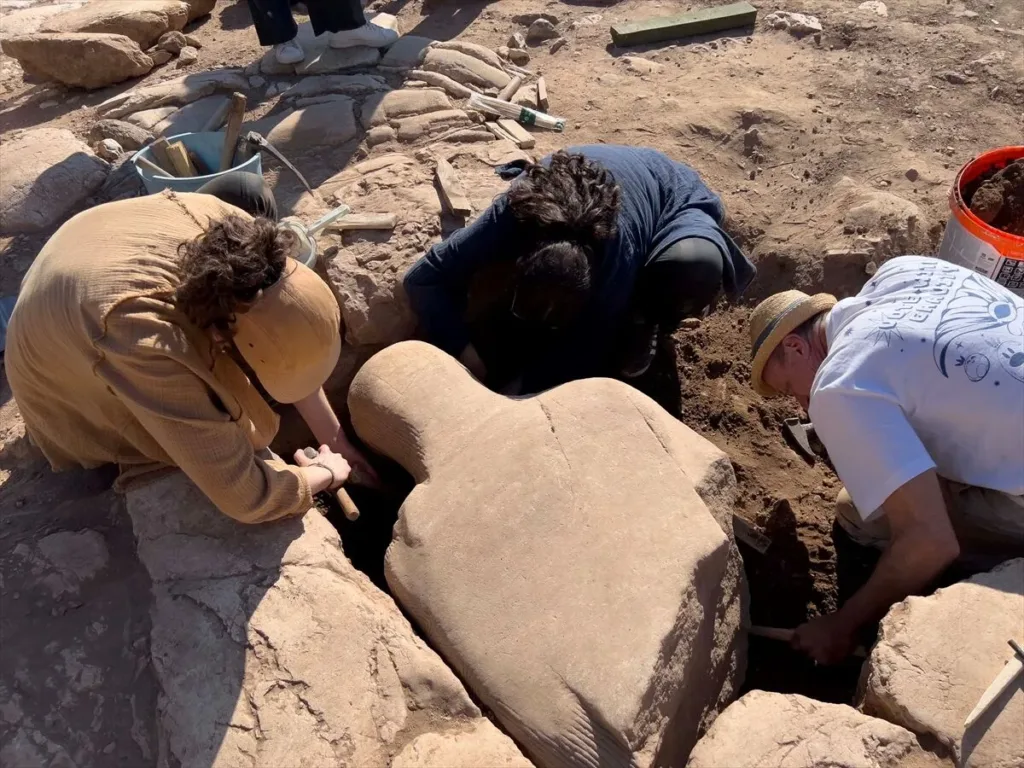
What makes the statue remarkable is not just its size, but its condition. It was found in two large pieces, with the feet and a handful of smaller fragments still missing — yet the face and finer details survived in striking clarity. The reason lies in an accident of history: during the Roman period, the statue was repurposed as building material and placed face-down within the paving of Sardis’s colonnaded street. Buried and hidden from view for close to two millennia, that position shielded it from erosion, weathering, and the wear that typically erases the finer features of ancient sculpture.
The result is a statue whose facial features, hand anatomy, and drapery remain unusually crisp for its age. The figure’s upright stance and long hair echo sculptural conventions of the 6th century BCE, while the precise modeling of the hands and face points to a slightly later date, in the early 5th century BCE.
Its clothing is especially telling. The young man wears a thick himation layered over a light chiton, beneath which is a distinct garment marked by horizontal lines — a combination not seen in comparable statues from Anatolia or mainland Greece.
Rather than following a single artistic tradition, the sculpture seems to fuse classical Aegean forms with local Lydian dress, a detail experts see as a direct signature of Sardis’s own hybrid visual culture. In his right hand, the figure appears to be holding a piece of fruit, quite possibly a quince, likely intended as an offering to a god or goddess — a small but evocative clue to the religious life of the period.
Significance for Anatolian Archaeology
Statues of this scale and condition from the early Classical period are exceptionally rare anywhere in the Mediterranean, which is part of what makes this discovery stand out. Researchers expect it to offer fresh insight into the elite society of Sardis in the early 5th century BCE, a moment when the city sat at the crossroads of Persian, Lydian, and Greek influence — and when its ruling class was shaping a visual identity that borrowed from all three.
Since ancient marble sculptures were frequently painted, conservation specialists, including experts in ancient polychrome sculpture, will now carry out careful scientific analysis to search for any surviving traces of pigment on the statue’s surface and in the surrounding soil. The marble is currently covered by a thick, hardened layer of sediment built up over centuries underground, so cleaning will proceed cautiously to avoid damaging any pigment that may remain.
Once cleaning, scientific study, and restoration are complete, the statue will go on permanent display at the Manisa Museum.
Source: Statement by Turkey’s Minister of Culture and Tourism, Mehmet Nuri Ersoy, via social media, and the Turkish Ministry of Culture and Tourism.
