
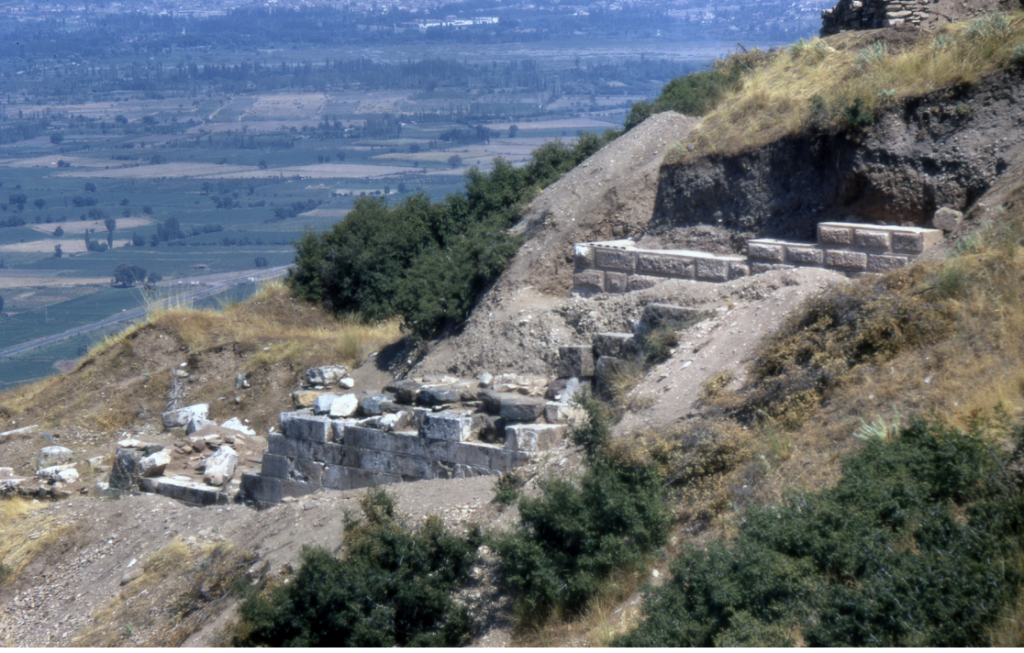
New research at Sardis reveals that Lydian builders created sophisticated stepped urban terraces under King Alyattes before the famous palace platforms of Croesus.
Long before the name of Croesus became linked with legendary wealth, Sardis was already being reshaped stone by stone.
A new archaeological study argues that the Lydian capital in western Türkiye developed a sophisticated system of stepped urban terraces during the reign of King Alyattes, in the late 7th and early 6th centuries BCE. These terraces did more than support buildings on difficult terrain. They transformed the rugged hills of Sardis into controlled, monumental spaces that announced royal power across the city.
The study, written by Güzin Eren and published in Arkeoloji Dergisi, focuses on a little-known architectural phase that came before the famous high platform terraces of Croesus. Those later terraces turned entire hills into massive podiums for elite and possibly palatial buildings. But Eren’s research shows that this architectural language did not appear suddenly. It evolved from an earlier Lydian system of shorter, multi-level stepped terraces.
A capital built on difficult ground
Sardis, the capital of Lydia, was one of the most powerful cities of Iron Age Anatolia. Its steep hills, ridges and slopes created both a challenge and an opportunity. For Lydian builders, the city’s uneven topography became a material to be shaped.
During the reigns of Alyattes and Croesus, Lydia grew from a regional kingdom into a major Anatolian power. Archaeology at Sardis reflects that political expansion. Monumental fortifications, elite buildings, urban terraces and luxury objects all point to a city undergoing rapid transformation.
The new study places Alyattes at the center of this earlier architectural phase. Instead of focusing only on Croesus, whose reign in the 6th century BCE has often dominated discussions of Lydian monumentality, the research suggests that Alyattes’ building program created the technical and visual foundation for what came next.
The missing step before Croesus
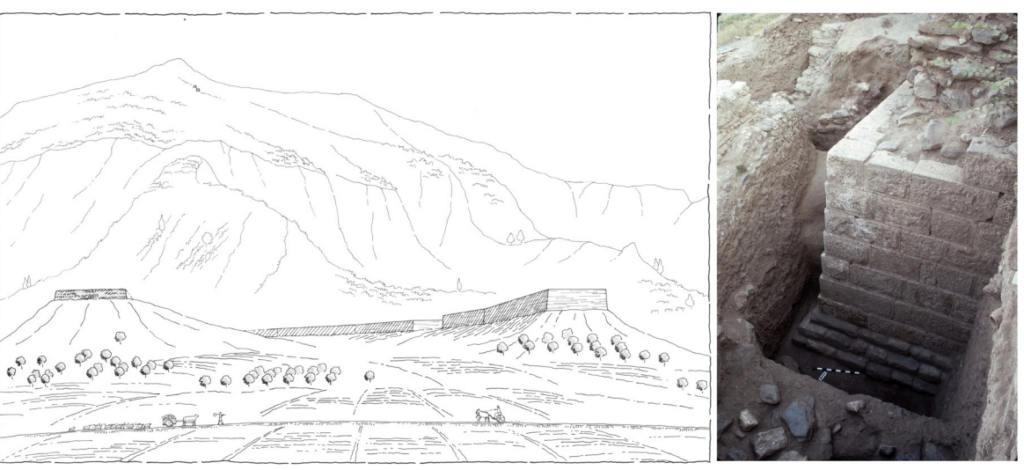
The best-known Lydian terraces at Sardis are the high-rising platform structures built during Croesus’ reign. These massive constructions wrapped around hills such as ByzFort and Field 49, creating elevated podiums that likely supported royal buildings overlooking the lower city.
But Eren identifies an earlier system beneath and around this later phase. These stepped terraces were found in several areas of Sardis, including ByzFort, Field 49, the northern slopes of the Acropolis and Kagirlik Tepe outside the main fortified zone.
Their distribution is important. The terraces were not isolated retaining walls. They formed a broader urban design strategy. At ByzFort, three parallel terrace walls arranged the hillside into stepped platforms rising toward the summit. At Field 49, additional terraces were added below an earlier monumental boulder terrace. On the Acropolis, a system of parallel walls created a controlled ascent up the steep northern spur. At Kagirlik Tepe, similar terraces may have marked a special or sacred space near the later Temple of Artemis.
Together, they suggest coordinated planning across different parts of the city.
Engineering power into the landscape
The terraces shared several technical features. They were often placed inside shelves cut directly into bedrock. Their backs rested against vertical cuts in the natural slope, while their fronts were set into shallow foundation trenches. This method reduced the need for huge artificial fills and allowed builders to carve monumental order into the existing terrain.
The masonry was equally deliberate. The terraces used hammer-dressed limestone and sandstone blocks, arranged in regular courses. Many had slight setbacks between courses, creating facades that leaned subtly inward for stability. In some cases, blocks were fastened with lead clamps.
One of the study’s most striking observations concerns orientation. The terraces followed strict axial alignments even across difficult slopes. Where they turned to follow the hill, the angles repeatedly fell between roughly 160 and 165 degrees. Such consistency suggests centralized planning, careful measurement, and a trained building workforce.
This was not improvised hillside construction. It was architecture as statecraft.
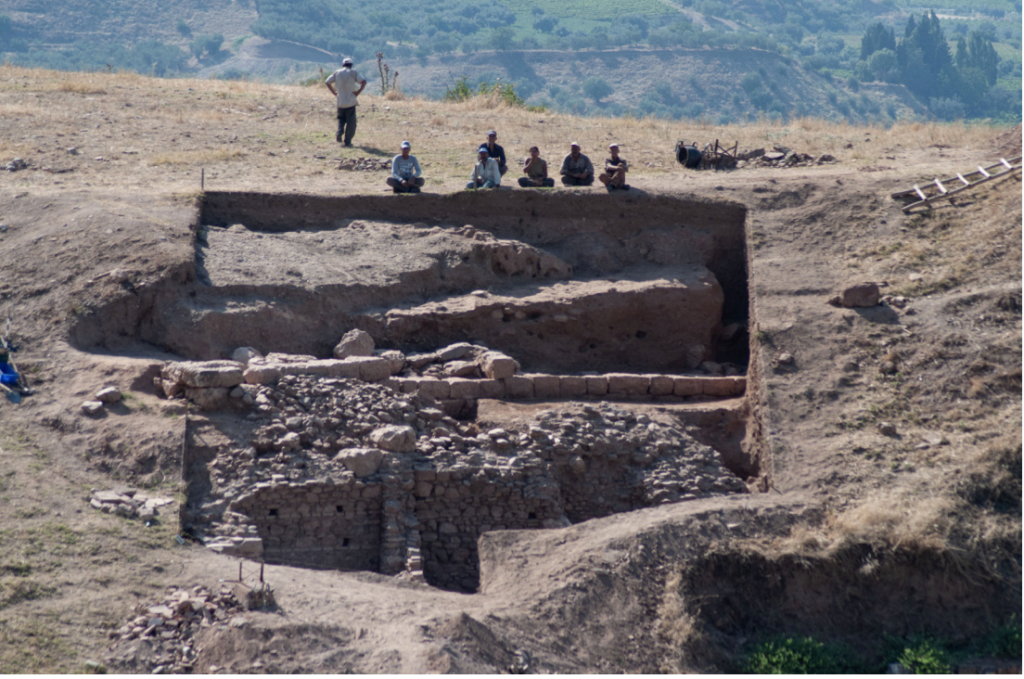
View of the higher-tier terraces at the center of ByzFort. © Archaeological Exploration of Sardis/President and Fellows of Harvard College. Credit: Eren, G., 2026, Arkeoloji Dergisi
Lydia between Anatolia, Assyria, and the Aegean
The stepped terrace system also reveals Sardis as a city connected to wider architectural traditions. Eren compares the Lydian terraces with monumental platforms and retaining structures in the Near East, western Anatolia, and the Aegean.
There are parallels with Assyrian and Syro-Anatolian palace platforms, Phrygian citadel constructions, and Ionian sanctuary terraces. Yet the Sardis system appears distinctive in the way it used stepped platforms to reshape elite urban zones. Unlike many Near Eastern platforms, these Lydian terraces were not simply massive retaining systems for large fills. They were cut into the natural landscape and arranged as visible architectural steps.
This combination of local innovation and external influence fits the historical picture of Alyattes’ Lydia. His kingdom was expanding militarily, economically, and diplomatically. Sardis stood between the Aegean world, inland Anatolia, and the Near East. Its architecture seems to have absorbed ideas from multiple directions while turning them into a distinctly Lydian form.
A royal landscape before the fall
The terraces remained in use until the Persian capture of Sardis in 547/6 BCE. In the palatial sector, some of the earlier stepped terraces were later modified or replaced by the taller podium-style terraces associated with Croesus. At ByzFort, the evidence shows earlier terrace walls partly dismantled, reused and realigned during this later construction phase.
That sequence matters. It shows that Croesus’ monumental terraces were not a sudden architectural revolution. They were the outcome of earlier experiments in stone, slope and royal display.
In that sense, the stepped terraces of Alyattes were true “stepping stones.” They helped Lydian builders move from multi-level hillside platforms to the more imposing podiums that became emblematic of Sardis. They also show that Lydia’s urban ambition was already mature before Croesus reached the throne.
The result is a sharper image of Sardis at the height of Lydian power. It was not only a wealthy capital. It was a planned, engineered, and visually staged royal city, where architecture turned natural hills into political monuments.
Eren, G. (2026). Stepping Stones: Stepped Urban Terraces of Sardis in the Late 7th and Early 6th Centuries BCE. Arkeoloji Dergisi, 36, 75–99. https://doi.org/10.51493/egearkeoloji.1885215
Cover Image Credit: Eren, G., 2026, Arkeoloji Dergisi
