
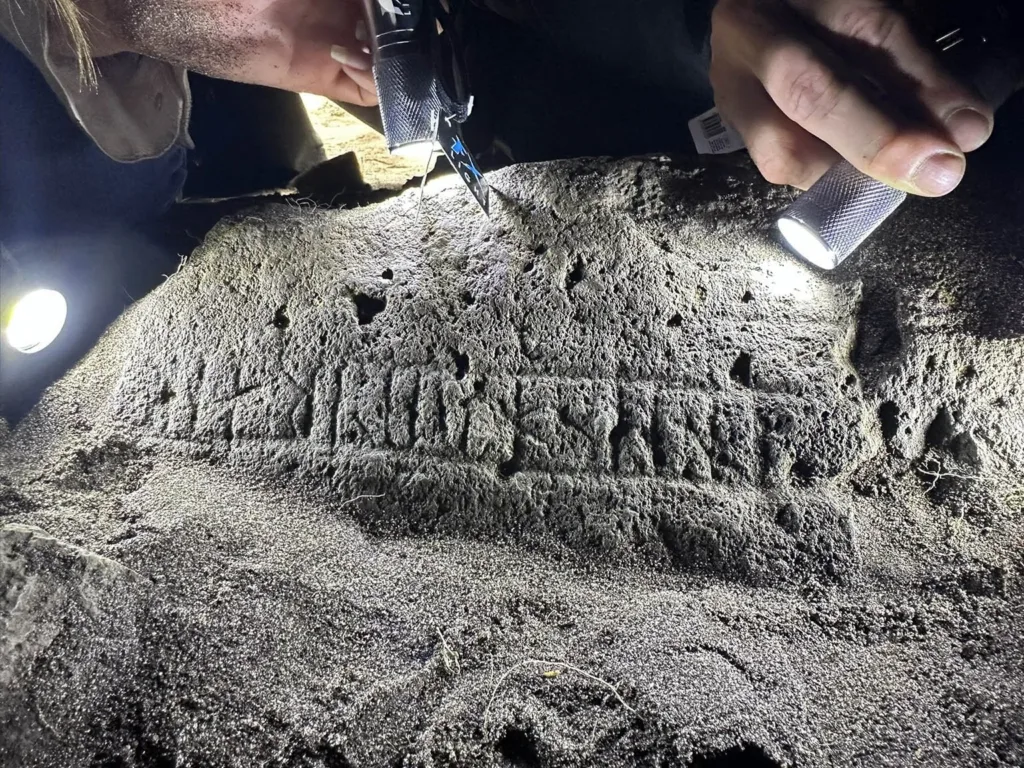
Archaeologists in the Faroe Islands have made a discovery so uncommon that experts are calling it a milestone moment for the small North Atlantic nation’s history: a runestone, pulled from the floor of what may once have been a medieval chapel.
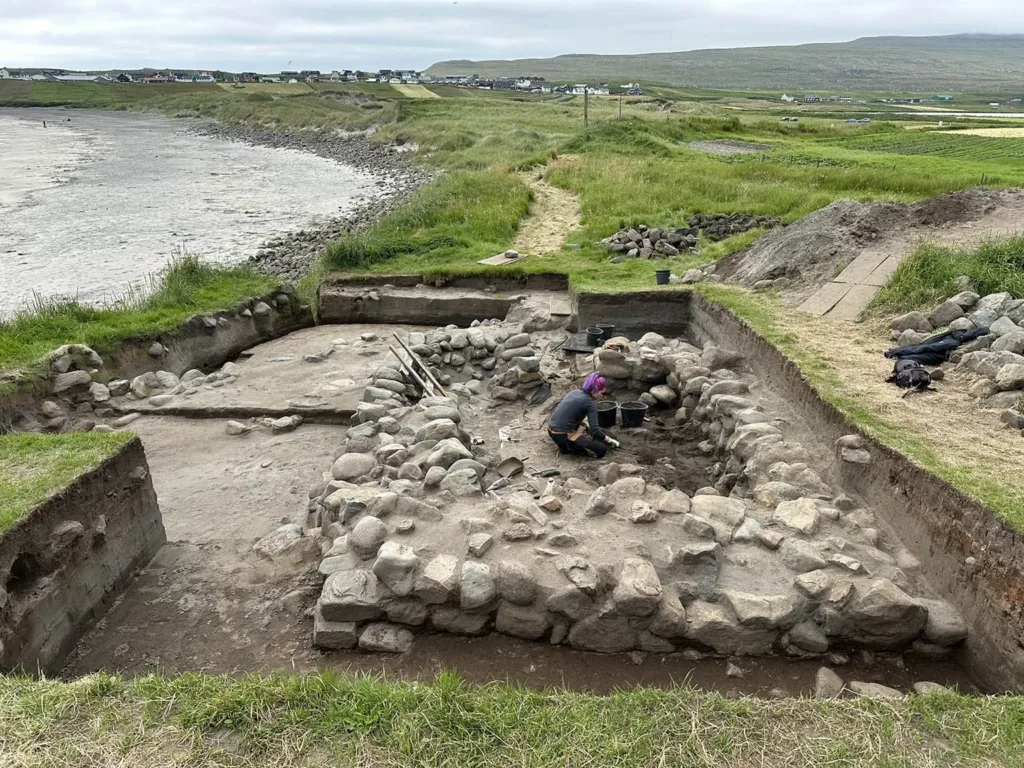
The find took place at Á Sondum, an archaeological site in the village of Sandur on the island of Sandoy, in the southern Faroe Islands. The Faroe Islands are a self-governing archipelago within the Kingdom of Denmark, tucked roughly halfway between Scotland and Iceland: a remote setting that makes any written record from the deep past especially precious.
A Stone That May Speak From the Grave
Runestones are exceptionally rare in the Faroe Islands, and staff from Tjóðsavnið, the National Museum of the Faroe Islands, immediately recognized the significance of what they’d found during excavations this past July. The stone had been built into the floor of a structure uncovered during this summer’s dig: a placement that itself raises intriguing questions about how, and why, it ended up there.
National Museum archaeologist Helgi Michelsen has offered an early, tentative reading of part of the inscription: “Her hvílur…” — Old Norse for “Here lies…” or “Here rests…” It’s a phrase loaded with meaning. If the reading holds up, it suggests the stone once served as a memorial or grave marker, though its full story is still locked in the runes.
To unlock that story, the museum has called in a specialist rune scholar, expected to arrive in the Faroe Islands in late August to examine the stone in detail. Until then, much about its origin and inscription remains an open question.
Time is also a factor. Having spent centuries buried in soil, the stone is now fragile and exposed to the elements. To protect it, archaeologists have moved it from the excavation site to the National Museum, where it can be preserved and studied under controlled conditions.
Clues to a Christian Past
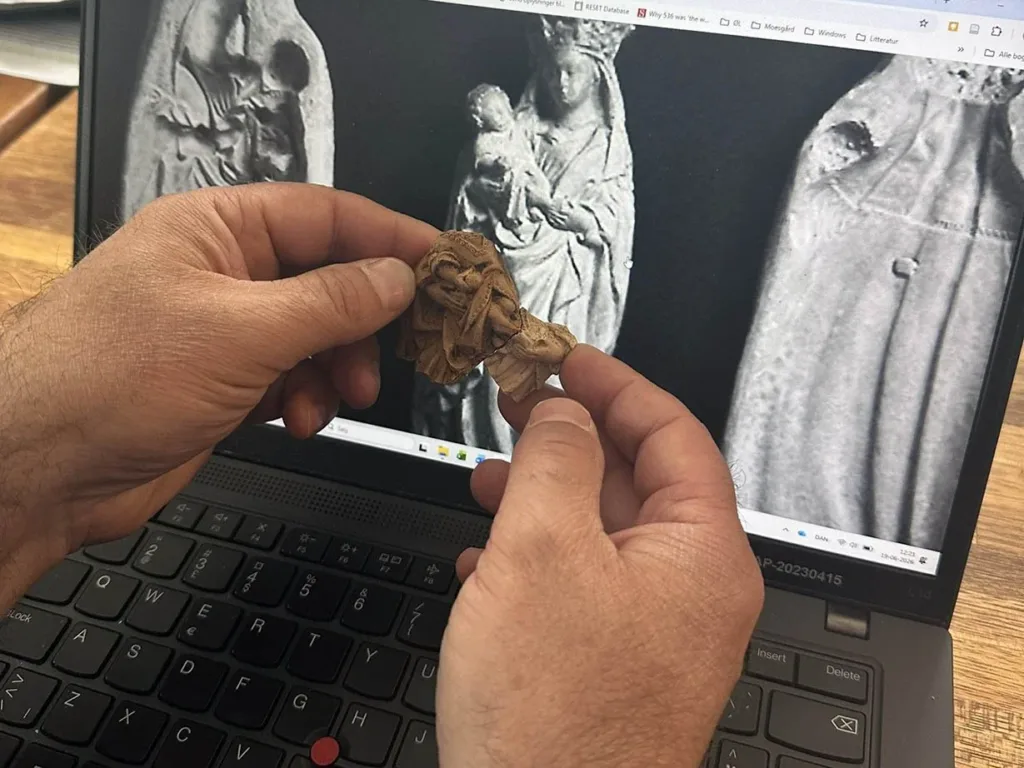
The runestone isn’t the only clue pointing to the building’s original purpose. Alongside it, archaeologists recovered fragments of a small statue depicting the Virgin Mary holding the Christ Child, as well as a kola — a small lamp traditionally fueled by fat or oil.
Together, these objects suggest the building may have had a religious function tied to early Christian worship. Its architecture supports that theory: the structure runs east to west, with its entrance at the western end — a layout characteristic of medieval chapels and prayer houses across the region.
Researchers currently believe the building may have served as a medieval oratory, a small house of prayer. Similar structures have been identified elsewhere in the Faroe Islands, including the oratory at Bønhúsberg on Mykines, Bønhústoft in Leirvík on Eysturoy, and a ruined site at Bakki in Velbastaður on Streymoy. These comparisons give archaeologists a useful framework for interpreting the newly uncovered building — though whether the runestone marked an actual burial, served some other purpose within the chapel, or was later repurposed as flooring material is still unknown.
Piecing Together Centuries of Settlement
Á Sondum is no stranger to important discoveries. The site has long been recognized as a key location for understanding the Faroe Islands’ settlement history, with previous excavations revealing evidence of continuous human activity stretching from before the Viking Age, through the medieval period, and into more recent centuries.
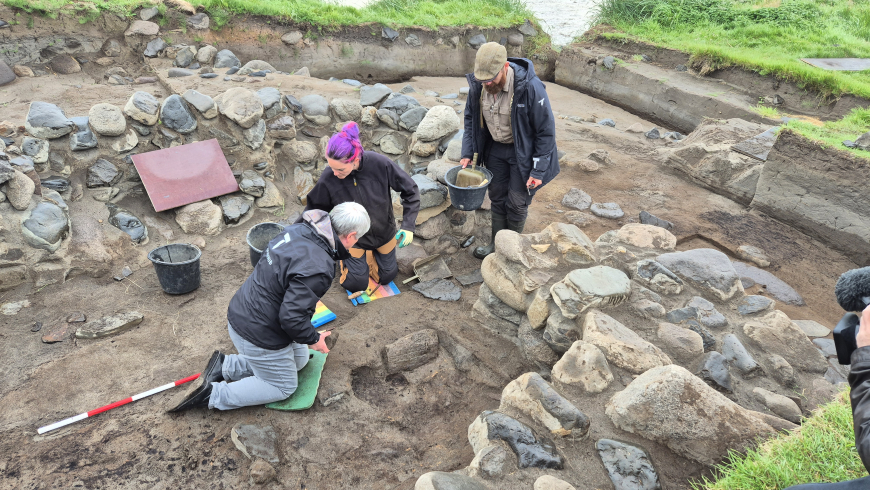
This summer’s excavation is being carried out by the National Museum in partnership with Aarhus University and Moesgaard Museum in Denmark. Archaeology students from Aarhus University have taken part in the dig for two consecutive summers as part of their academic training, with travel support provided by Smyril Line.
Work at Á Sondum is set to continue until the end of August, and the museum has extended an open invitation to residents and curious visitors to observe the excavation while it’s underway. Archaeologists say they’re happy to explain their findings when conditions allow, though visitors are asked to stay out of the excavation area itself — the exposed remains are delicate and can be damaged easily.
The Runestone Will Be 3D-Scanned for Preservation and Study
Alongside the excavation news, Faroese broadcaster KVF reported a detail that didn’t make it into most international coverage: the newly discovered runestone at Á Sondum is set to undergo 3D scanning. The goal is to create a precise digital model of the stone before its fragile surface deteriorates any further after centuries spent buried in soil.
The digital model isn’t just a preservation backup — it’s also expected to become a working research tool. By adjusting virtual lighting and shadow angles on the scanned surface, researchers can bring out shallow or worn carvings that are difficult to see with the naked eye or under fixed natural light. This kind of raking-light analysis is a well-established method for reading weathered runic inscriptions.
That capability matters here because part of the stone is broken and some of the runes are missing or damaged. So far, archaeologists at the National Museum say they can tentatively make out the words “hvílir” (rests) and “her” (here) — fragments consistent with a memorial or grave-marker phrase like “here rests.” A full reading, though, will likely depend on close inspection by a specialist and on what the 3D model reveals about faint or obscured letterforms.
The scanning effort runs in parallel with the stone’s physical move to the National Museum (Tjóðsavnið) in Tórshavn, where it can be studied and conserved under controlled conditions. Together, the digital and physical preservation tracks are meant to buy time until the visiting rune scholar arrives in late August to attempt a fuller translation.
The Bigger Picture
For a nation with a relatively small archaeological record of runic inscriptions, this discovery offers a rare, tangible link to the people who lived, worshipped, and perhaps were laid to rest in Sandoy centuries ago. As the rune specialist’s visit approaches and analysis continues, the stone may yet reveal more about a name, a memory, or a community that time had otherwise erased.
