
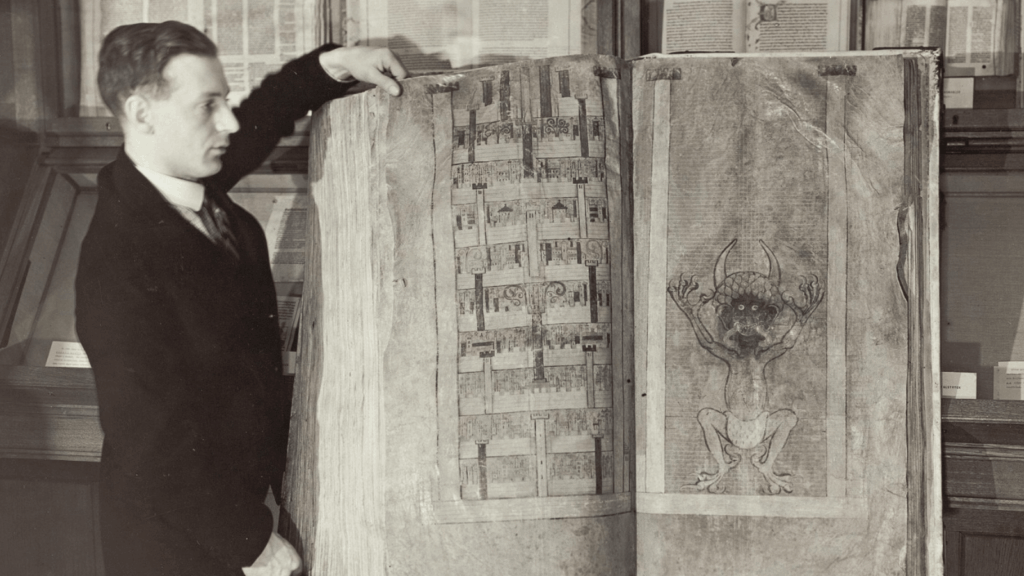
A condemned monk, a bargain with the Devil and a book so enormous that no ordinary scribe could have completed it alone. That is the legend attached to the Codex Gigas, the largest surviving medieval manuscript and one of medieval Europe’s strangest books.
At the center of the story is Herman the Recluse. According to tradition, Herman broke his monastic vows and was sentenced to be sealed alive inside a wall. To escape, he promised to create in one night a book containing the sum of human knowledge. As midnight approached, he supposedly offered his soul to the Devil. The manuscript was finished before dawn, and Herman added a full-page portrait of his supernatural helper.
The tale made the Codex Gigas famous as the “Devil’s Bible.” Evidence inside the manuscript, however, points to a slower and more human achievement. The National Library of Sweden stresses that the supernatural account has no historical basis, although versions of the story were already circulating during the Middle Ages.
Who Was Herman the Recluse?
The scribe’s identity remains unknown. The name Herman appears in the manuscript’s necrology, a calendar recording deaths, beside the Latin designation inclusus. Often translated as “recluse” or “shut in,” the term created an apparent connection between Herman and the monk described in the legend.
Yet inclusus did not necessarily describe a prisoner. In medieval religious life, it could refer to someone who voluntarily lived in isolation for prayer, penance or spiritual discipline. Some recluses were formally enclosed in cells attached to monasteries, occasionally during ceremonies resembling symbolic funerals.
Herman may therefore have been a real monk, but no surviving evidence proves that he wrote the Codex Gigas. The National Library of Sweden, which holds the manuscript today, treats the identification as speculation rather than established history.
One Scribe, but Not One Night
The supernatural story is fiction, but one part is unexpectedly close to reality: almost the entire Codex Gigas appears to have been produced by a single person.
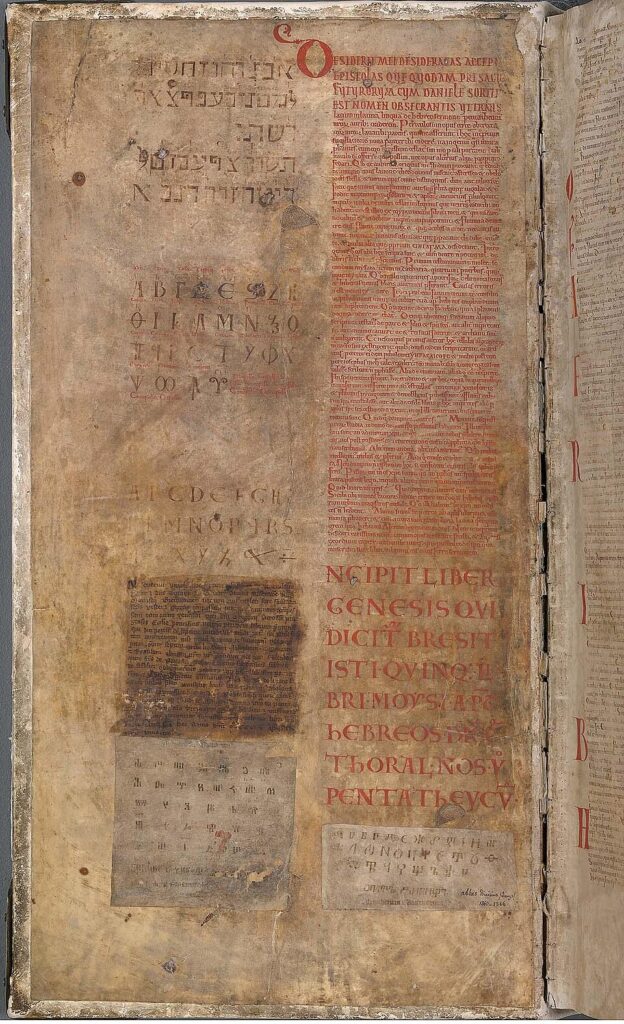
The handwriting remains remarkably consistent across hundreds of pages. The scribe used Carolingian minuscule, an older script already becoming outdated when the manuscript was created. Each page was ruled into two columns containing as many as 106 lines, while individual letters measure only about 2.5 to 3 millimeters high.
That consistency may have encouraged the belief that the book appeared suddenly. In reality, preparing parchment, ruling pages, copying texts and adding decoration may have taken at least 20 years and perhaps as many as 30. The manuscript could represent most of one scribe’s working life.
A Manuscript Built on a Giant Scale
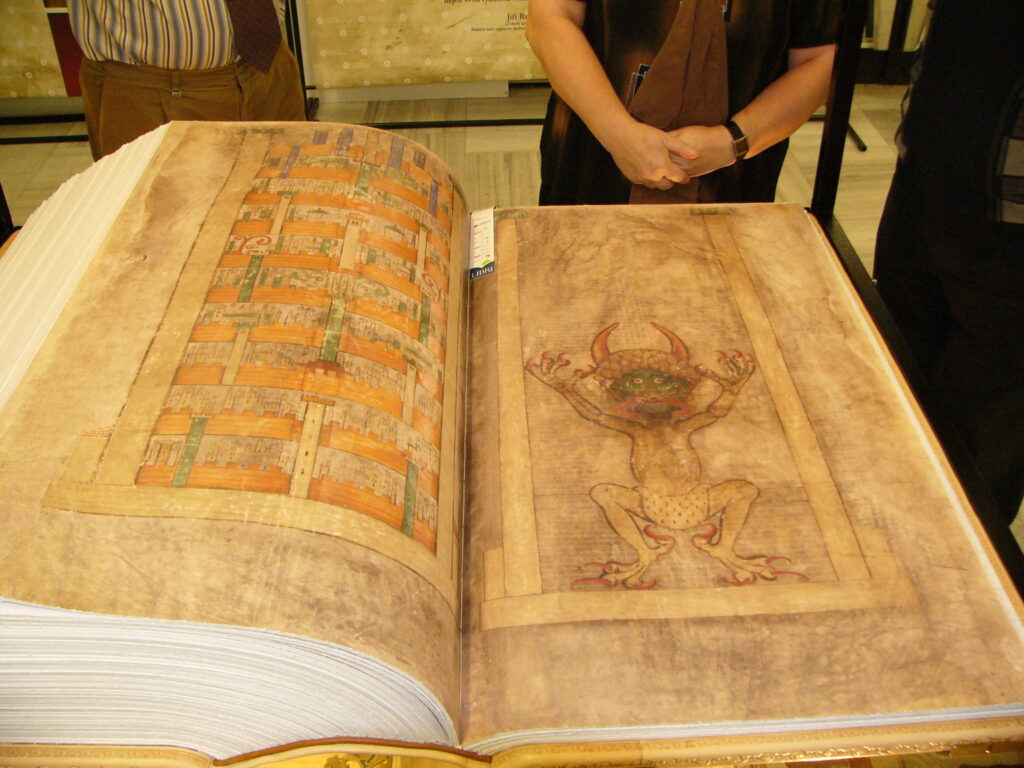
The name Codex Gigas means “giant book,” and the description is literal. The manuscript weighs about 75 kilograms and contains 310 parchment leaves, probably made from calfskin. Each leaf measures roughly 89 by 49 centimeters. Thick wooden boards, white leather, and elaborate metal fittings protect the volume.
Despite its size, the book was used. Notes added by later readers show that it was consulted rather than preserved solely as a ceremonial object. Its contents amount to a substantial medieval library bound into a single volume.
More Than a Bible
About half of the Codex Gigas contains the Old and New Testaments in Latin. The remaining pages combine history, medicine, encyclopedic knowledge, prayers, calendars and magical formulas.
The manuscript includes works by the Jewish historian Josephus, Isidore of Seville’s influential Etymologiae, medical texts including Ars Medicinae and the Chronicle of Bohemia by Cosmas of Prague. A five-page confession of sins appears alongside a calendar, a necrology and formulas intended to treat fever or help expose thieves.
The mixture may seem strange to modern readers, but medieval monasteries did not always separate religion, history, medicine and protective magic as sharply as later institutions did. The Codex Gigas was conceived as a collection of knowledge, not merely an oversized Bible.
Why Is the Devil Given a Full Page?
The manuscript’s most famous image faces a full-page representation of Heavenly Jerusalem. One side shows the ordered city of salvation; the other presents a solitary Devil crouching between two towers in an empty landscape.
The figure has horns, four fingers on each hand, four toes on each foot, and two long red tongues. It wears an ermine loincloth, a material associated with royalty, perhaps identifying the creature as the ruler of darkness. The facing pages create a deliberate contrast between salvation and evil.
The portrait is therefore not evidence of a satanic origin. It forms part of a moral sequence that also includes a confession of sins and texts concerned with protection from disease and misfortune. The image became the manuscript’s defining feature, but its original function was probably instructional rather than occult.
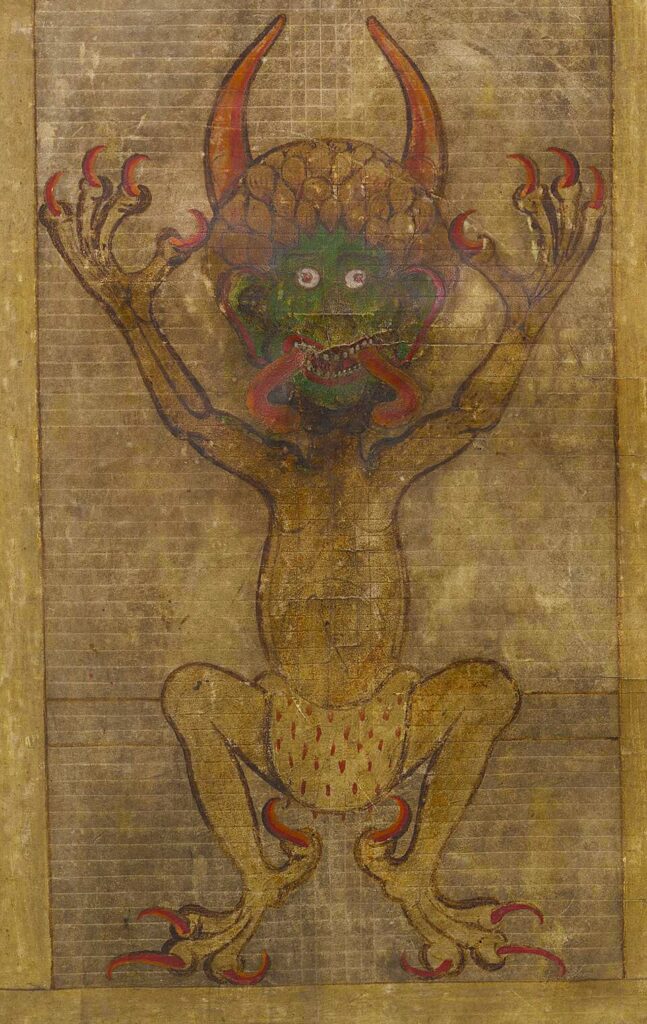
The manuscript’s most famous image faces a full-page representation of Heavenly Jerusalem. Credit: Michal Maňas – Public Domain
From Bohemia to Stockholm
The Codex Gigas was written in the Kingdom of Bohemia sometime between 1204 and 1230. Its first known owner was the Benedictine monastery of Podlažice, although the National Library notes that the relatively small and impoverished community may not have possessed the resources required to produce it.
The manuscript later entered Emperor Rudolf II’s collection in Prague. Swedish forces seized it as war booty during the Thirty Years’ War in 1648, and it reached Stockholm the following year.
It survived the 1697 fire at Tre Kronor palace after reportedly being thrown from a window. A later story claims that the enormous volume struck and injured someone standing below, although the National Library considers that detail uncertain. Damage to the binding, however, confirms that the book endured a violent escape from the burning palace.
Today the Codex Gigas is preserved at the National Library of Sweden. Its mystery no longer depends on believing that the Devil wrote it overnight. The more compelling possibility is that one medieval scribe, perhaps a religious recluse named Herman, devoted decades of his life to creating a book unlike any other.
National Library of Sweden. (2026a, July 16).
