
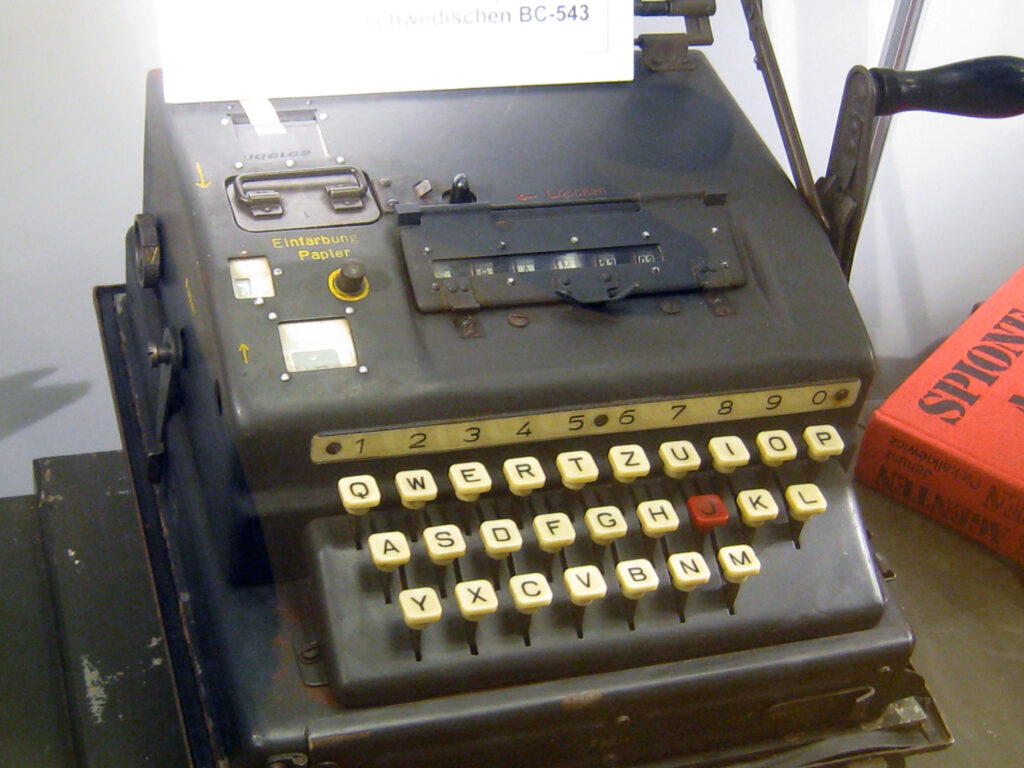
Lost Nazi encryption manuals of the Schlüsselgerät 41, a cipher machine more advanced than Enigma, have been discovered in Prague archives after 80 years.
Nearly eighty years after the end of World War II, researchers have uncovered a remarkable piece of cryptographic history hidden inside Czech archives. The long-lost original manuals for the Schlüsselgerät 41 (SG-41)—a highly secret German cipher machine considered more advanced than the famous Enigma—have finally been found, shedding new light on one of the most mysterious encryption devices of the war.
The discovery was revealed in a recent academic study by researchers Eugen Antal, Carola Dahlke, and Robert Jahn, who located the documents in two Prague institutions: the Military History Institute and the Security Services Archive. The files include operating instructions, encryption guidelines, and even original wartime key tables used by the German Wehrmacht in the final weeks of the war in 1945.
For historians and cryptographers, the find represents a breakthrough. For decades, the SG-41 had remained largely misunderstood due to the lack of technical documentation and the scarcity of surviving machines.
A Cipher Machine More Advanced Than Enigma
The Enigma machine became legendary after Allied codebreakers cracked its encryption during the war. Yet the SG-41, designed in 1941 by German inventor Fritz Menzer, was widely considered even more sophisticated.
Unlike Enigma’s electrical rotor system, the SG-41 relied on a purely mechanical design based on the pin-and-lug principle, a concept originally developed by Swedish cryptography pioneer Boris Hagelin.
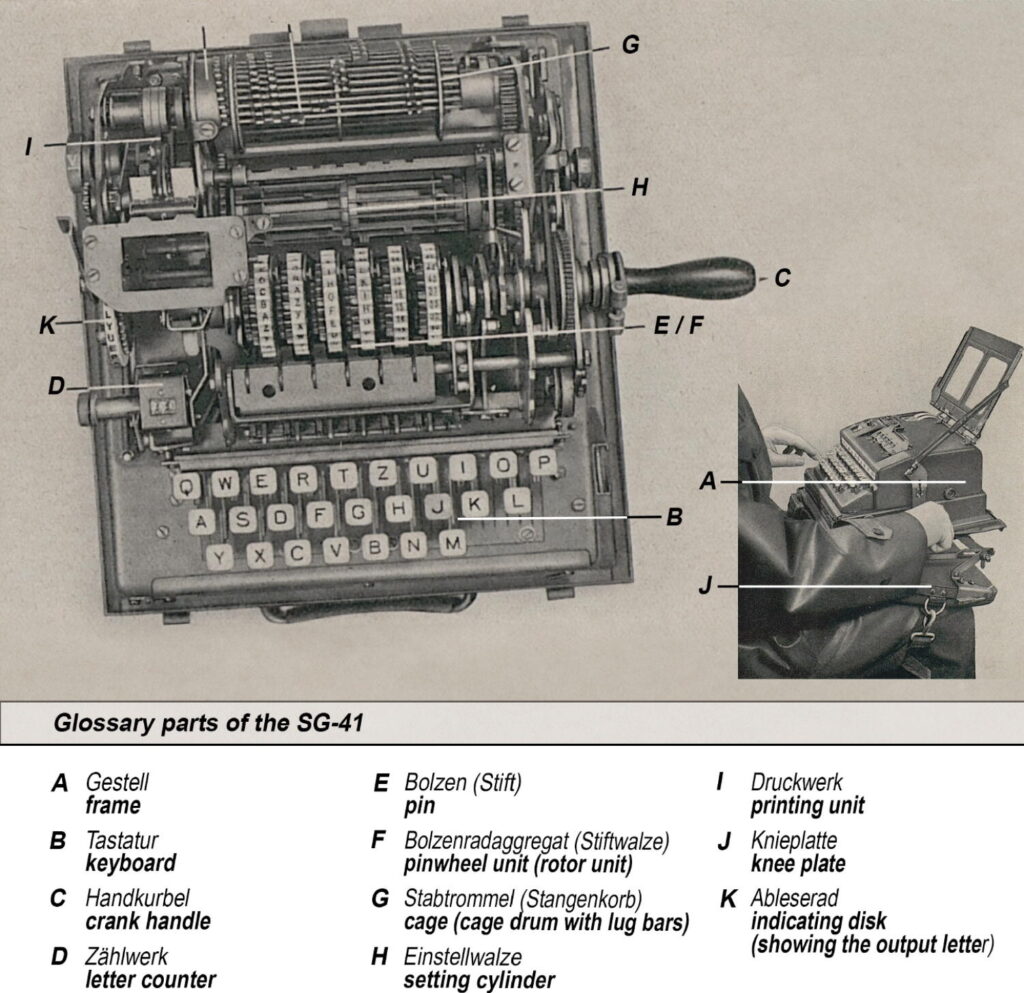
The device contained six rotating wheels with movable pins that could be set to active or inactive positions according to daily encryption keys. When an operator typed a letter on the keyboard, a mechanical system read the pin positions and produced a pseudo-random number. This number was then added to the plaintext letter to generate the encrypted output.
Decrypting the message required the reverse operation: subtracting the same value using an identically configured machine.
But Menzer’s design went far beyond Hagelin’s original concept.
Innovations That Confused Codebreakers
According to the researchers, the SG-41 incorporated two groundbreaking features that made it exceptionally difficult to analyze.
The first was an irregular stepping mechanism. In many cipher machines, rotors advance in predictable patterns. In the SG-41, however, the wheels influenced each other’s movement, meaning their positions changed in irregular ways. This made detecting repeating patterns—one of the key techniques used in codebreaking—extremely challenging.
The second innovation was a negation function built into the sixth wheel. If a specific pin on this wheel was active, it inverted the state of the other wheels’ pins. In simple terms, active pins became inactive and inactive pins became active, instantly altering the machine’s behavior and adding another layer of unpredictability.
These features helped make the SG-41 one of the most advanced mechanical cipher machines ever developed during the war.
Hidden in Prague’s Archives
The newly discovered documents were preserved in two different archives in Prague.
At the Military History Institute, researchers uncovered a folder labeled Wehrmacht Encryption Guidelines. Inside were several original German documents in excellent condition, including the Gebrauchsanleitung—the official operating manual for the SG-41 and its variant, the SG-41Z—dated September 2, 1944.
The folder also contained:
A field-use manual for operators
Vorschrift Nr. 90, detailing the rules for generating encryption keys
Monthly key tables used between March 16 and March 31, 1945
These key tables are particularly valuable because they show how the device was actually used during the final days of the war.
Meanwhile, in the Security Services Archive, researchers discovered a 41-page document written in Czech. The document contained a technical description of the machine and a postwar cryptanalysis performed by Czechoslovak intelligence services, suggesting that the country possessed a working SG-41 and studied it extensively after the war.
A Surprisingly Heavy “Portable” Device
One of the details clarified by the documents is the machine’s physical design.
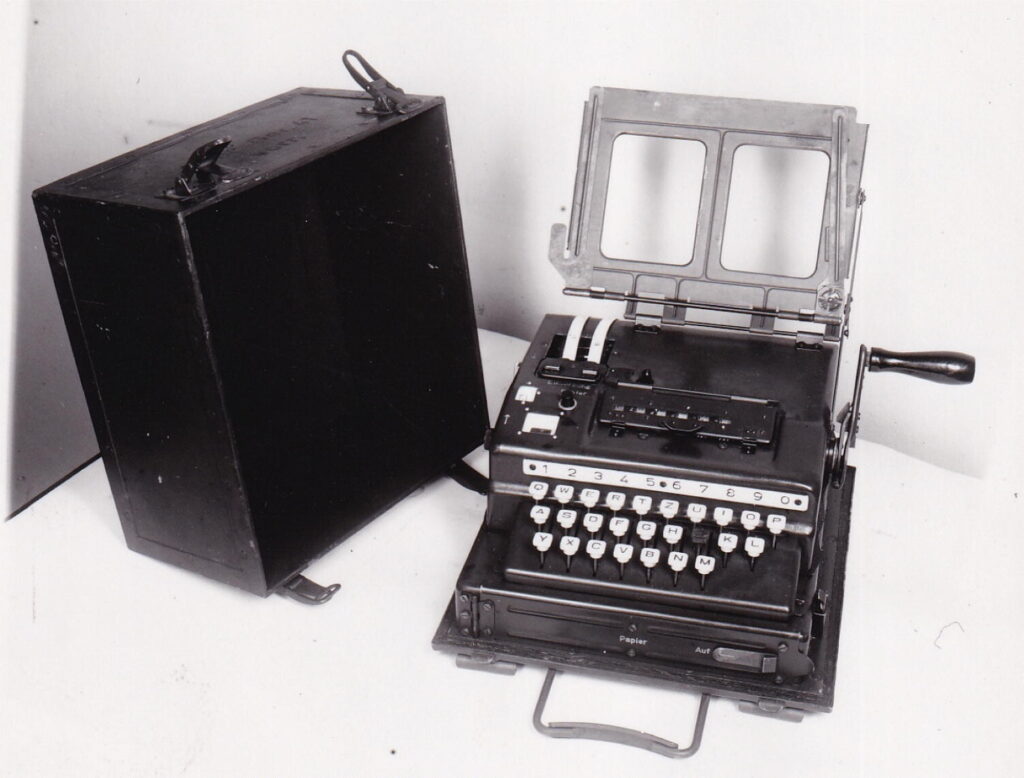
Despite being intended for field communications, the SG-41 was far from lightweight. The machine itself weighed around 10 kilograms, but when fully assembled with its protective lid and base plate, the total weight reached about 17 kilograms.
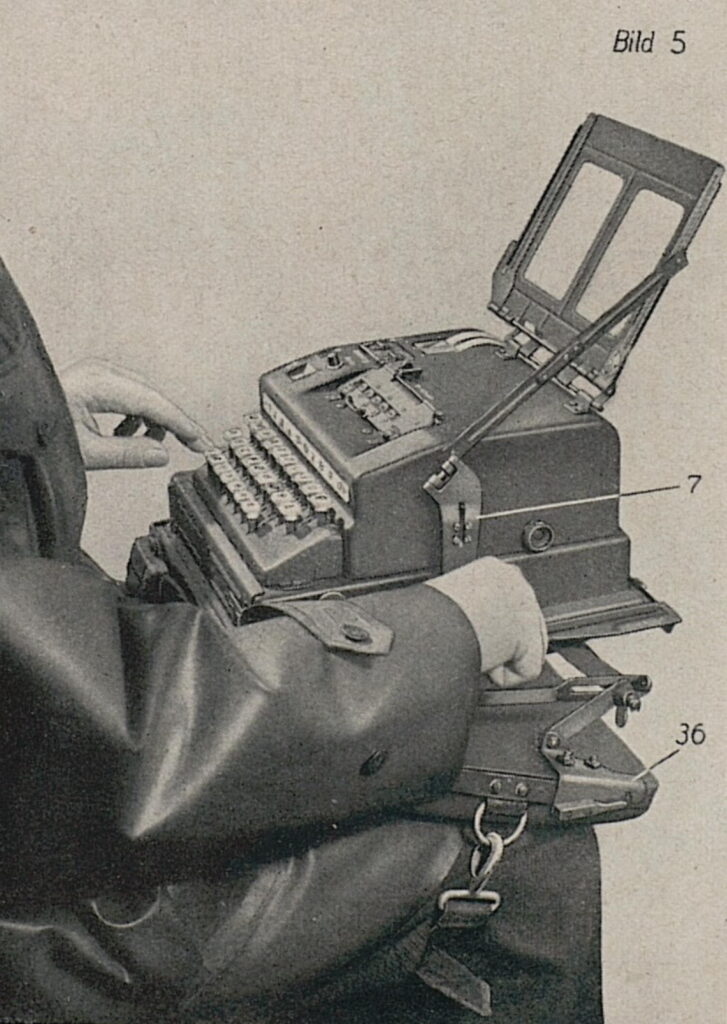
To make the device usable in military operations, German engineers created an unusual accessory called the Knieplatte, or “knee plate.” This padded wooden board allowed operators to place the machine on their knees while typing messages—similar to how a modern laptop might be used.
The board could also be converted into a backpack frame, allowing soldiers to carry the heavy machine during transport.
The Complex EncryptionKey System
Perhaps the most important discovery concerns the SG-41’s complicated three-level key system.
First, operators used a monthly table containing 26 possible pin configurations—one for each letter of the alphabet.
Each day, they received a daily key, consisting of six letters. These letters determined which configuration line from the monthly table would be applied to each of the machine’s six wheels.
The system also included a camouflage key, which scrambled the alphabet and concealed the starting position of each message, known as the indicator.
Finally, every communication station had its own two-digit identification number, set on the machine’s final two wheels.
Before sending a message, operators had to configure the machine according to all these settings—a process that could be time-consuming but ensured high security.
Was the Machine Truly Unbreakable?
The Czech intelligence analysis found a subtle weakness in the SG-41’s encryption.
Because of the way the machine generated numbers, some values appeared slightly more often than others. In theory, this uneven distribution could allow analysts to detect whether a text had been encrypted with the device.
However, when encrypting real human language, the frequency differences became so small that exploiting them would be extremely difficult.
The study concludes that although the SG-41 had theoretical vulnerabilities, it was probably very secure in practical wartime use.
A Mystery That Isn’t Fully Solved
Despite the discovery, many questions remain unanswered.
Researchers still do not know exactly how the Czech authorities obtained the documents, although evidence suggests they were analyzed for a conference in 1952.
Other key materials may also exist. When Soviet forces captured German factories in 1945, they reportedly seized SG-41 machines, components, and technical papers. Those items could still be sitting in Russian state archives today.
For now, the Prague discovery represents the most significant breakthrough in understanding the enigmatic cipher machine.
As the study’s authors conclude, the newly found documents finally clarify how the SG-41 operated and how its complex keys were managed.
After decades of mystery, one of World War II’s most advanced encryption devices is finally beginning to reveal its secrets—thanks to a forgotten box of documents in a Prague archive.
Antal, E., Dahlke, C., & Jahn, R. (2025). Revealing secrets from WWII: the original German instructions of Schlüsselgerät 41. Cryptologia, 1–30. https://doi.org/10.1080/01611194.2025.2557311
Cover Image Credit: Schlüsselgerät 41 at the Fort Reuenthal Museum. Public Domain
