
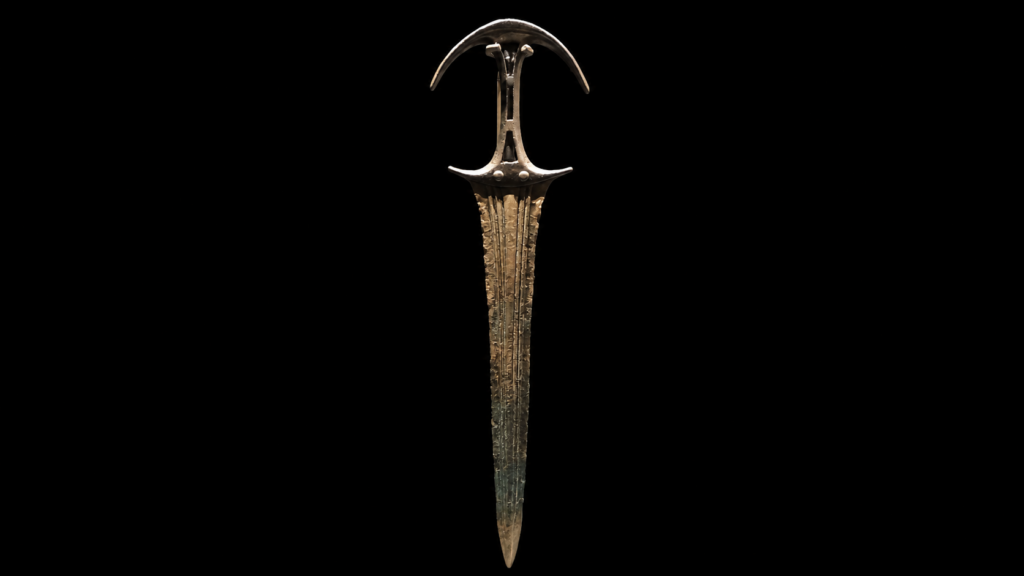
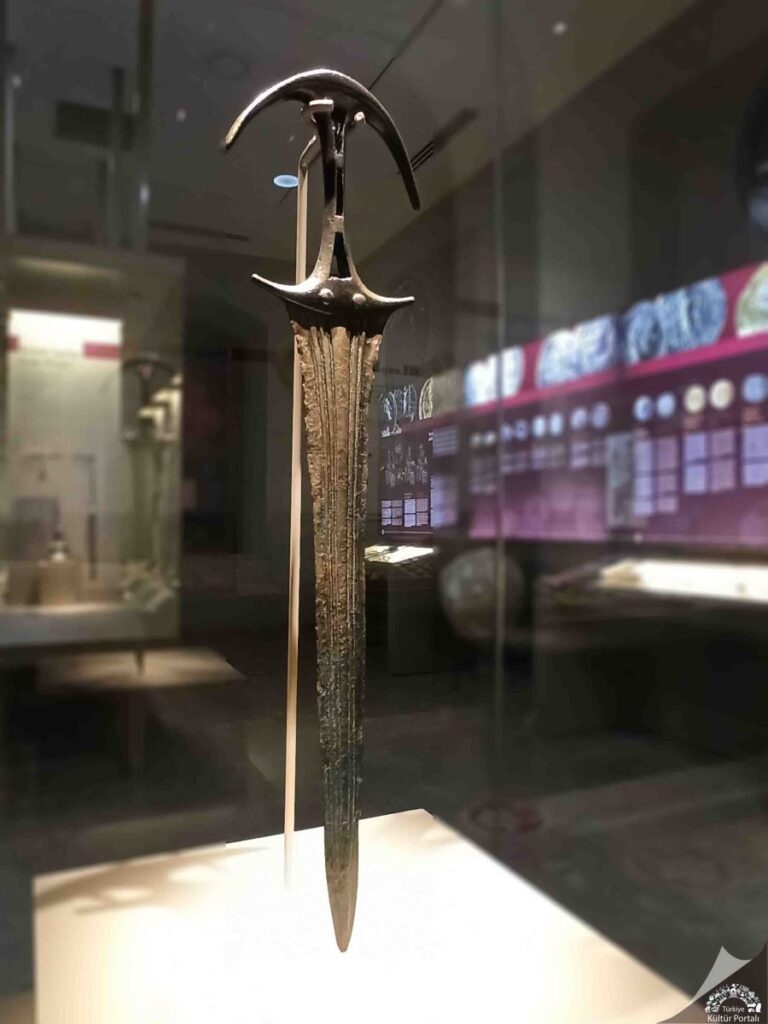
A Hittite dagger on display at the Amasra Museum on Türkiye’s Black Sea coast offers a remarkably vivid glimpse of ancient Anatolian craftsmanship. Measuring 42.5 centimetres in length, the weapon has survived with its blade, hilt and distinctive crescent-shaped pommel forming an unusually complete and elegant whole.
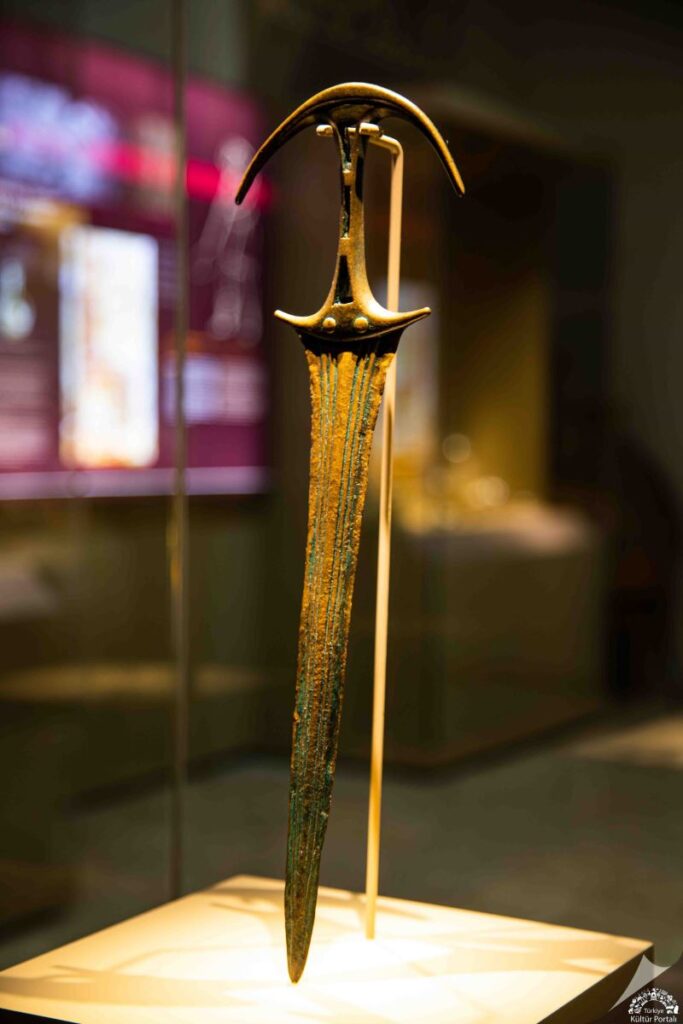
The museum describes the dagger as being made from a single piece of iron, including its handle. Two rivets placed on the hilt and the carefully shaped crescent terminal give the weapon a balanced, deliberate appearance. Despite its age, the dagger retains a clarity of form that makes its original design immediately recognisable.
Its appeal lies not in elaborate decoration but in its proportions. The narrow blade flows directly into a 12.2-centimetre handle, while the curved pommel provides a strong visual finish. The result is a weapon that appears both functional and ceremonial, reflecting a level of planning and workmanship rarely preserved so completely from the Hittite world.
A Weapon Known from Hittite Images
The dagger has also been examined in a recent academic study by archaeologist İzzettin Elalmış. Published in Praehistorische Zeitschrift, the research focuses on the weapon’s crescent-shaped pommel and its place within Hittite material culture.
Similar weapons appear in Hittite reliefs, seals and stone monuments, often carried by gods, kings or high-ranking figures. The Amasra example is therefore especially important because it transforms a form familiar from ancient images into a surviving three-dimensional object.
According to the study, the dagger entered the Amasra Museum collection in 2007 after being recovered from illicit excavations. Its exact discovery location is unknown, meaning it cannot be securely linked to a settlement, tomb or specific archaeological layer. Even so, its shape provides a clear visual connection with weapons represented in Hittite art.
A comparable crescent-pommelled metal weapon is known from Tell Atchana, ancient Alalakh, in southern Türkiye. Such parallels suggest that this distinctive design belonged to a broader elite weapon tradition in Late Bronze Age Anatolia and northern Syria.
Iron in the Hittite World
The Hittites established one of the major powers of the Late Bronze Age, ruling from their capital at Hattusa and extending their influence across Anatolia and northern Syria during the second millennium BCE.
Although ironworking was known in Bronze Age Anatolia, iron objects remained uncommon. Archaeological and textual evidence suggests that small quantities of smelted iron were produced in Anatolia after approximately 2000 BCE, but widespread iron use developed much later. Most weapons used during the Hittite period were still made from bronze.
Hittite texts mention ironworkers as well as prestigious objects such as an iron throne, sceptre and basin. A frequently discussed 13th-century BCE letter from King Hattusili III also refers to difficulties in producing “good iron” and records the dispatch of an iron sword or dagger point. These references suggest that iron was available but remained difficult to obtain and produce consistently.
Older claims that the Hittites controlled a secret ironworking monopoly are no longer accepted by most scholars. The evidence instead points to limited, specialised production, with iron often carrying economic, ceremonial or high-status value.
Seen in this context, the Amasra Museum dagger is significant not simply as an ancient weapon but as a rare expression of early metalworking. Its crescent-shaped pommel connects it with recognisable Hittite imagery, while its reported iron construction places it within one of the most important technological transitions of the ancient world.
What makes the weapon memorable today is its completeness. The crescent-shaped pommel, surviving rivets and uninterrupted profile allow visitors to appreciate the object not merely as an archaeological fragment, but as a carefully designed weapon that has preserved much of its original visual power.
No published metallurgical analysis has yet established the dagger’s precise composition or manufacturing method.
Elalmış, İ. (2026). A Hittite dagger with crescent-shaped pommel in the western Black Sea region of Turkey: Bartın Amasra Museum example. Praehistorische Zeitschrift. Advance online publication. https://doi.org/10.1515/pz-2026-2016
