
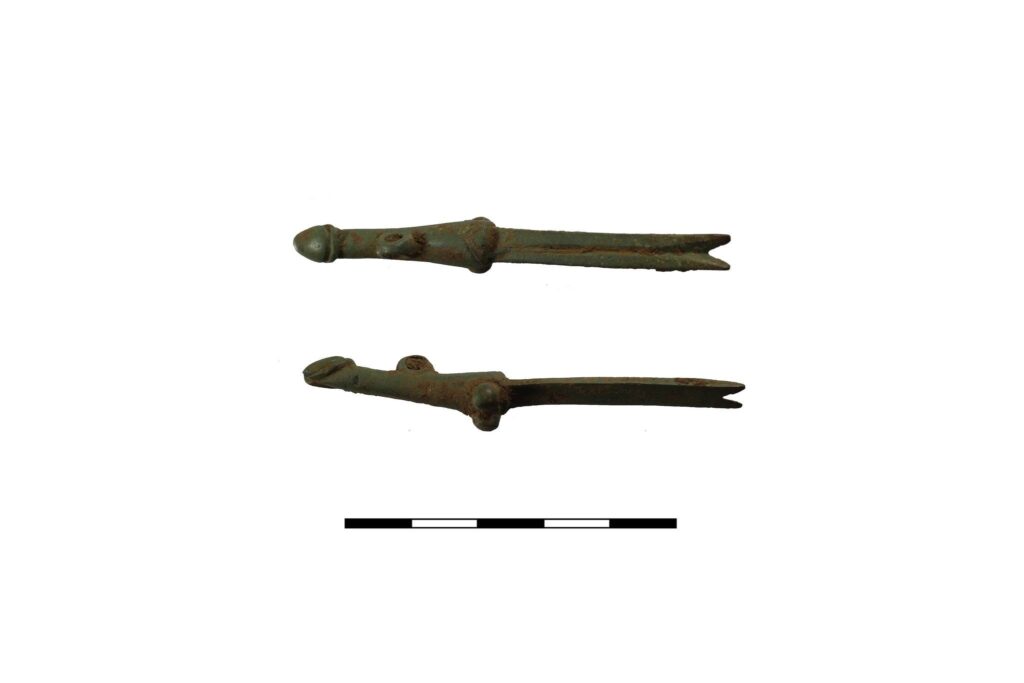
A rare Roman phallic nail cleaner dating back around 1,600 years has been discovered during excavations near Cheltenham in Gloucestershire, England. Archaeologists say the unusually well-preserved copper-alloy object may be the finest example of its type yet found in Britain.
The small personal item was recovered at one of the archaeological sites being examined ahead of Gloucestershire County Council’s M5 Junction 10 Improvements Scheme. Archaeological Research Services Ltd is carrying out the excavations for Galliford Try.
Although several comparable nail cleaners have been recorded across Britain, the quality and condition of the Cheltenham example immediately attracted attention. It dates to the late Roman period, around AD 300–400, when Roman rule in Britain was entering its final century.
Personal Care with a Protective Symbol
Nail cleaners were practical grooming tools designed to remove dirt from beneath the fingernails. Many were small enough to be carried on the body, sometimes alongside tweezers, ear scoops and other personal-care implements.
The Cheltenham object, however, was not shaped purely for practical reasons. Its phallic form gave an everyday utensil a second layer of meaning.
Phallic images were common throughout the Roman world and were not necessarily regarded as obscene. They were widely used as symbols of protection, good fortune and fertility. Roman men, women and children carried phallic amulets, while similar images appeared on jewellery, household decorations and military equipment.
The newly discovered object may therefore have served both as a grooming tool and as a protective charm carried by its owner.
Decorated Roman Belt Buckle Found Nearby
A second late Roman discovery from the excavation offers another glimpse into personal appearance during the same period.
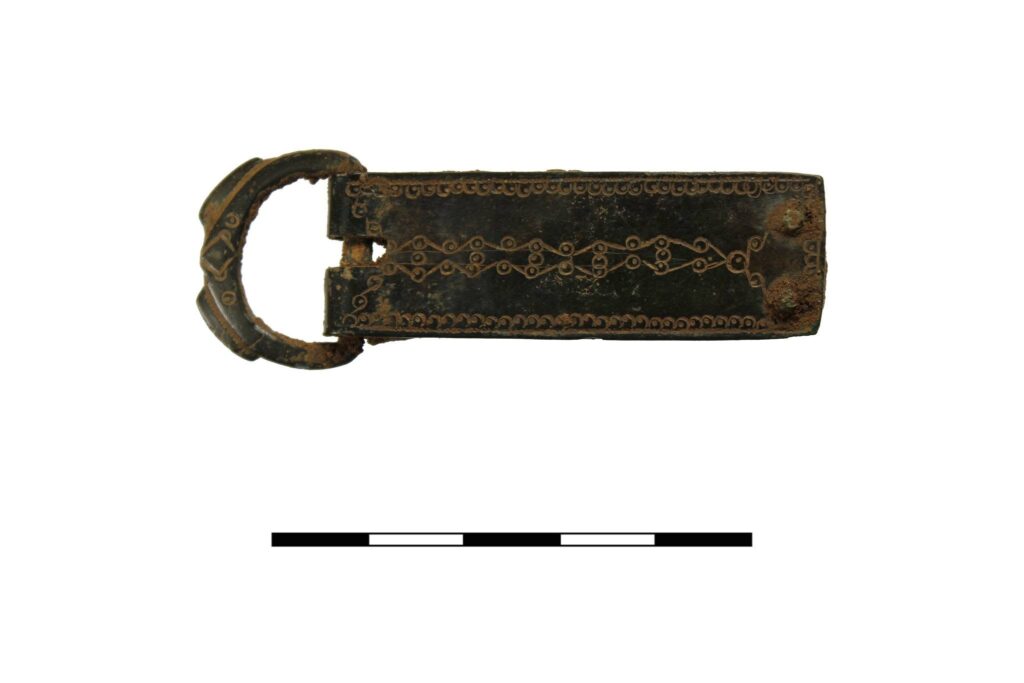
Archaeologists uncovered a copper-alloy belt buckle and plate made from a single sheet of metal. The sheet had been bent around the D-shaped buckle and fastened with rivets at its open end, allowing the buckle to move while the belt was being worn.
The plate was carefully decorated with stamped circles around its edges and a geometric plant-like design across the centre. Such decoration transformed a functional fastening into a visible part of the wearer’s clothing and identity.
Together, the buckle and nail cleaner provide a more personal view of the people who once lived or worked at the site. Rather than monumental buildings or military weapons, they preserve small details of how individuals dressed, groomed themselves and understood protective symbolism.
A Landscape of Settlement, Farming and Work
The objects were found at Site 2.1, where archaeologists have also uncovered a well and a dense collection of features connected with settlement, agriculture and production.
Ditches, pits, postholes, trackways and enclosed areas show that the land was repeatedly organised and reshaped. Deposits of household waste and demolished building material add evidence for daily occupation and changing structures.
Numerous coins have also been recovered, covering more than 2,000 years of activity. Their dates stretch across several historical periods, showing that the landscape continued to be visited and used long after Roman rule ended.
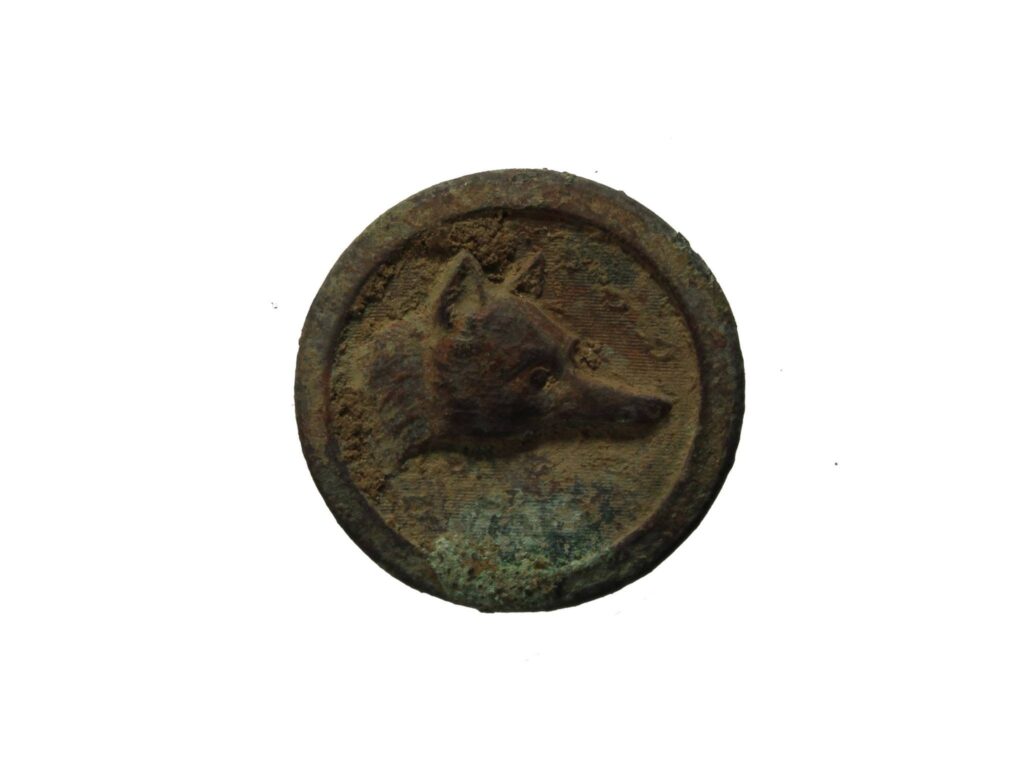
Later finds include 18th-century “dandy” buttons issued by the Royal Navy, 19th-century livery buttons decorated with animals associated with particular families, and a possible lead seal connected with Holland and Barrett. The seal may once have secured a sack of flour.
Roman Gloucestershire
Gloucestershire contains some of the richest Roman archaeology in western Britain. Villas, farms and roadside settlements developed across the Cotswold countryside, particularly around routes connecting major Roman centres such as Glevum—modern Gloucester—and Corinium, now Cirencester.
The wider M5 Junction 10 excavation covers about 30 hectares and began in October 2025. Earlier work produced Roman coins, brooches, pottery, a grain-drying structure and an unusual late Roman burial in which the skull had been placed between the individual’s knees.
The phallic nail cleaner is among the smallest objects recovered from the project, but it may prove to be one of its most memorable. Its survival offers a direct link to a person who lived near Cheltenham during the closing centuries of Roman Britain—and who carried a practical grooming tool shaped to offer a little extra protection.
