
12 February 2026 The Future is the Product of the Past

Rare Roman Cavalry Swords Lead to Major Archaeological Discovery of Iron Age to Roman Settlement in Gloucestershire

A remarkable archaeological excavation in Gloucestershire has unveiled a vast settlement site dating back over 2,000 years, bridging the Iron Age and Roman periods. This discovery was triggered by the rare find of two Roman cavalry swords during a 2023 metal detecting rally near Willersey.

The excavation, funded by Historic England and conducted in partnership with Cotswold Archaeology, has revealed traces of an extensive settlement from the Early to Middle Iron Age, continuing into the first and second centuries AD. Among the most intriguing finds is possible evidence of a Roman villa featuring winged extensions, though further investigations are required to confirm its exact nature.

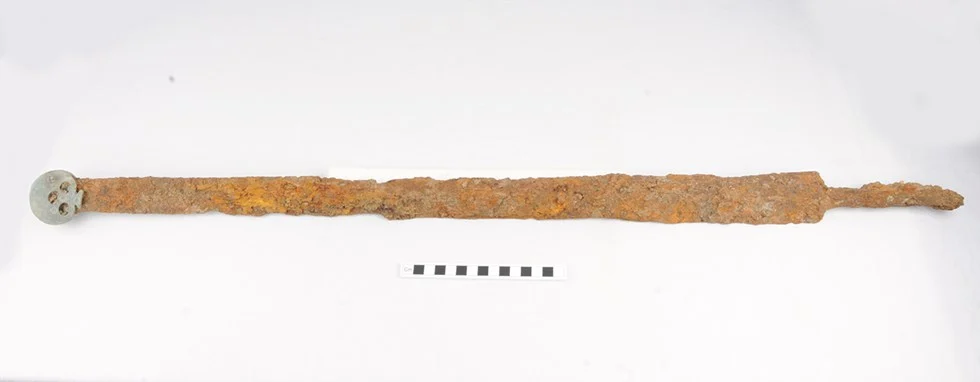
The swords, known as spatha, are long iron cavalry weapons used by Roman horsemen between the early second and third centuries AD. Notably, one sword displays intricate pattern welding — a decorative and costly forging technique — indicating it belonged to a higher-status soldier. The other sword is plainer, suggesting different social or military ranks.
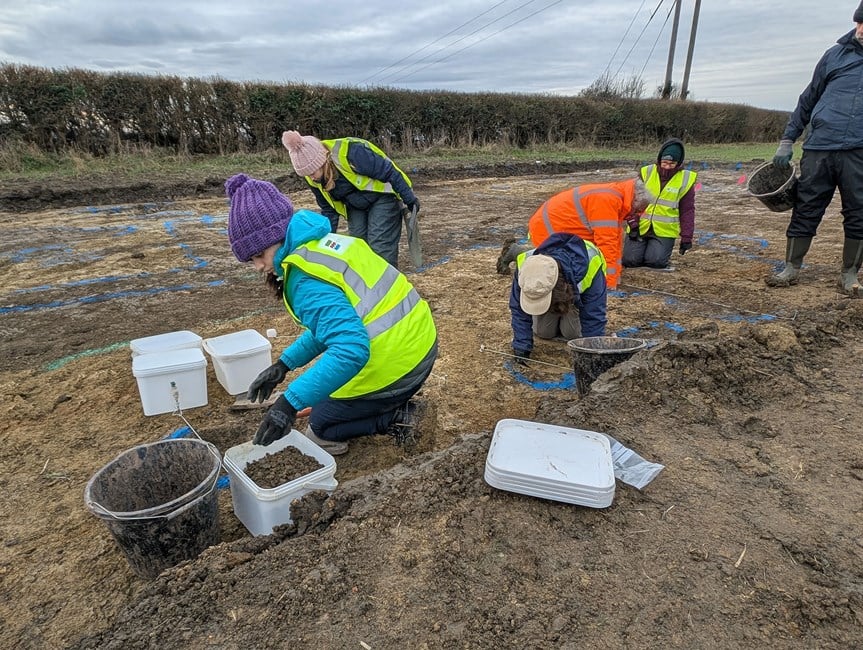
Historic England and community volunteers in trenches on the Willersey dig. Credit: Cotswold Archaeology

Discovered mere inches beneath the surface, these swords were nearly destroyed by farm machinery, highlighting the fortuity of their recovery. After their discovery, the swords were X-rayed at Historic England’s science laboratory in Portsmouth, providing valuable insights into Roman metallurgy and craftsmanship.

Additional finds at the site include Roman building materials such as ceramic roofing tiles, box flue tiles likely related to underfloor heating, and fragments of painted wall plaster. These point towards the presence of a sophisticated Roman villa. Moreover, several Iron Age ring ditches and a rectangular enclosure further demonstrate the site’s long history of occupation.


📣 Our WhatsApp channel is now LIVE! Stay up-to-date with the latest news and updates, just click here to follow us on WhatsApp and never miss a thing!!


Significant human and animal remains were also uncovered: an Iron Age burial featuring an iron arm band and a horse skull buried nearby, though their relationship remains unclear.
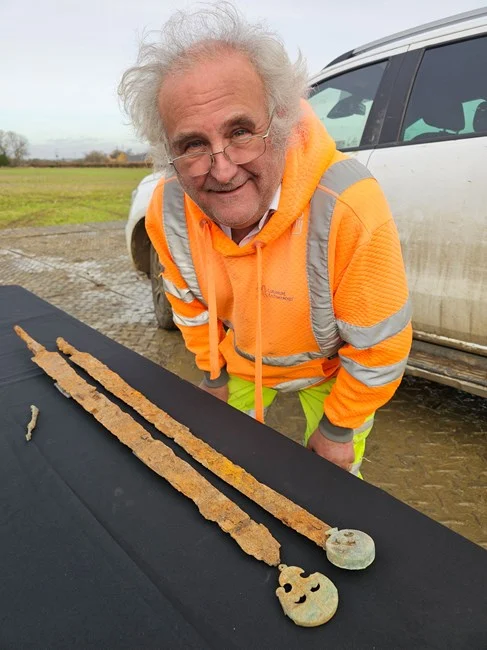
Peter (Buzz) Busby from Cotswold Archaeology looking at the swords. Credit: James Haris

Ian Barnes, Senior Archaeologist at Historic England, remarked, “This excavation offers a rare window into centuries of settlement activity, shedding light on the transition from Iron Age communities to Roman occupation in Gloucestershire.”

The Corinium Museum in Cirencester will showcase the swords starting August 2, allowing the public to engage directly with this unique slice of British history.

Glenn Manning, the metal detectorist who made the original discovery, said, “Finding two cavalry swords in one place was incredible — almost like the stars aligned. It’s an honor to contribute to uncovering our ancient past.”
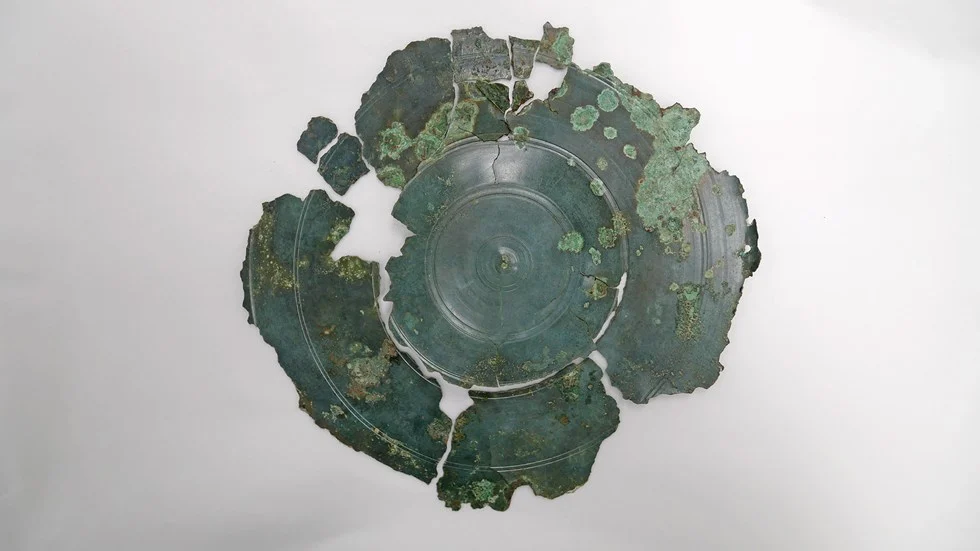
Fragments of a copper bowl found with the Roman cavalry swords. Credit: Corinium Museum

As Historic England reviews the full archaeological report, consideration will be given to protecting the site as a scheduled monument, ensuring its preservation for future generations.

Historic England

Cover Image Credit: Roman cavalry sword with its protective fitting known as a chape. © Corinium Museum

Related Articles

2,800-Year-Old Hallstatt Dagger Found on Baltic Coast— A True Work of Art

20 October 2025

20 October 2025

After powerful storms eroded a coastal cliff along Poland’s Baltic shoreline, nature itself unveiled a secret buried for nearly three...

Farmer Found Sarcophagus of Hellenistic Period in his Field

9 April 2021

9 April 2021

The citizen named E. G. in Akçakoca, Taşkuyucak District of Gölmarmara district of Manisa (Turkey), while plowing his field, thought...

Archaeologists Uncover Rare Trojan War-Era Armor from 1200 BCE in Czechia

22 July 2025

22 July 2025

A remarkable archaeological discovery in South Moravia has brought new insights into Bronze Age Europe and its warrior elites. The...

DNA Cracks a 750-Year-Old Murder: The Vicious Killing of a Forgotten Duke Finally Exposed

16 November 2025

16 November 2025

For more than seven centuries, the violent end of a young medieval nobleman remained an unresolved whisper in European history—half...

The statue head of Hygieia, the Greek goddess of health, found stuck between two rocks in Laodikeia

21 May 2024

21 May 2024

A 2100-year-old statue head of the Hygieia (Health) Goddess was found during the excavations in the ancient city of Laodikeia...

Cuneiform Clues Reveal Körzüt as “The Sacred City of Haldi,” in Urartu Kingdom

6 August 2025

6 August 2025

Excavations in eastern Türkiye uncover a major religious center of the Urartian Kingdom—The Sacred City of Haldi, shedding new light...

Archaeologists uncovered a 3,500-year-old Egyptian Royal Retreat in the Sinai Desert

5 May 2024

5 May 2024

An Egyptian mission uncovered the ruins of a 3,500-year-old “royal fortified rest area” at the Tel Habwa archaeological site in...

God Pan statue unearthed at Istanbul’s historical church of St. Polyeuctus

1 June 2023

1 June 2023

A Pan statue thought to belong to the Roman period was recovered during excavation works carried out by Istanbul Metropolitan...

Mass graves of Crusaders killed in the 13th century have been discovered in Lebanon

17 September 2021

17 September 2021

From 1096 to 1291, waves of Europeans took up arms and marched into the Middle East. They hope to “take...

2,700-year-old Unique Rock Tombs Disappear

18 July 2023

18 July 2023

The 2,700-year-old rock tombs, unique in Turkey, in the Taşköprü district of Kastamonu are in danger of extinction due to...

Citizen scientists discover more than 1,000 new burial mounds in a Dutch archaeological project

29 January 2023

29 January 2023

A Dutch archaeological project in which thousands of amateur sleuths combed specialized maps and high resolution photographs resulted in the...

Anthropologists say humans have been using personal ornaments to communicate about themselves without the fuss of conversation – for millennia

24 September 2021

24 September 2021

Anthropologists believe that for millennia, individuals have used personal decorations to communicate about themselves without the hassle of dialogue. They...

Ancient city site unearthed in Central China produces fortune-telling relics

8 February 2024

8 February 2024

Bone slips used for “fortune-telling activities” and “ancient sacrificial ceremonies” were unearthed during excavations at an archaeological site in Puyang,...

Rare Five Bronze Age Axes found in the Forests of Poland

5 December 2023

5 December 2023

Archaeologists in Poland have discovered five Bronze Age axes in Starogard Forest District, located in Kociewie. A metal detectorist named...

Earliest glass workshop north of the Alps unearthed in Němčice

25 July 2023

25 July 2023

Archaeologists excavated the famous Iron Age site Němčice and uncovered the earliest glass workshop north of the Alps. Numerous beautiful...