
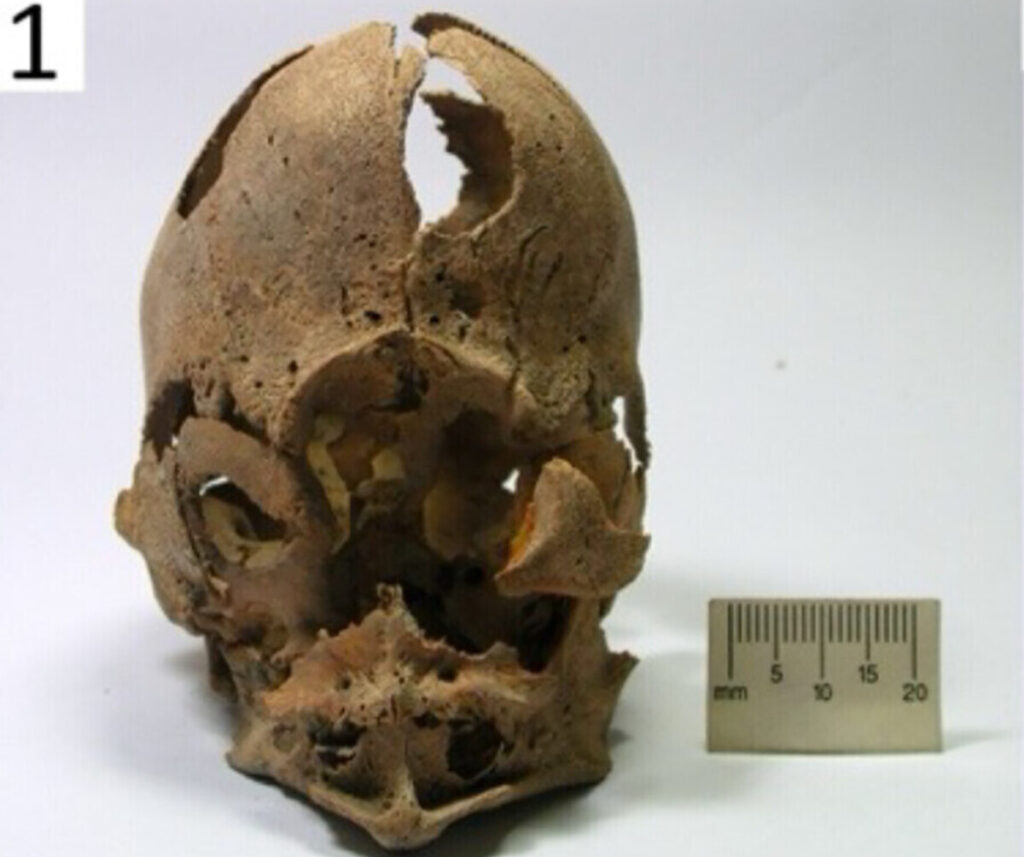
Around 1,600 years ago, a community in southern Peru buried two infants together inside a ceramic vessel. One of the children had an extraordinary physical condition: her skull contained a single eye socket in the center of her face. Now, ancient DNA has revealed the genetic explanation for her unusual anatomy. Yet the reason the two infants shared a grave remains unknown.
The discovery comes from Jauranga, an archaeological site in Peru’s Palpa Valley, where researchers investigated a burial dating to the Nasca period. Their findings, published in Proceedings of the National Academy of Sciences (PNAS), connect an exceptionally uncommon congenital condition with the funerary traditions of a society that flourished along Peru’s southern coast.
Two Children in a Single Burial Urn
Jauranga’s history began long before the two infants were buried there. Communities occupied the site during the Paracas period, and centuries later, Nasca populations used part of the area as a cemetery. Archaeologists identified 31 graves dating to approximately AD 325–440, including Burial 25, which contained the remains of the two children.
The infants lay one above the other inside a ceramic vessel, with no additional grave goods accompanying them. Both skeletons survived in relatively complete condition, allowing researchers to examine their development and physical characteristics. Genetic analysis established that both children were female, but their skeletal remains told strikingly different stories.
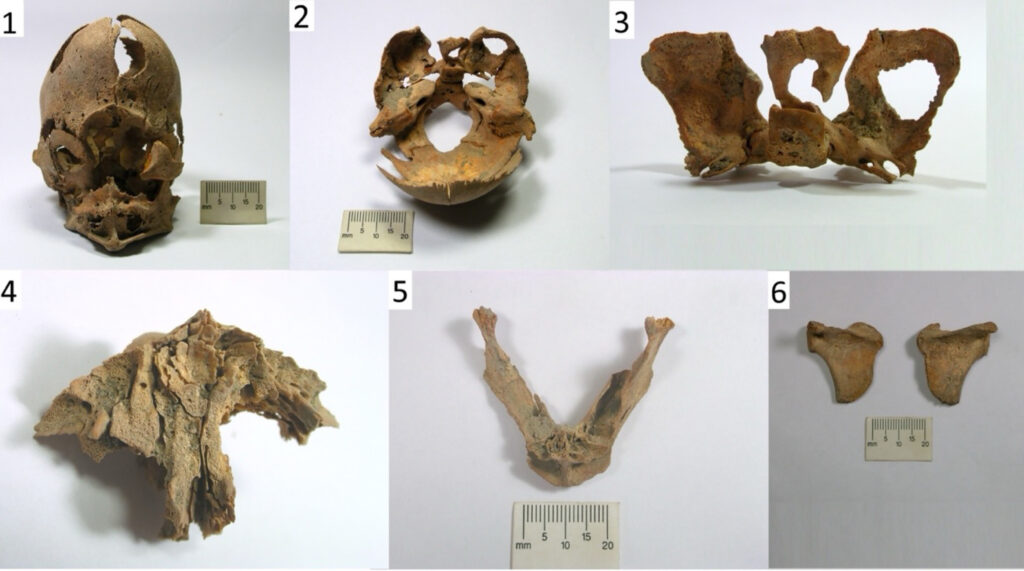
The first infant, identified as JA13A, had an unusually small skull and a single central eye socket. Several bones normally forming the nose and middle of the face were missing or severely underdeveloped. By contrast, the second infant, JA13B, showed no comparable skeletal abnormalities.
Ancient DNA Reveals the Cause
The unusual features of JA13A’s skull pointed toward cyclopia, an exceptionally uncommon condition that develops during early pregnancy. It occurs when the embryonic brain fails to separate properly into two hemispheres, severely affecting the formation of the eyes and central facial structures. Cyclopia affects approximately one in 100,000 births and usually causes death before or shortly after delivery.
To investigate the infant’s condition, researchers led by Elsa Tomasto-Cagigao of the Pontifical Catholic University of Peru and Lars Fehren-Schmitz of the University of California, Santa Cruz, examined ancient DNA recovered from the two skeletons. Their analysis revealed that JA13A carried three copies of chromosome 13 rather than the usual two. This condition, known as trisomy 13 or Patau syndrome, can cause severe developmental abnormalities, including cyclopia.
The team tested its findings through three independent analytical approaches and compared the results with genetic data from 250 ancient South American individuals. Each method supported the presence of an additional chromosome 13, strengthening the diagnosis.
The study, published in PNAS on November 9, 2026, identifies trisomy 13 as the likely genetic cause of the infant’s unusual skeletal anatomy.
Did the Infant Survive After Birth?
The investigation uncovered another detail that researchers could not easily explain. JA13A’s teeth suggested a developmental age of approximately two to four months after birth, while the long bones more closely resembled those of a late-term fetus or newborn. This difference raises the possibility that the child survived beyond birth despite a condition that is typically fatal during the earliest stages of life.
However, severe genetic conditions can alter normal patterns of skeletal and dental growth. The researchers therefore caution that neither measurement provides a reliable estimate of the infant’s actual age. Although survival beyond birth remains possible, the available evidence cannot establish how long she lived or whether she required sustained care.
Two Infants Who Did Not Share a Mother
DNA analysis revealed another unexpected detail about the burial. Although the two infants shared the same ceramic vessel, they carried different mitochondrial DNA lineages, indicating that they did not share maternal ancestry. The researchers could not establish whether the children had other family connections or why their bodies were placed together.
Their shared grave also raises questions about how Nasca communities responded to children born with severe physical differences. Ceramic urn burials accounted for approximately one-quarter of documented Nasca graves in the Palpa region, particularly those of children younger than six. Archaeologists have also documented similar practices elsewhere in the wider Nasca region.
Burial 25 followed these established traditions. The infants shared an ordinary ceramic vessel, and the grave contained no unusual offerings or other objects suggesting that the child with cyclopia received distinctive funerary treatment. This finding provides evidence of how the community buried her, although it cannot reveal how others perceived or cared for her during life.
A Burial That Reveals More Than a Medical Condition
The researchers place the discovery within a broader history of bodily differences in ancient Andean societies. Archaeological evidence from other periods shows that communities responded to physical impairments in different ways, ranging from inclusion and assistance to exclusion. However, these examples come from different cultural settings and cannot establish how Nasca society understood the condition of the infant at Jauranga.
The burial also demonstrates both the possibilities and limitations of ancient DNA research. Genetic analysis identified the chromosomal disorder responsible for the infant’s unusual skull and established that the two children did not share maternal ancestry. Archaeology, meanwhile, showed that the community buried her according to familiar funerary traditions.
Neither approach can explain the circumstances that brought the two infants into the same ceramic vessel. Their shared grave remains an unresolved part of the story, even as modern science provides an answer to the extraordinary condition of one of the children.
E. Tomasto-Cagigao,M. Reindel, J.I. Cuadrado,M. Lund Valle, K. Kassadjikova, K. Harkins, & L. Fehren-Schmitz, A Nasca-period perinatal burial reveals cyclopia associated with trisomy 13 in southern Peru, Proc. Natl. Acad. Sci. U.S.A. 123 (46) e2625042123, https://doi.org/10.1073/pnas.2625042123 (2026).
