
For centuries, communities in southern Peru had access to high-quality obsidian, sophisticated projectile weapons, and long-distance exchange networks. They also lived through a period of population growth and rising violence. Yet one weapon remains conspicuously absent from the archaeological record: the bow.
A new study of Paracas-period sites in the Palpa valleys argues that this absence was not a gap created by poor preservation. Researchers examined 200 obsidian projectile points, compared them with archaeological darts and arrows, and found that the points consistently belonged to spearthrower darts rather than arrows. The same pattern appears in burials, textiles, and other representations of Paracas weaponry.
The result challenges a familiar assumption about ancient weapon technology. Population pressure and conflict are often expected to encourage the adoption of the bow, yet the Paracas evidence shows that technological change did not necessarily follow that path.
200 obsidian points, but no arrowheads
The research focused on material from five archaeological sites in the Palpa valleys. Of 406 stone artifacts initially reviewed, the team excluded pieces that were not projectile points or had been heavily fractured, reshaped, or recycled, leaving 200 examples for detailed study. Every one was made from obsidian.
The researchers then compared the width and thickness of the Palpa points with archaeological examples that could confidently be linked to bows or spearthrowers. Bayesian statistical models produced a striking result: all 122 complete points were classified as darts, with median probabilities of between 95 and 99 percent. Even incomplete or heavily reworked examples followed the same general pattern.
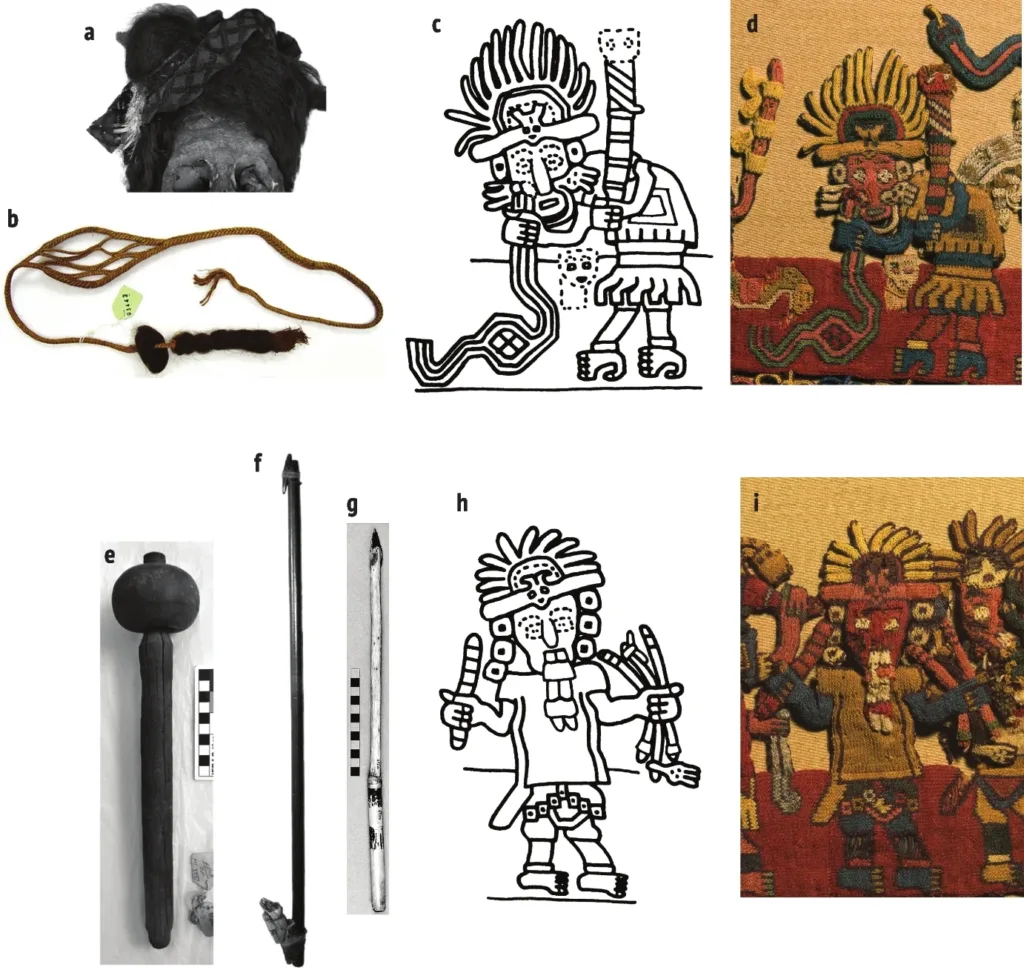
That conclusion also fits evidence outside the stone tools. Paracas male burials contained spearthrowers, slings, obsidian knives, stone mace heads, and hide-covered shields. Textiles show figures carrying the same types of weapons. Bows, however, are missing from both the graves and the imagery.
The weapons remained remarkably stable
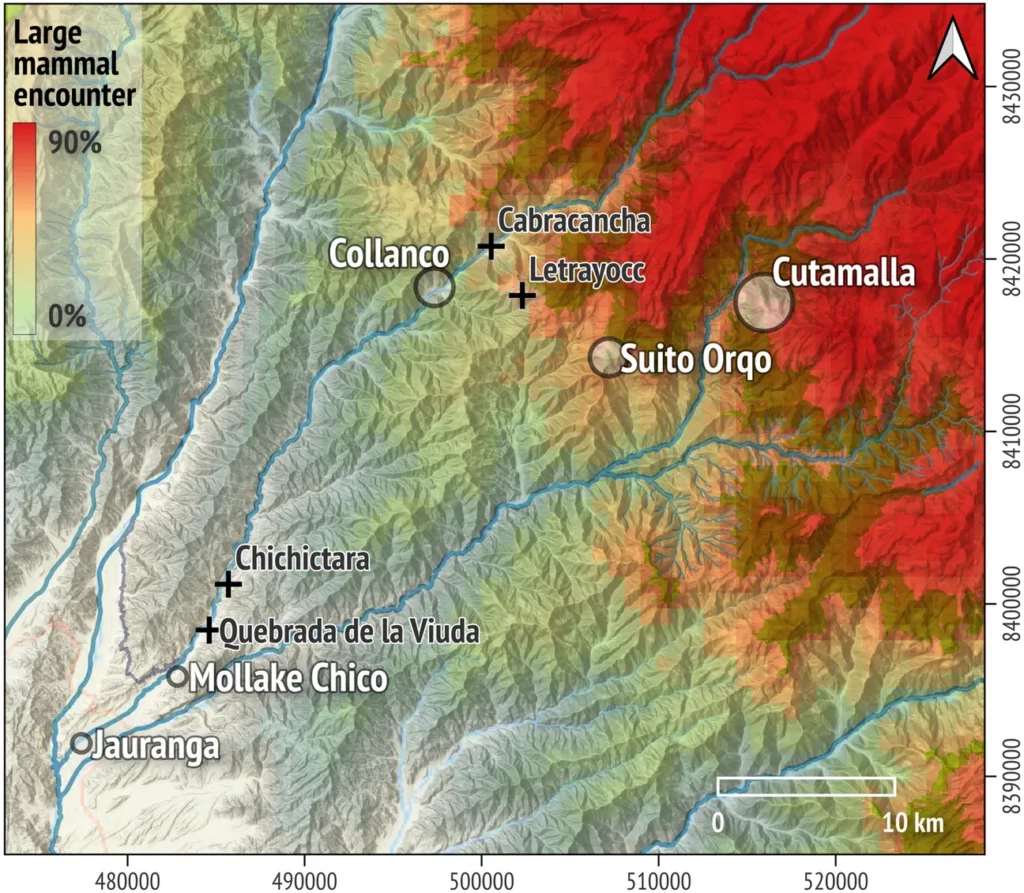
The chronology makes the absence harder to dismiss as a short-lived local pattern. At Jauranga, researchers dated the Paracas occupation and its projectile points to roughly 460–250 BC. At the highland settlement of Cutamalla, occupation followed from around 240 to 40 BC, and most of the study’s projectile points came from this site.
Cutamalla should have offered favorable conditions for experimentation with projectile technology. It lay close to the Quispisisa obsidian source and produced exceptionally high densities of projectile points and camelid bones. Nearby Collanco even yielded a spearthrower hook, directly confirming that obsidian-tipped darts formed part of the local weapon system.
The communities were not isolated or short of suitable stone. Nearly all obsidian found in the region came from the Quispisisa source, demonstrating sustained movement and exchange, probably supported by llama caravans. Obsidian served as a major raw material for projectile points as well as other cutting tools.
In other words, the evidence does not describe a technologically simple society that failed to develop effective ranged weapons. Paracas communities already maintained specialized weapon traditions and networks capable of moving valuable raw materials across considerable distances.
Violence increased without producing a bow
The broader historical setting makes the pattern more unusual. During the Final Formative period, roughly 400–1 BC, coastal Peru experienced exceptionally high levels of interpersonal violence. Adult cranial trauma reached about 31 percent in the coastal sample discussed by the researchers, while Paracas Cavernas recorded trauma in 40 percent of 124 adults.
Fortified locations, walls, slingstones, mace heads, and skeletal injuries also appear in the Palpa valleys. The study compiled 53 sites with walls, weapons, or defensible positions, although the researchers emphasize that evidence for conflict there remained less pronounced than at some coastal sites.
That distinction matters. The authors interpret the Palpa evidence as more consistent with limited raiding than sustained large-scale warfare. Many projectile points probably served hunting rather than combat, particularly in highland areas where wild camelids and deer could be targeted.
The bow therefore did not appear even under conditions often assumed to encourage its adoption: growing populations, interpersonal violence, competition and access to high-quality raw material.
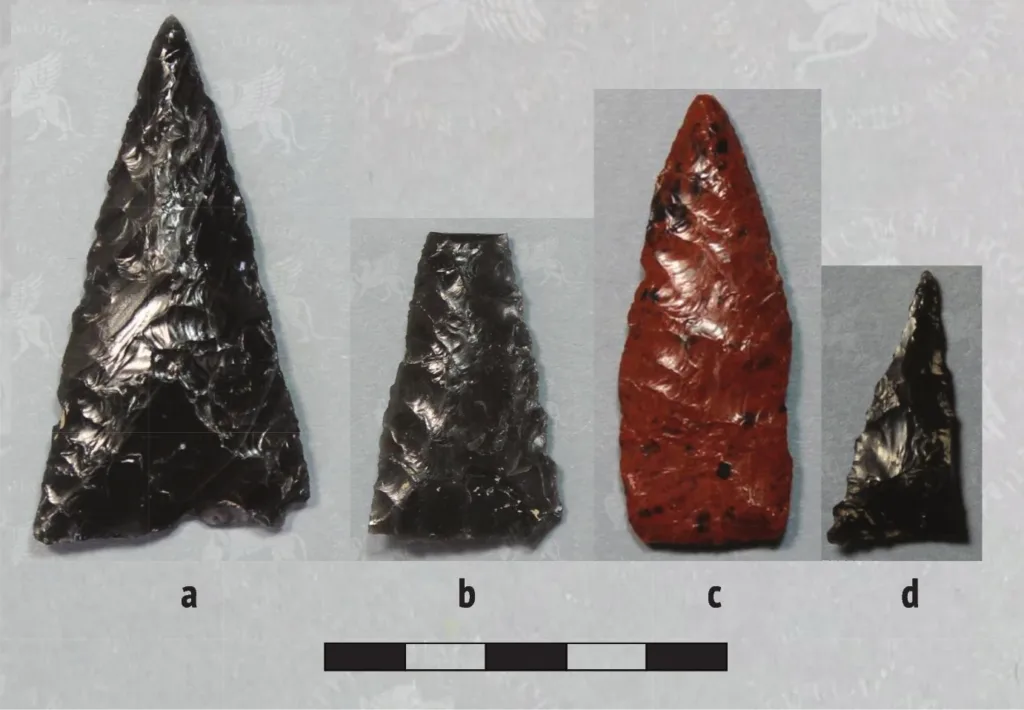
Examples of Paracas projectile points from Jauranga, Cutamalla, and Collanco, showing different levels of preservation and reuse. Point A retains its original symmetrical form, B shows minor retouching, C is more heavily reshaped, and D was recycled into a non-projectile tool. Scale bar: 5 cm. Credit: Marsh, E.J., et.al., 2026
Why change a weapon system that worked?
The answer may lie partly in the landscape. Spearthrowers suited the open environments of southern Peru, where hunters had room to use the broad throwing motion the weapon required. Heavy darts also offered considerable stopping power against deer and wild camelids, the region’s most valuable large prey.
Slings added another effective ranged weapon. They were simple to make from materials such as wool, hide, and stone, and unlike bows, they could be used with one hand. Their importance wasn’t limited to hunting: slings remained widespread in Andean warfare centuries later, even after bows were known elsewhere in South America.
The environment may also have worked against archery. The researchers note that local woods such as acacia and mesquite were often too stiff, knotty or heavy for efficient bows and arrow shafts. Suitable wood was not necessarily impossible to obtain, but the materials already used for darts and other weapons may simply have been better matched to local conditions.
Tradition may have mattered as well. Spearthrowers and slings were embedded in Paracas hunting and warrior practices, and slings even appeared as visible elements of warrior regalia. In communities where group hunting and established weapon traditions already worked, there may have been little pressure to replace them.
The mystery may extend beyond Paracas
The implications may reach farther along the Pacific coast. The researchers point out that Nasca, Moche and Chimú material culture also contains clear evidence for spearthrowers while bows remain difficult to identify. For the Palpa valleys, however, the evidence is much firmer: projectile measurements, preserved weapons and visual representations all point in the same direction.
The work also raises questions about earlier claims for ancient archery elsewhere in South America. Some identifications relied on comparisons with ethnographic arrowheads that are larger than securely identified archaeological arrows. The authors argue that this can cause small dart points to be mistaken for arrowheads.
The Paracas case therefore complicates the idea of a simple technological progression from spearthrower to bow. In the Palpa valleys, communities had obsidian, skilled craftspeople, established projectile weapons, and increasingly violent social conditions. What the archaeological record shows is not a rush toward the bow, but the persistence of a weapon system that apparently continued to meet their needs.
Marsh, E.J., Yebra, L., Castro, S. et al. Unbowed: Raiding and Hunting with Paracas Spearthrowers and Slings and the Conspicuous Absence of the Bow in Western South America. J Archaeol Method Theory 34, 24 (2027). https://doi.org/10.1007/s10816-026-09826-9
