
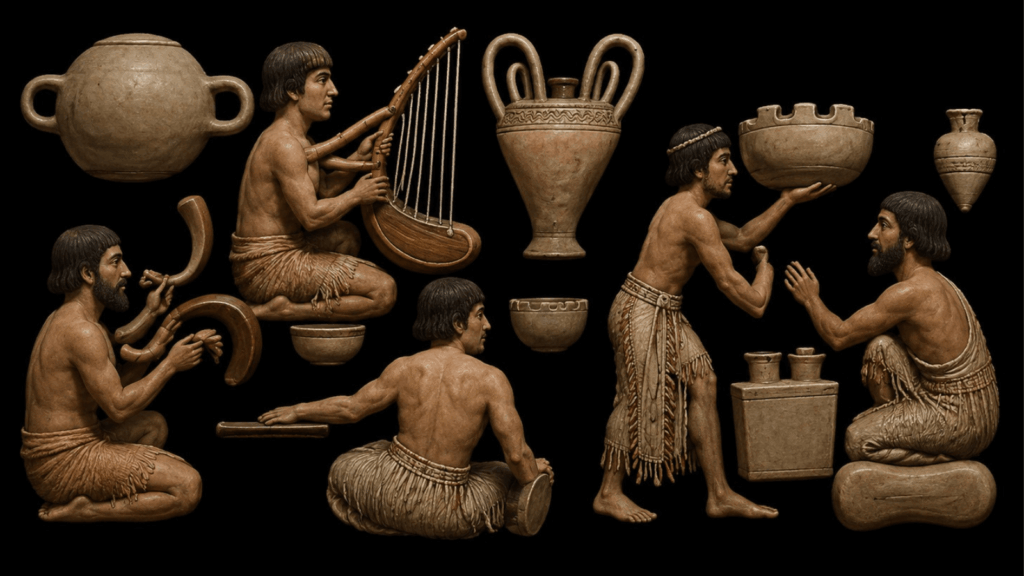
Six millennia ago, on the plains of what is now southwestern Iran, a musician plucked the strings of a curved harp as part of what may be the oldest documented musical ensemble on Earth. That sound vanished for thousands of years: until an Iranian craftsman and researcher decided to bring it back.
Abdolali Bagherinejad, a luthier and music historian born in 1967 in Kermanshah, has spent more than four decades immersed in Iran’s instrumental heritage, and over 25 of those years specifically chasing the ghost of a single instrument: the ancient curved harp once played at the archaeological site of Chogha Mish, near Dezful in Khuzestan province.
The Clue Carved in Stone
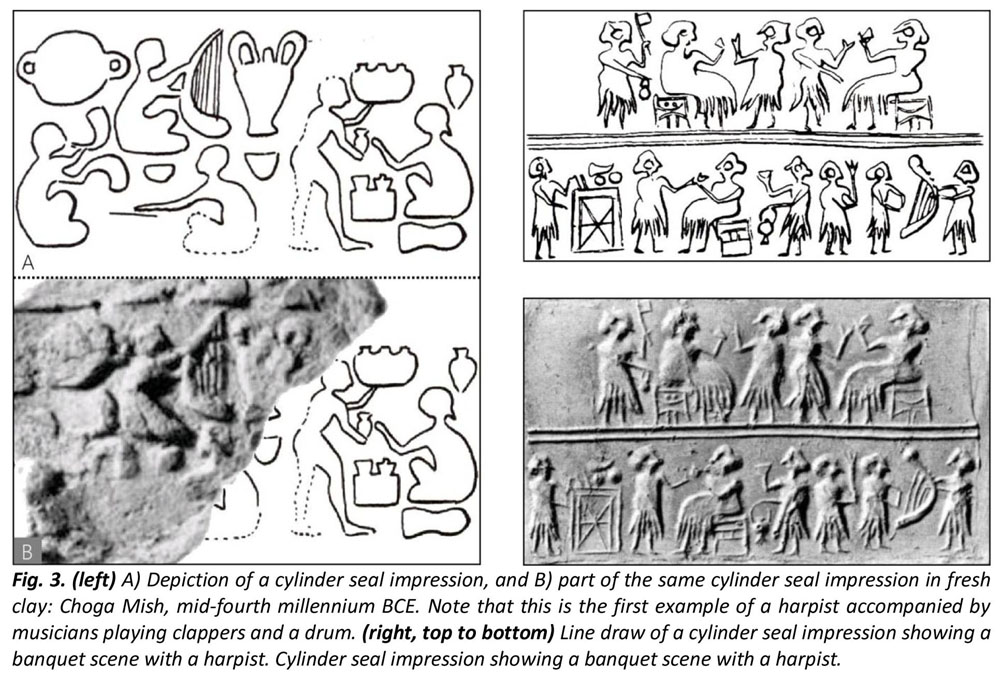
The entire reconstruction traces back to a single small seal unearthed at Chogha Mish by archaeologists Helene J. Kantor and Pinhas Delougaz. Carved sometime in the fourth millennium BCE, the seal depicts a full musical group: a harpist playing a curved instrument strung with five or six strings, joined by a singer, a wind player, and a percussionist. Bagherinejad considers this tiny artifact the earliest surviving depiction of an organized orchestra anywhere in the world: evidence that the Iranian plateau was home to structured musical performance thousands of years before written history took shape.
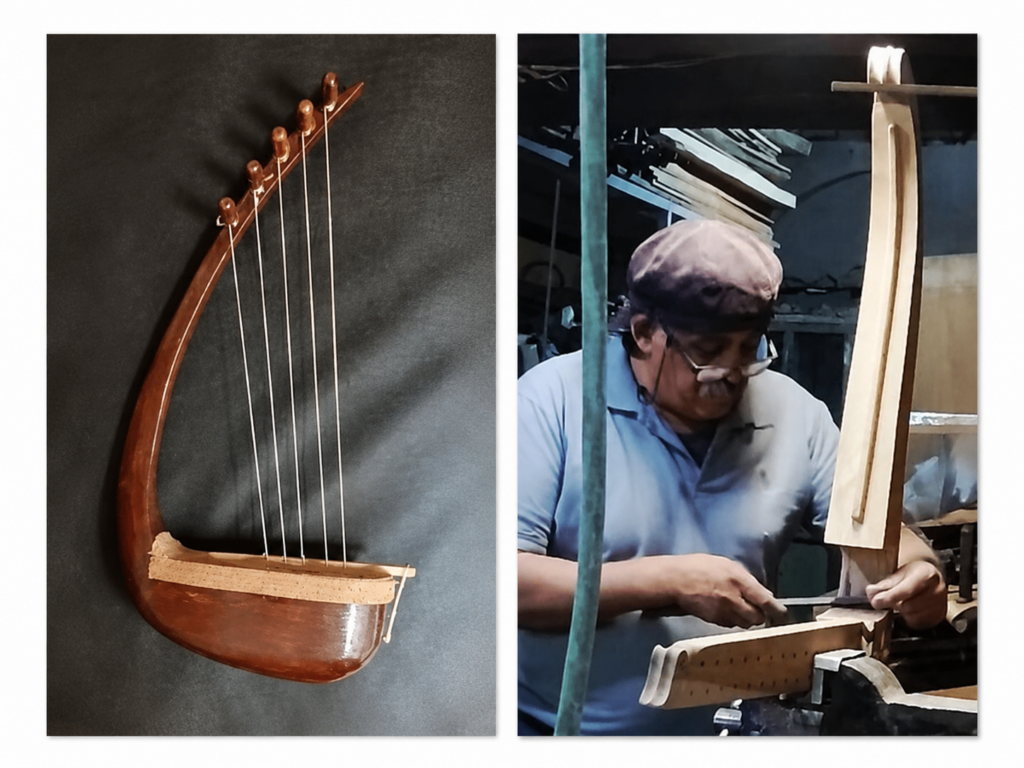
Turning that flat, stylized carving into a working instrument was no simple task. Bagherinejad spent years studying the proportions of the engraved figures, cross-referencing them against average human body measurements to reverse-engineer the harp’s true size and shape. What emerged was a curved wooden-framed harp with a soundbox wrapped in stretched animal hide to project resonance, strung with silk strings tightened by wooden pegs. Every measurement and structural choice, he says, was pulled directly from the archaeological record rather than guesswork.
Tracing the Harp Through Persian History
Bagherinejad’s research didn’t stop at Chogha Mish. He followed the instrument’s footprint across centuries of Iranian civilization. At the Elamite reliefs of Kul-e Farah near Izeh — dated to roughly 1800 BCE — carved inscriptions actually name the musicians shown playing, making them among the earliest individually identified performers in recorded history.
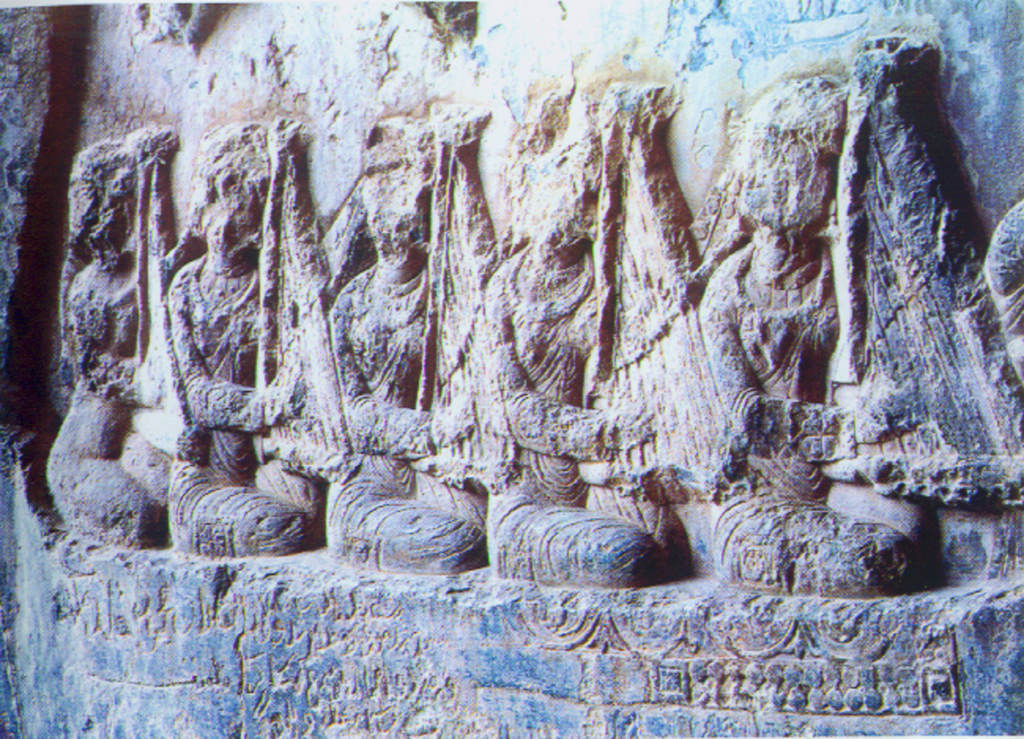
Later, at the Sasanian site of Taq-e Bostan, harpists reappear in elaborate court imagery, shown performing during royal boating scenes and palace festivities.
After the arrival of Islam, the instrument lived on in Persian literary tradition as well, most famously in the legend of the poet-musician Rudaki, whose harp performance is said to have been so moving that a Samanid ruler rushed toward Bukhara barefoot upon hearing it.
From Research Project to National Heritage
What kept Bagherinejad committed for a quarter-century wasn’t just the harp’s age: it was the realization that its unique voice had completely disappeared from Iran’s living musical culture. After settling in Karaj, he staged his first public research concert on the harp’s history in 2008, with performances by his own wife and daughters, and donated a reconstructed harp to the Kerman Museum. Since then, he has led numerous concerts, lectures, and exhibitions in cities such as Karaj, Qazvin, Mashhad, and Tehran, including a notable 2009 performance at Tehran’s Vahdat Hall. His exhibition “Archaeo-Musicology of Iran” paired reconstructed harps with life-sized sculptures of ancient musicians, giving audiences a tangible sense of Iran’s ancient soundscape.
His broader instrument-making career is equally extensive: after learning tanbur and daf as a child, he began building instruments in 1982, later teaching music and running a workshop in Ahvaz where he built tar, setar, santur, qanun, oud, and kamancheh. Inspired specifically by the Taq-e Bostan reliefs, he completed his first Sasanian harp reconstruction in 1996 and refined the design further in 2007. He is also considered a leading authority on the traditional one-piece tanbur, a craft officially registered as part of Iran’s intangible cultural heritage in 2012.
In January 2025, Iran’s Cultural Heritage Organization formally registered Iranian harp construction as a national craft: a recognition Bagherinejad views as validation of decades of solitary research and a meaningful step toward safeguarding a shared cultural legacy.
Ancient Harps Beyond Iran
Iran’s curved harp joins a much wider ancient tradition. In Mesopotamia, elaborately decorated lyres and harps — including the famous gold and lapis lazuli instruments recovered from the Royal Cemetery of Ur — date to roughly the same era as the Chogha Mish seal, suggesting a broader Near Eastern culture of stringed instruments.
Ancient Egyptian tomb paintings from as early as 3000 BCE show arched harps played at banquets and religious ceremonies, while harp-like instruments appear in biblical texts describing courtly and devotional music. Seen against this backdrop, the Chogha Mish harp is a strand of a much older, cross-regional story about how early civilizations turned strings and resonance into structured art.
A Living Tradition, Not a Museum Piece
Today, Bagherinejad’s reconstructed harps are moving well beyond glass display cases. Young Iranian musicians are learning to play them through his workshops, courses, and published research on the instrument’s history and technique, with partner institutions such as the Soleimanieh Palace Museum in Karaj helping widen public access.
For Bagherinejad, the project was never simply academic: he sees the harp as a living voice carrying the emotions and rituals of long-vanished communities, and its revival as proof that a sound once thought permanently lost can still be heard, taught, and shared six thousand years later.
Delougaz, P., & Kantor, H. J. (1996). Chogha Mish, Volume 1: The first five seasons, 1961–1971 (A. Alizadeh, Ed.). Oriental Institute of the University of Chicago.
