
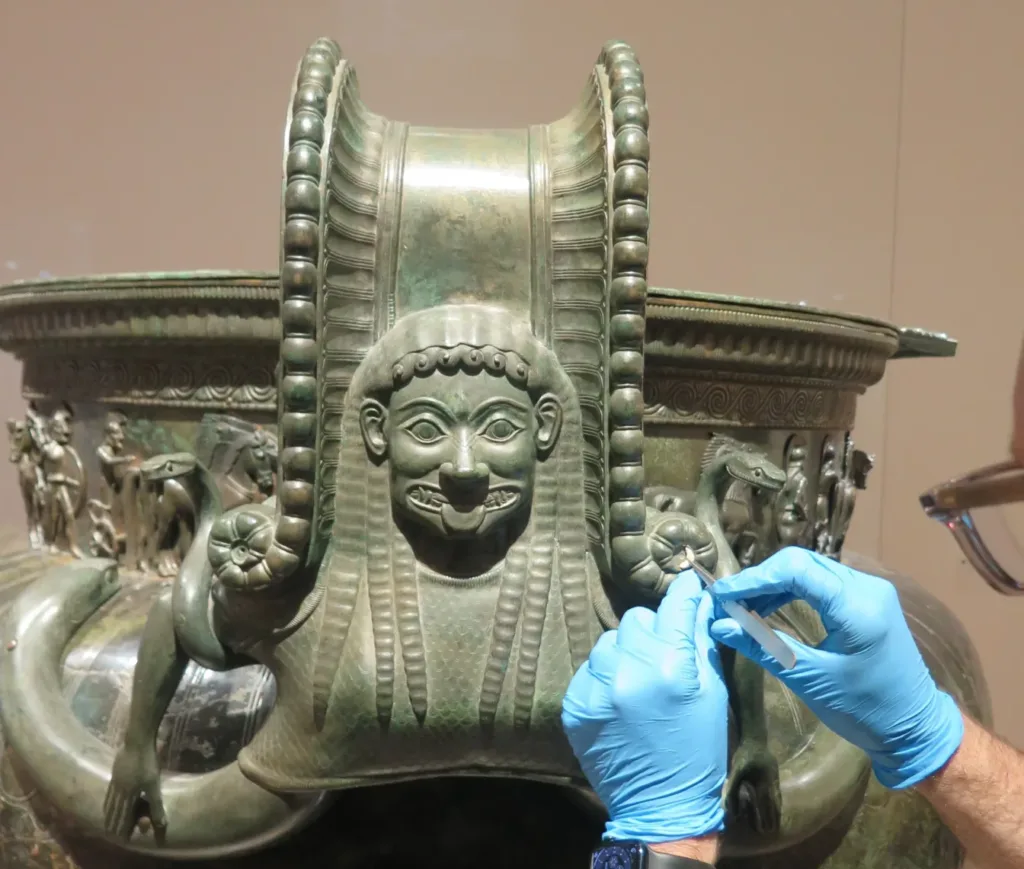
A small piece of coral discovered in the tomb of a 2,500-year-old Celtic princess in France may change the mythological significance of one of the ancient world’s most magnificent bronze vessels. Researchers have determined that the coral, which was once bright red, may have belonged to one of the decorations surrounding the Medusa figures on the handles of a giant Greek krater. This connection brings back to the forefront the theory that red coral symbolized the petrified blood of Medusa in Greek mythology.
Bastien Dubuis, an archaeologist at the National Institute for Preventive Archaeological Research (Inrap), evaluated the results of a re-examination of the famous Vix tomb in a detailed interview with Inrap. The findings include missing decorations from the krater, a tiny bronze fragment that explains the movement of the female figurine, and jewelry that alters the chronology of the tomb. New analyses provide a different dimension to the Vix princess’s relationship with the Mediterranean world.
Red Coral Representing Medusa’s Blood
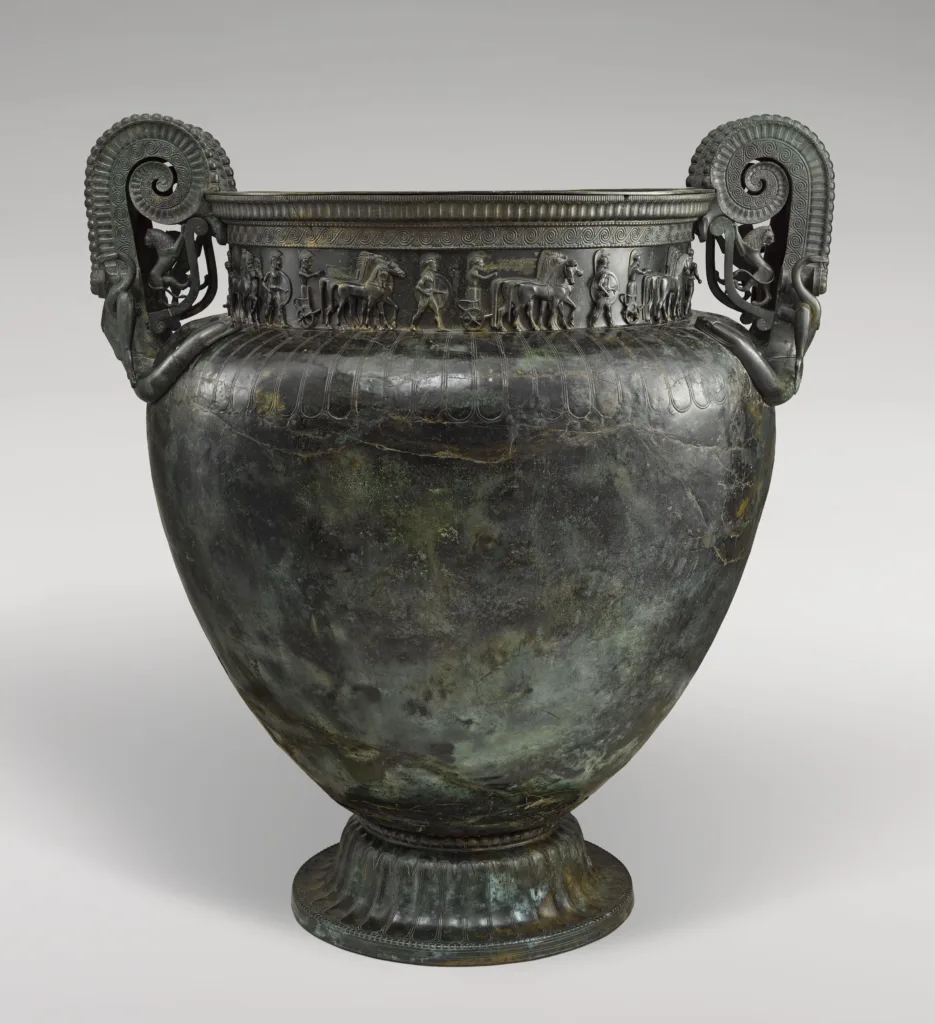
Located near Mont Lassois in the Côte-d’Or region of France, the Vix tomb became renowned following excavations carried out by archaeologists in 1953. The burial chamber contained a gold torc, a four-wheeled ceremonial chariot, precious vessels, and the remains of a high-status woman. However, the most striking artifact of the discovery was a giant Greek bronze krater, approximately 1.64 meters in height.
The krater, capable of holding roughly 1,100 liters of liquid, features depictions of the Gorgon Medusa on its two large handles. In Greek mythology, Medusa—believed to turn people to stone with her gaze—is one of the most famous mythological creatures slain by Perseus. The spiral decorations on the krater’s handles contain a small detail that researchers have struggled to explain for years.
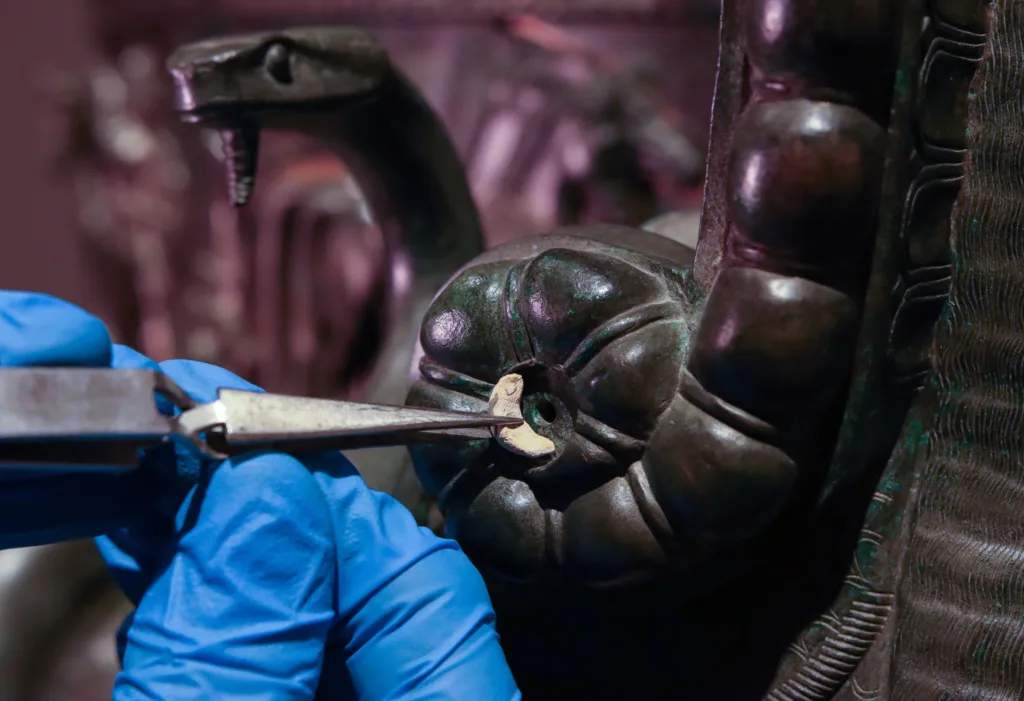
There are two spiral ornaments on each handle, and at the center of each is a round socket. Totaling four sockets, these contain holes drilled to secure the decorative pieces. Archaeologists have known since 1953 that these sockets were empty; however, they were initially unable to determine which material had been used.
While re-examining the soil screened after the 2019 excavation, Dubuis’s team identified a small, semi-circular piece of coral. The fragment, slightly exceeding one centimeter in diameter, fits perfectly into the round sockets on the krater’s handles. Consequently, researchers believe the bronze surface of the krater may have originally been completed with red coral decorations.
It is notable that the coral currently appears off-white. According to Inrap’s photo descriptions, the piece was once a brilliant red. Thus, it is understood that the pale find seen in the photos is the same object as the red coral mentioned by researchers.
Dubuis suggests that this choice of material may not have been accidental. A connection is drawn in Greek mythology between the formation of coral and the blood of Medusa. According to the researcher, the red coral ornaments flanking the Gorgon heads may have represented Medusa’s petrified blood.
This interpretation suggests that the krater was not merely an object showcasing wealth. The color contrast between the greenish surface of the bronze and the red coral may have been a conscious part of the mythological narrative. However, no inscription or other definitive evidence directly confirming the symbolic meaning of the coral has yet been found.
Dubuis also proposes a potential semantic link between red coral, blood, and red wine. Wine arriving from the Mediterranean to the Celtic world was a precious beverage for the elite. The fact that a giant krater designed for mixing wine was decorated with Medusa and coral indicates that the beliefs of different cultures may have converged in a single object.
A Seven-Millimeter Bronze Piece Changes the Meaning of the Female Figurine
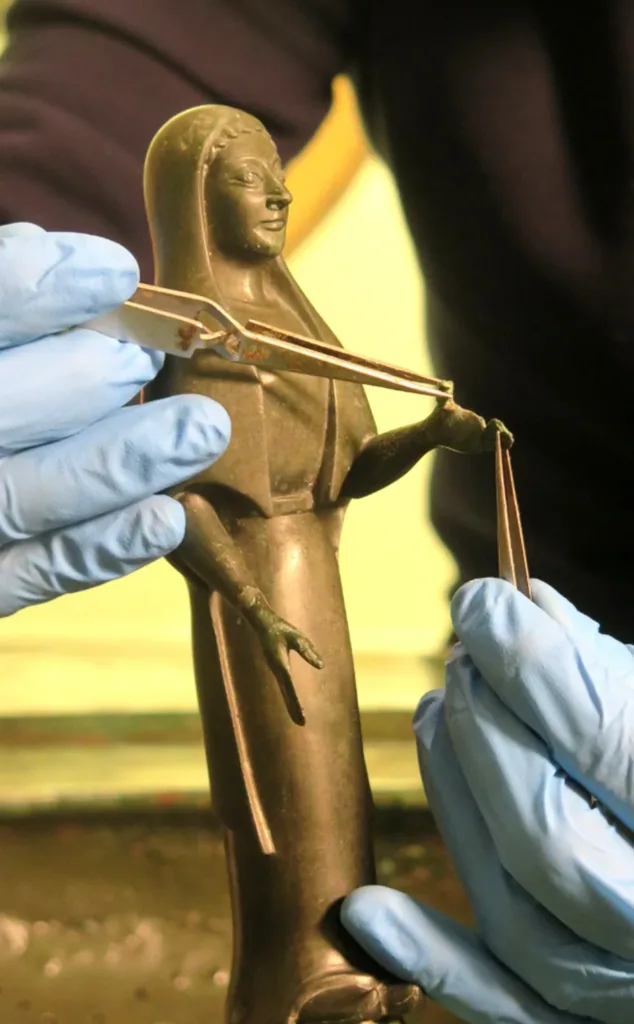
The small female figurine on the lid of the Vix krater is also a focus of the new research. For years, researchers interpreted this figure as a priestess pouring wine from a vessel or performing a religious offering. The wine-related vessels within the tomb seemed to support this explanation.
However, while examining hundreds of small bronze fragments, Dubuis noticed a piece only seven millimeters long with parallel lines on it. He identified this as the fingers of the figurine’s left hand. Subsequently, he found the missing thumb of the same hand in the museum storage.
These two small finds made it possible to re-evaluate the figure’s posture. The woman was not holding an offering vessel, as previously thought. Instead, she was extending both hands forward, open.
According to Dubuis, this gesture could be a sign of welcoming, greeting, or bidding farewell. Furthermore, there were originally other figurines on the lid of the krater. Connection marks and rivet holes that have survived to the present day indicate the existence of these lost figures.
The researcher believes that the other figurines may have been deliberately removed at some point. Such a change might have transformed the vessel’s original narrative and given a new meaning to the central female figure. However, the reason why the figurines were removed remains unknown.
The production date of the krater also makes this possibility significant. Dubuis states that the piece was produced around 540 BCE, while the Vix princess may have lived several generations later. Therefore, the vessel may have been used for a long time or passed down through generations before the woman’s death.
2,000 Pieces from Old Excavation Soil Change the Tomb’s History
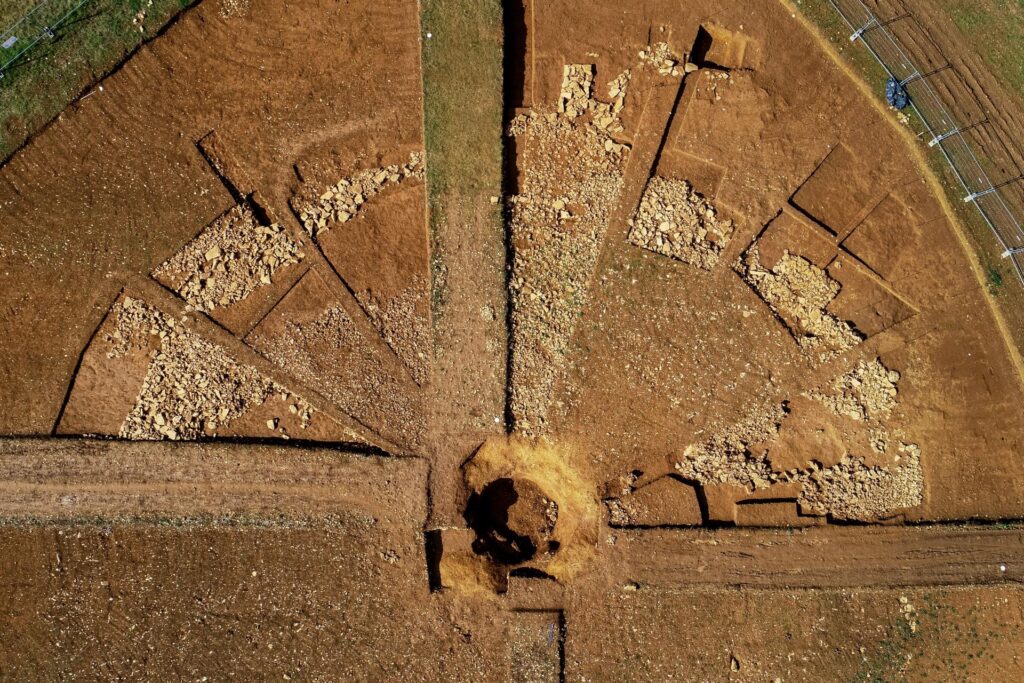
When the Inrap team returned to the Vix tomb in 2019, they did more than just conduct a new excavation. Archaeologists re-examined the area excavated by René Joffroy and Maurice Moisson in 1953. Since a large portion of the soil fill from the first excavation had been returned to the tomb, there was a possibility that small finds still remained in that soil.
The team collected approximately 72 large bags of soil and passed them through three-millimeter sieves. This work resulted in the identification of approximately 2,000 new fragments. Findings included metal components of the ceremonial chariot, bronze nails, vessel fragments, and fibulae (brooches) used to fasten clothing.
One of the most significant results was that the number of known fibulae in the tomb increased from eight to 16. By analyzing the forms of these pieces of jewelry, researchers re-evaluated the date of the burial. While previous studies placed the tomb around 500 BCE, Dubuis indicates that the new findings suggest the burial did not occur before 470 BCE.
This shift moves the tomb at least one generation later. At the same time, it strengthens the idea that the krater was produced long before the princess’s lifetime. The mix of old and new objects in the tomb suggests that Celtic elites preserved precious items for long periods.
The screening process also uncovered other personal items. Archaeologists found fragments of black sapropelite bracelets determined to have come from the Dorset coast of England. This material demonstrates the connections of the Vix elite extending beyond the English Channel.
During the screening, researchers also found one of the princess’s teeth. DNA obtained from the tooth showed that the Vix princess was not the mother or grandmother of the prince buried in the nearby Lavau tomb. Although the two tombs are chronologically close, the findings do not support a direct mother-son or grandmother-grandson relationship.
Red Wine, Greek Mythology, and Celtic Elites
Where exactly the Vix krater was produced remains a subject of debate. One view associates the work with workshops around the Greek city of Poseidonia in Southern Italy. Another approach points to the Northern Ionia region near Phokaia on the western coast of present-day Turkey.
Dubuis considers that if the proposal of eastern origin is correct, the female figure on the lid could be linked to a historical person. One potential candidate is the priestess Aristarche, mentioned in the migration narratives of the Phokaians. However, this interpretation remains a hypothesis, and no evidence has yet confirmed the figure’s identity.
Wine amphorae of Marseille origin found at Vix show that the region was integrated into Mediterranean trade networks. Bronze vessels from the Greek world, Etruscan items, and decorative materials transported from distant regions reveal the scope of these relationships.
But was there actually wine inside the giant krater? Chemical analyses on bronze fragments thought to be from the krater identified traces of pitch and black grapes. However, the analyses did not reveal fermentation markers that would confirm the presence of wine.
Dubuis emphasizes that the intensive washing of the fragments in the past may have affected the chemical residues. For this reason, it is not possible to say with certainty that the Vix krater contained wine. In contrast, analyses performed on the large cauldron at Lavau revealed residues associated with red wine.
According to Dubuis, the Vix krater shows that objects arriving from the Mediterranean did not gain importance in Celtic societies solely because of their material value. The Medusa figures, the red coral, and the changing arrangement of the figurines on the lid suggest that the vessel may have held different meanings across different eras.
