
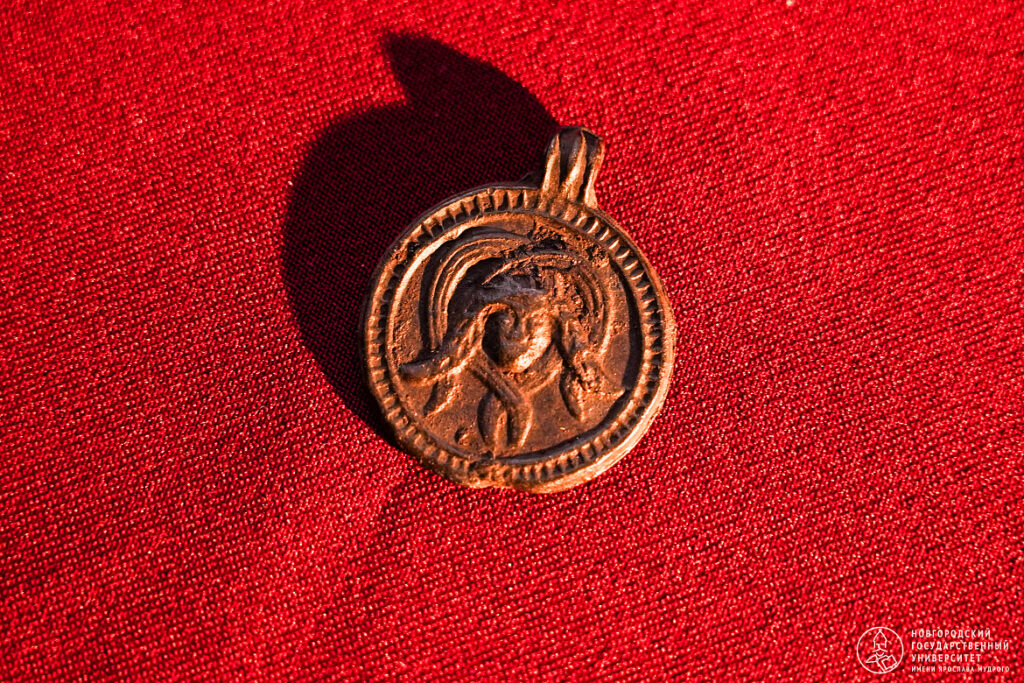
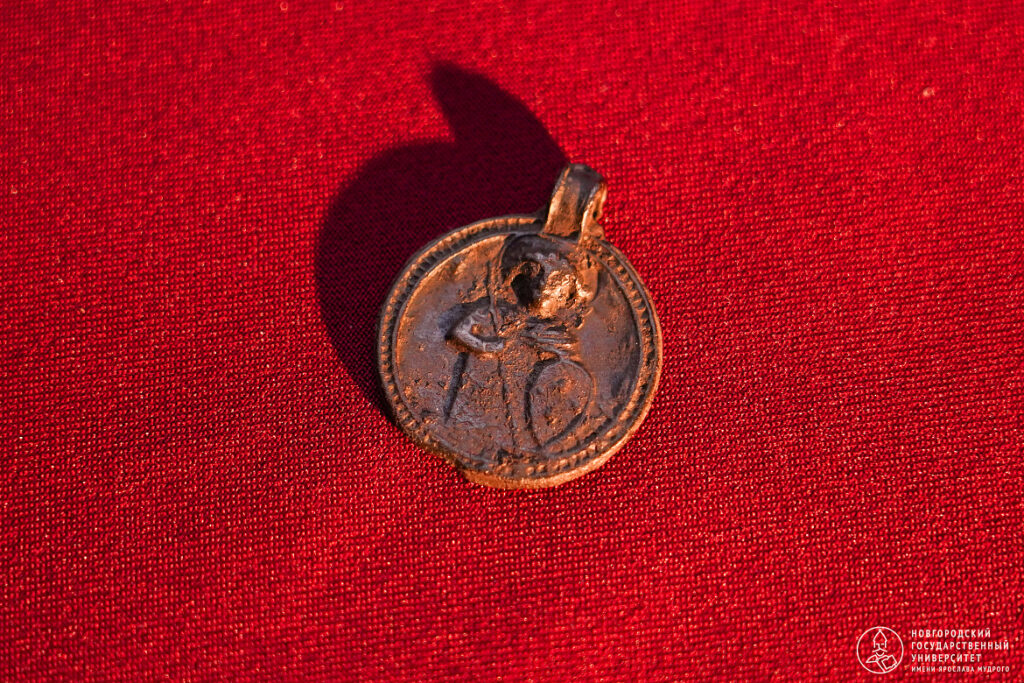
Archaeologists from Novgorod State University have discovered a rare 11th-century serpent amulet in Staraya Russa, with a Christian warrior saint depicted on one side and a snake-haired female face reminiscent of Medusa Gorgon on the other. The unusual pendant is among the earliest objects of its kind known from the territory of medieval Novgorod and offers a striking glimpse into a world where Christianity and older protective beliefs could exist on the same object.
The copper-alloy pendant was uncovered at the Pyatnitsky excavation site, within the boundaries of an ancient urban estate that was only beginning to develop during the 11th century. Researchers believe the Christian figure may represent Theodore Stratelates, a warrior saint shown carrying a spear and shield.
A Christian saint and a snake-haired face
The reverse side creates a very different impression. It depicts a female head surrounded by what appears to be snake-like strands of hair, an image ultimately derived from Medusa Gorgon of ancient Greek mythology.
Sergey Toropov, director of Novgorod State University’s Center for Archaeological Research, cautions that the figure probably should not be interpreted as a literal representation of the mythological Medusa. Instead, it may have served as a generalized image of dangerous or dark supernatural forces.
That combination lies at the heart of what makes the object unusual. From the perspective of strict Christian doctrine, the two images belong to very different traditions, yet medieval serpent amulets deliberately brought them together.
Known in Russian as Zmeeviki, these double-sided medallions typically carried an accepted Christian image on the front and a non-Christian serpent composition on the reverse. Christ, the Virgin Mary, the Archangel Michael and warrior saints such as St. George could all appear on examples of the type.
An amulet against illness
The tradition reached the lands of Rus’ from Byzantium, where ancient imagery continued to influence objects associated with protection and healing. Some surviving serpent amulets even carry Greek magical inscriptions, strengthening the interpretation that their owners wore them as protection against illness or other forms of harm.
The apparent contradiction may therefore have been intentional. A sacred Christian figure placed opposite a threatening serpent image could symbolize the triumph of divine or benevolent power over dangerous forces, while still preserving elements of older magical traditions.
The Staraya Russa pendant belongs to the earliest period in which such objects appeared in ancient Rus’. The oldest known examples date to the 11th century, and archaeologists recovered the newly discovered pendant from archaeological layers belonging to that same period.
Its age makes the discovery particularly significant for Staraya Russa. Only four serpent amulets had previously been found in the town, and all of them dated considerably later, between the 12th and 14th centuries.
A glimpse of an early Christian community
Researchers say the pendant adds to evidence that a functioning Christian community already existed in Staraya Russa during the 11th century. At the same time, the object illustrates how conversion did not immediately erase earlier concepts of protection, magic and supernatural danger.
Christian belief could instead coexist with traditions whose imagery reached back through Byzantium to the classical Mediterranean world. A pendant worn in medieval northern Rus’ could therefore carry, on opposite sides, a Christian warrior saint and an image whose visual ancestry extended to one of ancient Greece’s most recognizable monsters.
The find also points to cultural connections between Staraya Russa and Byzantium. Such objects were not simply religious ornaments; their form and iconography travelled along wider networks through which artistic ideas, beliefs and technologies circulated across medieval Europe.
Who owned the amulet?
Toropov suggests that the pendant may have belonged to a relatively prosperous resident of the estate: someone who might loosely be described as part of the medieval “middle class.” Poorer inhabitants were unlikely to afford such an object, while members of the elite tended to wear ornaments made from more valuable materials such as silver or gold.
There is another intriguing possibility. Archaeologists believe the Staraya Russa amulet may have been produced by copying another serpent pendant, and evidence indicates that a workshop capable of making such an object operated directly within the estate where it was found.
If so, the discovery would reveal more than the beliefs of a single owner. The small pendant could represent a local attempt to reproduce a centuries-old protective tradition that had travelled from Byzantium to medieval Rus’: compressing Christian devotion, ancient imagery and everyday fears into an object small enough to wear around the neck.
