
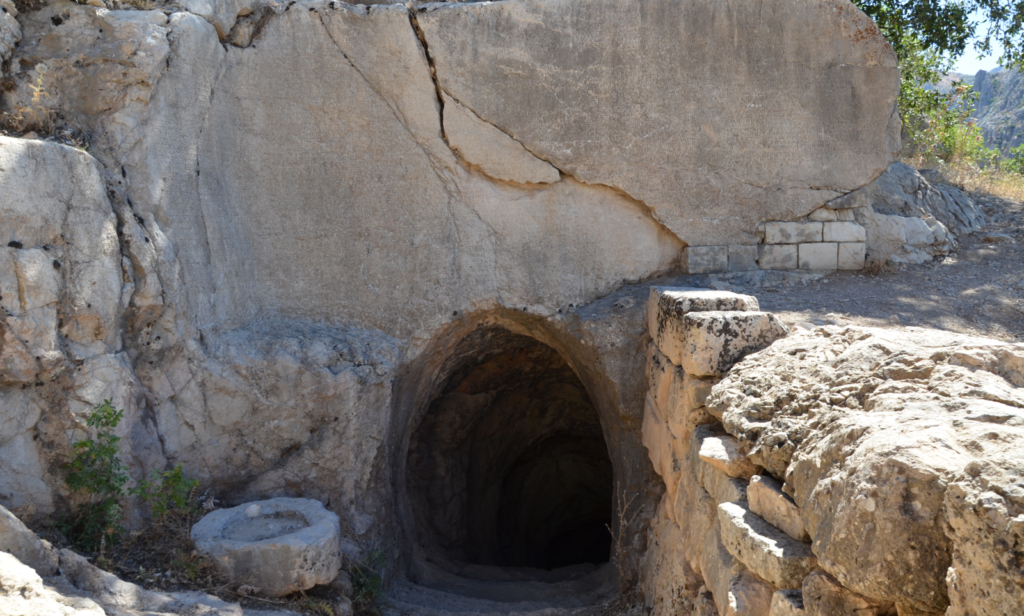
The 158-meter stepped tunnel extending deep into the rocks of the ancient city of Arsameia in Adıyaman may have played a far more significant role for those visiting the sacred sites of the Kingdom of Commagene approximately 2,000 years ago than previously thought. New research by archaeologist Lennart Wouter Kruijer from Leiden University reveals that the structure, long believed to have been used solely for water supply, may have also functioned as an element that shaped the movements, senses, and religious experiences of visitors.
The study, published in the Journal of Roman Archaeology, examines the tunnel at Arsameia—which became a major royal cult center during the reign of King Antiochus I—alongside the sacred way, the royal tomb, monumental reliefs, and religious inscriptions. According to Kruijer, the darkness of the tunnel, its narrow passages, steep steps, and the groundwater found at the end were integral parts of the relationship visitors established with the sacred site.
At the heart of the research is not only the purpose for which the tunnel was built, but also the question of how it might have influenced the behavior and perceptions of those who entered. Kruijer views the tunnel as an active element of a pilgrimage experience formed by the reciprocal relationships between people, objects, the natural environment, and rituals.
A Tunnel Entered Into Ritual
The researcher begins his article with an analogy made by anthropologist Maurice Bloch in 1974 regarding rituals:
“Ritual is a kind of tunnel into which one plunges, and where, since there is no possibility of turning either to right or left, the only thing to do is to follow.”
The Arsameia tunnel studied by Kruijer possesses characteristics that could be the physical manifestation of this analogy. The narrow, steep stairs carved into the rock force the entrant to move in a specific direction, while the conditions created by the darkness, depth, and enclosed space progressively limit freedom of movement.
The researcher approaches these features as a kind of “trap” designed to direct people toward a specific mode of behavior. Here, the “trap” is not a mechanism intended to capture people; rather, it is a concept used to explain the sacred space’s capacity to guide the movements, attention, and experience of its visitors.
According to Kruijer, this effect of the tunnel was not independent of the general layout of the sacred area. In the religious environment created by the Commagene kings, visitors were guided along a predetermined route even before reaching the tunnel.
On the Sacred Way of the Commagene Kings
Arsameia is located near Mount Nemrut in southeastern Türkiye, approximately 26 kilometers from the town of Kahta in Adıyaman Province. The ancient sanctuary occupies a rocky hill overlooking the Nymphaios River, now known as the Kahta River, opposite the historic Eski Kahta Castle. The site served as the tomb-sanctuary of King Mithridates I Kallinikos and became an important center of the Commagene royal cult under his son, Antiochos I.
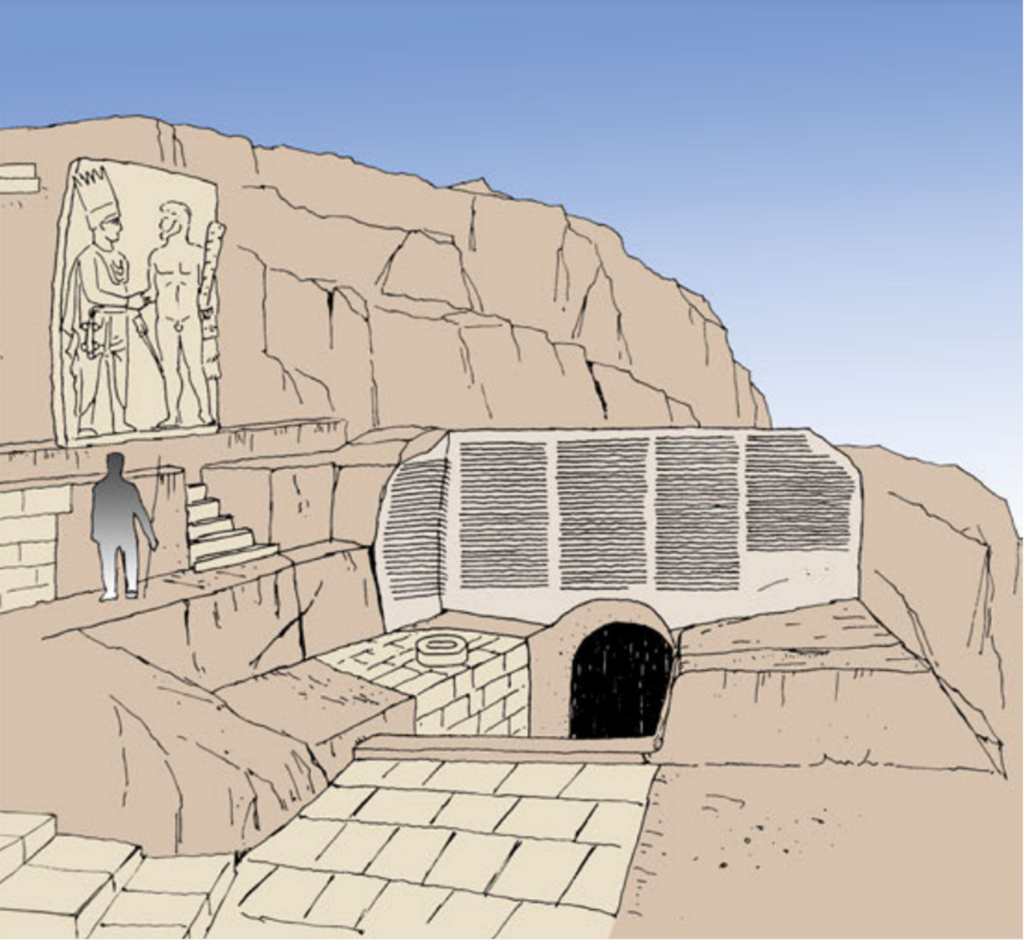
Those visiting the sacred site followed a monumental road that wound upward from the valley. Along the way were reliefs depicting kings shaking hands with gods, places of worship and offerings, rock-cut structures, and inscriptions.
One of the key stops on this route was another stepped passage, approximately 10 meters long, which is thought to have led to the burial chamber of King Mithridates I. Following this, visitors reached the 158.1-meter tunnel, the entrance of which featured a large Greek inscription.
The text, known as the Great Cult Inscription, contained the religious regulations established by Antiochus I for the sacred site. The inscription included rules regarding the hosting of local and foreign visitors, as well as monthly festivals held for the birthdays of the king and his father.
Near the tunnel was a monumental relief showing Antiochus I shaking hands with Artagnes-Herakles, who was identified with the Greek hero Heracles.
Kruijer states that the sacred way and its monuments guided visitors in stages. The tunnel is viewed as a continuation of this route—an element that delayed the visitor’s arrival at the statues of the king and gods in the highest section of the sacred area, while altering their physical and sensory experience.
Darkness, Fear, and the Underworld
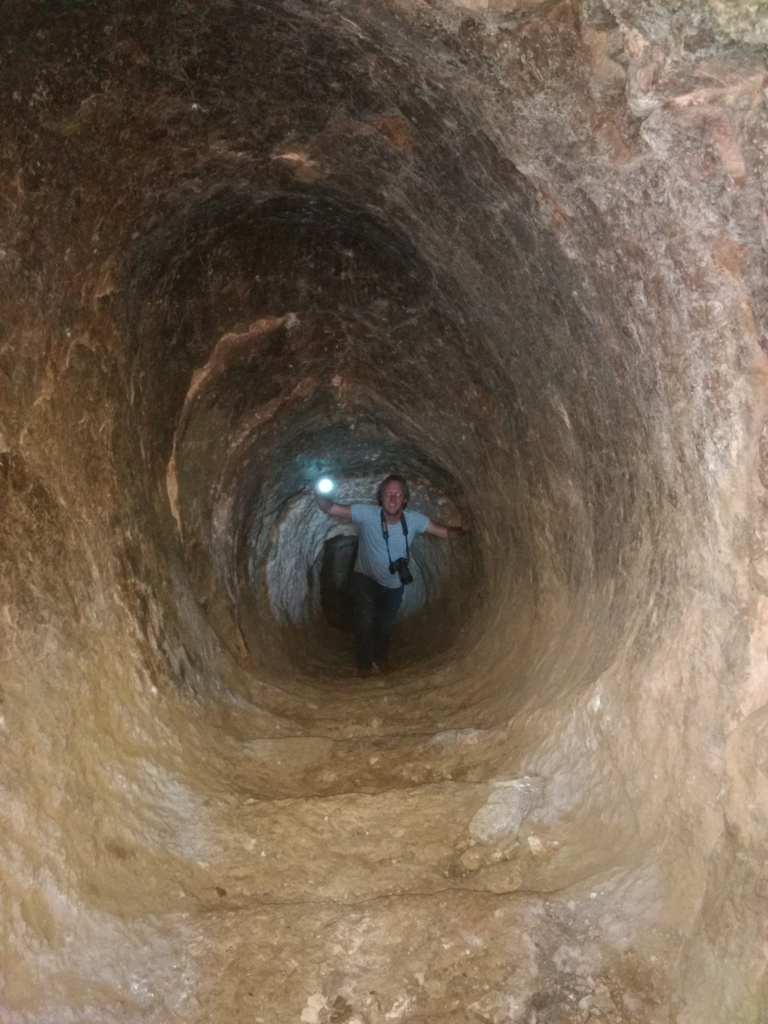
Starting from an entrance approximately two meters high and 1.5 meters wide, the stairs progress into the rock mass. Along the passage, light diminishes rapidly, the temperature drops, and the sounds of the outside world are replaced by the echoes of the enclosed space.
The irregular steps require careful foot placement and an increasing forward lean. According to the researcher, such a descent could have altered not only the way visitors moved but also how they perceived the space they were in.
Evaluating this effect, Kruijer draws on observations from excavations conducted at Arsameia in the 1950s. Friedrich Karl Dörner, who managed the excavations, noted that workers descending into the depths of the tunnel became increasingly uneasy due to the darkness and depth.
Kruijer reports that when he entered the tunnel in 2019, he felt a similar sense of anxiety coupled with a simultaneous desire to continue moving forward.
The religious meaning of the darkness is examined in the study alongside the royal tomb visited immediately before the tunnel. The fact that both structures have stepped passages descending underground and are located near royal reliefs suggests that visitors may have associated these spaces with death and the afterlife.
The depiction of Heracles at the entrance of the tunnel is also significant for this interpretation. According to Kruijer, the representation of Heracles—who in ancient mythology descended into the underworld—strengthens the possibility that the passage held meanings associated with the divine world.
However, the research does not prove that a specific ritual related to the underworld was performed in the tunnel. These connections are evaluated through the architectural layout of the sacred area, mythological references, and the sensory conditions visitors likely encountered.
Two Circular Hollows and Water at the End of the Tunnel
The Arsameia tunnel ends without reaching an exit after the 158.1-meter descent. In the final section of the passage, at approximately 141 and 150 meters from the entrance, there are two circular hollows. Each is approximately 2.5 meters in diameter, with depths ranging between 40 and 50 centimeters.
Additionally, there is groundwater at the end of the tunnel, the level of which varies by season. Following rainfall, the water can rise and partially fill the passage; in the summer months, it can recede significantly.
This feature supports the traditional view that the tunnel was used to provide water. It is known that water was required for the feasts held in the sacred area, the needs of visitors, and other activities.
However, Kruijer argues that water should not be seen merely as a practical resource.
The Great Cult Inscription of Antiochus I associates the natural resources and water of Arsameia with the identity of the sacred site. In the inscription, the region’s waters are mentioned alongside divine attributes. There are also provisions stating that drinking vessels used in religious feasts must not be taken outside the sacred area.
According to the researcher, the collection, transport, and ceremonial use of water created a constant relationship between people and the natural environment. The variability of the water level also influenced the conditions of the activities within the sacred area.
While it has been previously suggested that the circular hollows at the end of the tunnel might be linked to ritual bathing, this use has not been definitively proven.
What Do Other Stepped Tunnels in Anatolia Reveal?
Kruijer compares the Arsameia example with other rock-cut stepped tunnels in Anatolia. A significant number of these structures are found in the regions of Pontus, Paphlagonia, and Galatia.
In a comprehensive study published in 1967, 51 tunnels in Anatolia were examined. Subsequent research documented 39 more tunnels in 30 different locations in the Pontus region, adding them to the scope of the work.
Many of these passages were interpreted in the past as military structures, specifically built to provide access to water during sieges. This view is supported by the fact that some reach groundwater and are connected to fortress settlements.
However, not all tunnels share the same characteristics. While some stand out for their large size, others are found near religious reliefs, cult niches, and statues.
The statue of Cybele discovered at the entrance of the tunnel at Kurul Castle in Ordu is one of the striking examples showing that these structures could be associated with religious practices in some cases. Similar connections are discussed at İncesu near Çorum and in other settlements.
Rather than claiming that all Anatolian tunnels were used for the same purpose, Kruijer emphasizes that each structure should be evaluated within its historical and religious context.
Kruijer, L. W. (2026). Descent into a trap: Pilgrim affordances of the rock-cut staircase tunnel at Arsameia on the Nymphaios. Journal of Roman Archaeology, 1–20. doi:10.1017/S1047759426101196
