
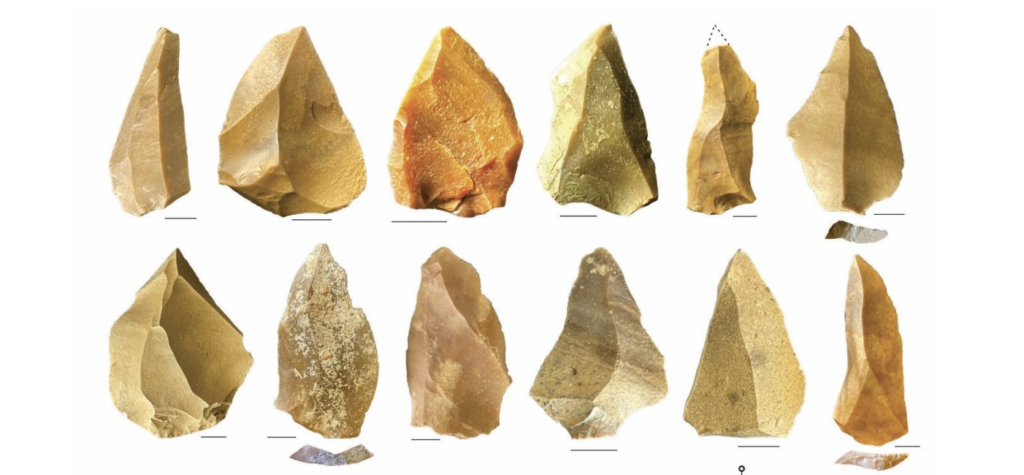
Stone hunting weapons dating to approximately 125,000 years ago have yielded traces of plant-based poison in Saudi Arabia, potentially pushing back the earliest evidence of poisoned hunting technology by 65,000 years. Researchers identified chemical compounds associated with toxic plants on prehistoric stone points that also carried impact damage and animal residues. The discovery suggests that early human populations in Arabia possessed sophisticated knowledge of plants and combined different materials to manufacture hunting weapons.
An international research team led by Chris Clarkson of Griffith University investigated the archaeological site of ‘Uruq Aljelibah, near the ancient shores of Lake Mundafan in southern Saudi Arabia. Their study, published in the journal Science, documents 5,511 stone artifacts and more than 500 fossils, providing evidence of hunting, toolmaking, and extensive plant processing in a landscape now dominated by desert.
Poison Residues on Prehistoric Hunting Weapons
The strongest evidence emerged from microscopic and chemical examinations of 89 stone tools. Researchers identified organic residues on 75 artifacts, including plant fibers, resins, animal-derived materials, and chemical compounds associated with potentially poisonous vegetation.
Several pointed tools displayed fractures consistent with impacts during hunting. On some specimens, researchers identified chemical biomarkers linked to Acokanthera schimperi, a toxic plant traditionally used to produce hunting poisons in parts of Africa.
The plant contains cardiac glycosides, substances that can interfere with heart function. Finding related chemical signatures on stone points alongside animal residues and impact damage strengthens the interpretation that prehistoric hunters may have deliberately incorporated poison into their weapons.
However, the researchers cannot yet establish precisely how people prepared these substances, applied them to the stone points, or whether the resulting weapons delivered physiologically effective doses. The evidence supports the use of poisonous plant materials, while leaving important questions about their preparation and practical effectiveness unresolved.
The discovery also has wider implications for the history of hunting technology. In January 2026, researchers reported evidence of plant poison on 60,000-year-old stone arrowheads from South Africa’s Umhlatuzana Rock Shelter. The Arabian findings suggest that comparable technological knowledge may have existed approximately 65,000 years earlier.

Stone Tools Combined with Wood, Fibers, and Resins
Evidence of poison represents only one aspect of the technological capabilities documented at ‘Uruq Aljelibah. Researchers also found indications that prehistoric inhabitants attached stone points to wooden shafts using plant fibers and adhesive materials.
Of the 89 tools examined for residues and wear, 34 provided evidence consistent with hafting, while another 10 showed possible indications of the same practice. Some preserved resin and fibers near their bases, alongside animal-derived residues closer to their working edges.
These combinations suggest that people manufactured composite implements rather than relying exclusively on handheld stone tools. Making such weapons required an understanding of how different materials behaved and how to secure stone components during use.
Microscopic wear patterns also indicate that other tools served for cutting, sawing, and processing vegetation. The results demonstrate that Middle Paleolithic communities employed diverse technologies for exploiting resources beyond the animals they hunted.
A 340-Square-Kilometer Lake in Today’s Desert
The archaeological discoveries came from an environment dramatically different from modern southern Arabia. Around 125,000 years ago, the Mundafan basin contained a freshwater lake covering approximately 340 square kilometers and reaching an estimated maximum depth of 29 meters.
Today, extensive dunes of the Rub’ al-Khali, or Empty Quarter, surround the former lakeshore. During the Last Interglacial, however, wetter climatic conditions supported vegetation, freshwater ecosystems, and large populations of animals.
The research team documented fossils belonging to hippopotamuses, extinct long-horned buffalo, camels, Arabian oryx, gazelles, and ostriches. Their presence indicates that the ancient lake and surrounding grasslands sustained wildlife communities largely absent from the region today.
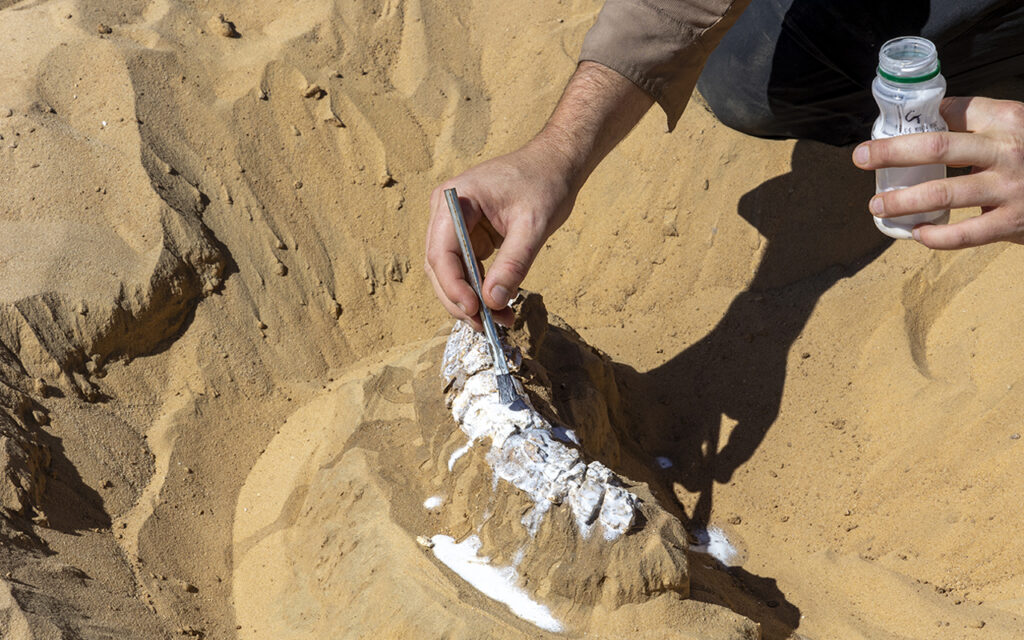
Archaeologists also identified concentrations of stone artifacts near animal remains. Refitting stone fragments helped demonstrate that people repeatedly manufactured tools and processed animal resources along the lakeshore.
The findings therefore present Arabia as more than a temporary passage between continents. During favorable climatic periods, its freshwater environments offered resources that could support repeated human activity and increasingly complex technological practices.
Plant Processing Beyond Poison Production
Residue analysis identified traces of palms, woody plants, underground plant organs, resins, and fibers on different stone tools. These discoveries indicate that vegetation played a substantial role in everyday activities, extending beyond its potential use in hunting poisons.
Researchers suggest that inhabitants processed plants to obtain food and materials for tool handles, bindings, cordage, and other equipment. Such organic objects rarely survive for more than 100,000 years, making the microscopic traces on stone artifacts particularly informative.
The variety of residues also reveals how prehistoric communities exploited different parts of their environment. Rather than specializing exclusively in large-animal hunting, they appear to have combined animal processing with woodworking and plant-fiber production.
This evidence expands our understanding of Middle Paleolithic technology, particularly the importance of perishable materials that conventional archaeological excavations often fail to preserve.
New Evidence for Early Human Life in Arabia
Scientists established the site’s approximate chronology primarily through optically stimulated luminescence dating of sediments. They also examined fossil hippopotamus teeth using uranium-series and electron spin resonance methods, obtaining results broadly compatible with a humid period around 125,000 years ago.
An important limitation remains: researchers collected many artifacts from exposed surfaces rather than directly dated archaeological layers. Consequently, the geological chronology supports their association with the ancient lakeshore but does not independently establish the precise age of every individual tool.
No human fossils have been recovered from ‘Uruq Aljelibah, preventing researchers from conclusively identifying which human population manufactured the artifacts. Nevertheless, the combination of hunting weapons, botanical residues, animal fossils, and toolmaking evidence provides an unusually detailed record of prehistoric activity.
As the Spanish National Research Centre for Human Evolution (CENIEH) explains, humid phases transformed Arabia into a landscape capable of supporting diverse human activities, rather than simply opening migration routes between Africa and Asia.
The possible use of plant poisons adds another dimension to this picture. It suggests that early inhabitants possessed practical botanical knowledge and incorporated potentially toxic substances into complex hunting systems long before the development of later prehistoric societies.
Chris Clarkson et al., Poisoned hunting weapons, megafauna, and plant use at a 125,000-year-old Arabian paleolakeshore. Science 394,746-751(2026).DOI:10.1126/science.aef9342
