
23 January 2026 The Future is the Product of the Past

3,000-Year-Old Rare British-Style Sickle Unearthed in France

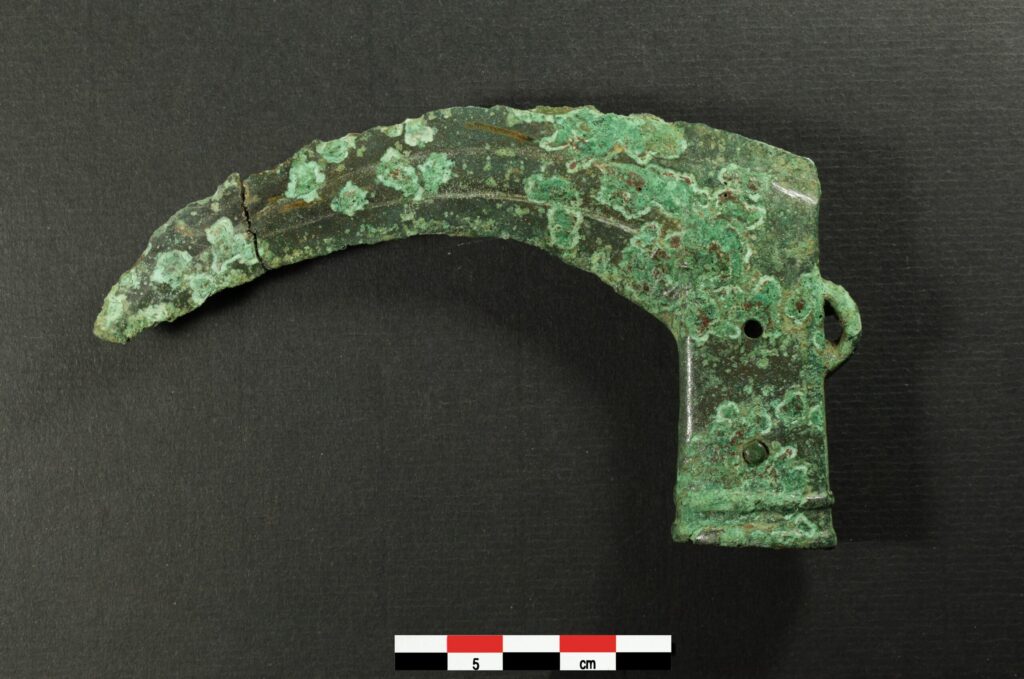
On August 6, 2025, France’s Inrap (Institut national de recherches archéologiques préventives) announced a remarkable archaeological find at Val-de-Reuil, in the Eure department: a rare British-style socketed sickle dating to the Late Bronze Age (10th–9th century BC).

A Legacy Buried in the Seine Valley

The sickle was found inside a small pit at the “Le Suret” site in the lower Seine Valley. Alongside it lay a cordoned pottery vessel and fragments of burnt sandstone, suggesting the deposit may have had ritual or symbolic significance.

Made from a copper alloy, the tool measures 134 mm in length, 50 mm in height, and weighs 104 g. While the blade shows signs of wear with chipped edges and a broken tip, the socket is remarkably well preserved. It features two decorative mouldings, a lateral suspension ring, and two pin-holes that once secured a wooden handle. One of these pins—likely made from bone—still remains intact. Inside the socket, traces of the original handle were found, though the wood was too degraded for precise identification.

Botanical Clues: Tracing the Handle’s Origins

Specialized wood analysis narrowed the handle’s material to five possible tree species: willow, poplar, alder, hornbeam, or hazel. Evidence points most strongly to willow, a flexible and readily available wood in the region during the period. Radiocarbon dating places the artifact firmly in the Atlantic Final Bronze Age, around the 10th to 9th centuries BC.
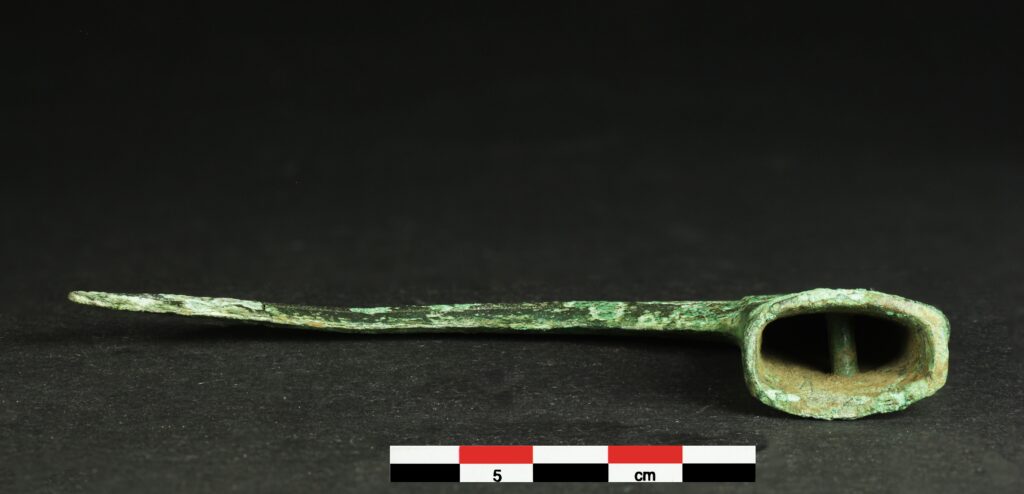
Val-de-Reuil, Le Suret (Eure): British-style socketed sickle from the Late Bronze Age, side view. Credit: S. Le Maho, Inrap

A Rare Find That Speaks Volumes

Socketed sickles of this British style are exceptionally rare on the European mainland. Only about a dozen examples have been recorded, most from coastal regions along the English Channel, including the Somme and Seine valleys and the Atlantic seaboard. Before this discovery, only two other specimens were known from the Seine Valley—one in Vernon and another recovered from the Seine in Paris.


📣 Our WhatsApp channel is now LIVE! Stay up-to-date with the latest news and updates, just click here to follow us on WhatsApp and never miss a thing!!


The Val-de-Reuil sickle underscores the existence of extensive Bronze Age maritime and river trade routes, which connected both sides of the English Channel. These waterways played a central role in the movement of metals, tools, and ideas across what is now northern France and southern Britain.

Bridging Past and Present

Beyond its rarity, the sickle offers valuable insights into prehistoric craftsmanship, agricultural practices, and the cultural links between communities separated by sea but united through trade. Its sophisticated design reflects both functional utility and aesthetic care, marking it as an object of high skill in metalworking.

This discovery contributes to a broader understanding of the Bronze Age exchange systems and the strategic role of river valleys in fostering long-distance connections. It also enriches the archaeological record of the lower Seine Valley, offering a tangible link to a time when metal and water shaped the social and economic landscapes of Europe.

INRAP

Cover Image Credit: S. Le Maho, Inrap

Related Articles

Remarkable discovery of Iron Age and Roman treasures found near a boggy area on Anglesey

29 February 2024

29 February 2024

Metal detectorist Ian Porter unearthed sixteen historical artifacts in a boggy field on Anglesey. Among the items found were Iron...

Unique 2700-year-old mosaics unearthed in illegal excavations

17 November 2021

17 November 2021

Two 2700-year-old mosaics, which are thought to belong to a Roman rich man and symbolize magnificence, were found in a...

A Rare Late Neolithic Period Seal found in Domuztepe Mound

25 August 2022

25 August 2022

A rare Late Neolithic Seal was discovered during the 2022 excavations of the Domuztepe Mound (Domuztepe Höyük), located on the...

First Human Figurine of the Mesolithic Era (Circa 9000 Years Old) Discovered in Azerbaijan’s Damjili Cave

19 April 2025

19 April 2025

A groundbreaking discovery has been made in the Damjili Cave in Azerbaijan’s Gazakh district: the first human figurine from the...

Rare Medieval Flail Weapon Discovered Near Battle of Grunwald Site in Poland

1 January 2026

1 January 2026

A rare medieval flail weapon has been unearthed near the historic Battle of Grunwald site in northeastern Poland, offering valuable...

A Remarkably Rich Roman-Era Funeral Pyre Discovered in Southwestern France

26 November 2025

26 November 2025

A remarkably rich Roman-era funeral pyre was discovered in Dordogne, France, revealing a rare 1st–2nd century cremation structure with luxury...

Ruins of China’s earliest state academy found in east China

21 February 2022

21 February 2022

The ruins of ancient China‘s first government-run institution of higher learning, built in 374 BC, have been discovered in the...

First European farmers’ heights did not meet expectations

9 April 2022

9 April 2022

A combined study of genetics and skeletal remains shows that the switch from primarily hunting, gathering and foraging to farming...

Statue Head of Goddess Tyche Discovered in Bulgaria

8 December 2024

8 December 2024

A remarkably crafted head of a large statue of the Greek goddess Tyche was recently unearthed during the excavations of...

The 1800-year iron mask unearthed in Turkey is proof of the first military base of the Roman period in the Western Black Sea Region

23 November 2021

23 November 2021

An iron face mask used by a skilled member of the Roman cavalry 1,800 years ago has been discovered in...

1,800-Year-Old Sanctuary to Mithras discovered in Spain

8 February 2023

8 February 2023

Archaeologists excavating at Villa del Mitra in Cabra, Spain, have uncovered a sanctuary dedicated to the god Mithras, along with...

A Polish-Croatian team discovered Ancient Roman Temple under a Croatian 18th Century church

24 November 2022

24 November 2022

Under an 18th-century church, the Church of St. Daniel in Danilo near Sibenik, Croatia, the foundations of an ancient Roman...

2,000-Year-Old Roman Stele Decorated with an Eagle and Greek Inscriptions Found in Manbij, Syria

23 August 2025

23 August 2025

A striking Roman-era stele carved from black basalt, featuring a detailed eagle clutching a wreath and adorned with Greek inscriptions,...

1,400-Year-Old Bronze Cauldron Discovered in Pergamon’s ‘Mosaic House’

27 July 2025

27 July 2025

A remarkable archaeological discovery has been made in the ancient city of Pergamon (modern-day Bergama) in Turkey’s İzmir Province. Excavations...

The researchers may have cracked the mystery of da Vinci’s DNA

7 July 2021

7 July 2021

A recent study of Leonardo da Vinci’s family tree indicates that the renowned Renaissance artist, inventor, and anatomist had 14...