
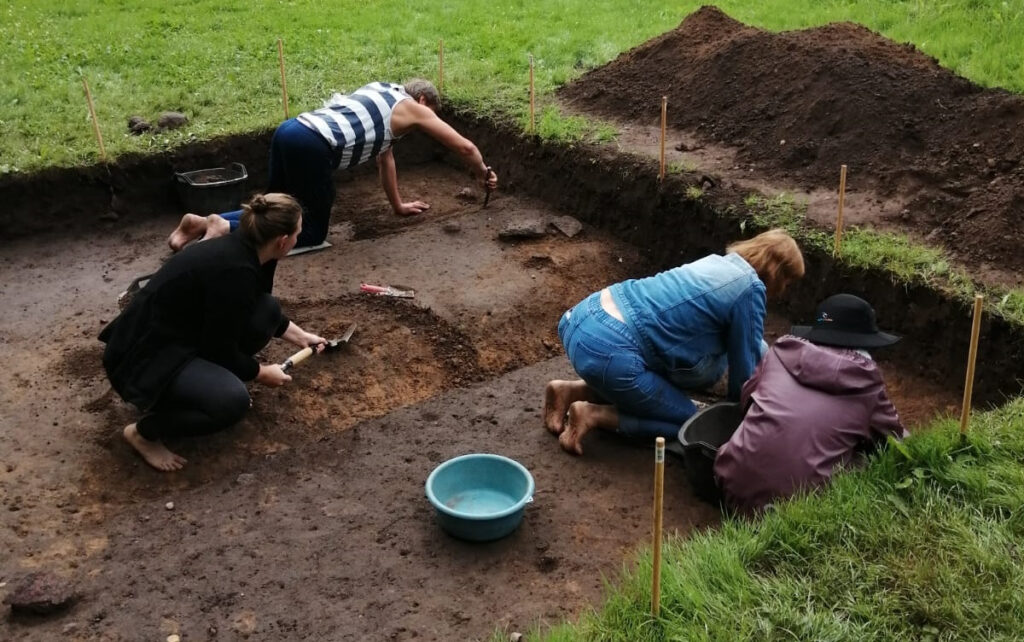
Archaeologists have uncovered remarkable evidence of ancient human habitation during the latest excavations at Skaņkalne Hillfort, offering fresh insights into the site’s origins and its significance in Latvian prehistory.
The ongoing research, led by archaeologists Ināra Kuniga and Liene Švēde, has not only revealed new historical layers but has also actively involved the local community. Students and history enthusiasts have joined the dig, gaining hands-on archaeological experience and contributing to the preservation of Latvia’s heritage. Among the participants are local school student Sergejs Lemes and amateur historian Gvido Mārins, both of whom are playing an enthusiastic role in the project.
From the Iron Age to the Late Neolithic
Skaņkalne Hillfort was first archaeologically investigated in 2022, when a 12.5-square-meter area revealed the remains of a dwelling, complete with a sunken hearth used for cooking and heating. Charred remains from the hearth contained fragments of clay pottery, hinting at the daily life of its early inhabitants.
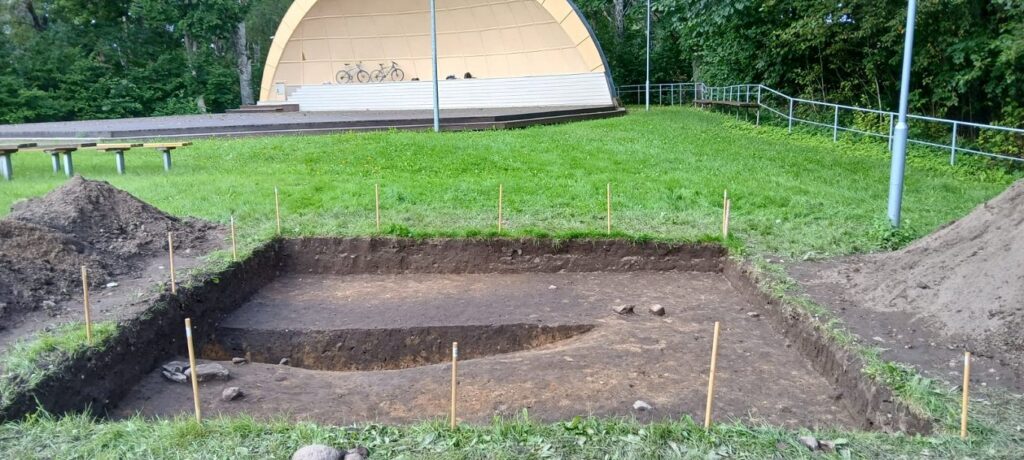
This year’s excavations, covering 16 square meters on the northern part of the hillfort, have brought even older history to light. “We were very excited to find charcoal remains,” said archaeologist Kuniga. “They will allow us to determine the exact age of the structure using radiocarbon dating.”
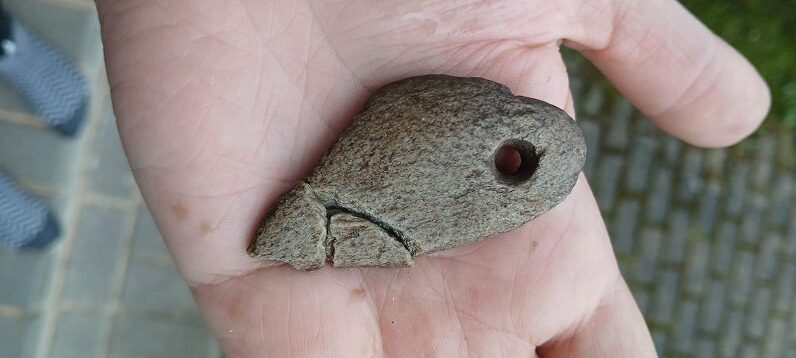
While the cultural layer left by the Livonians in this part of the site has been destroyed, deeper soil layers preserve traces of habitation from the Late Neolithic (3000–1800 BCE) and the Bronze Age. Finds include a slate pendant, flint tools, and incised pottery. An oval-shaped flint striker, dating to the mid-1st century CE, suggests that occupation of the site continued well into the early Iron Age.
“These discoveries have shifted our understanding of Skaņkalne Hillfort’s history to a much earlier period,” explained Švēde. “Its location at the confluence of two rivers offered excellent conditions for fishing, hunting, and safe settlement in a naturally protected environment. Locals can be proud of such an ancient heritage.”
A Monument of Strategic and Cultural Importance
Skaņkalne Hillfort, also known as Skulberģi Hillfort, Kolberga Hillfort, Lībju Hill, Ogļu Hill, and Lībiešu Hillfort, sits between the left bank of the Salaca River and a tributary gorge, near the historic Lībiešu homestead in Valmiera Municipality. Its irregular oval plateau is encircled by a defensive rampart up to five meters high and 70 meters long, separating it from the surrounding landscape. The plateau measures roughly 70 meters in length and 30–60 meters in width.
In 1927, researcher Ernests Brastiņš suggested that the fortifications dated to the Late Iron Age (10th–12th centuries). However, the new findings push the earliest human presence at the site back several millennia, changing the narrative of its settlement history.
Adding to its intrigue, the sandstone cliff facing the Salaca River contains a cave known as Upurala (“Sacrifice Cave”), believed to have served as a religious site for the hillfort’s ancient inhabitants. Such ritual caves are frequently found near Livonian hillforts, hinting at a deep spiritual connection between the community and the surrounding landscape.
Hands-On Heritage Preservation
The Skaņkalne excavations are not just a professional research project—they are also an educational initiative. Through programs run at the Riga Students’ Palace Archaeology Club, local residents can join professional archaeologists in the field, learning excavation techniques, mapping finds, and cataloging artifacts. All discoveries will be recorded and handed over to the Latvian National History Museum.
The work is physically demanding: the first day involved removing turf and topsoil with shovels, while later stages required finer tools to carefully uncover and document each find. Precise mapping and drawing of the excavation area ensure that the context of every artifact is preserved for future research.
Future of Skaņkalne Hillfort Research
Given the size and complexity of Skaņkalne Hillfort, the archaeological work will continue for several more years. Researchers hope that further excavations will refine the site’s chronology, uncover more evidence of ancient daily life, and shed light on its role in trade, defense, and spiritual practices.
For Latvia’s heritage community, Skaņkalne Hillfort is more than just an archaeological site—it is a bridge between the country’s distant past and its present identity, telling the story of human adaptation, resilience, and cultural continuity over thousands of years.
Cover Image Credit: Latvian National History Museum
