
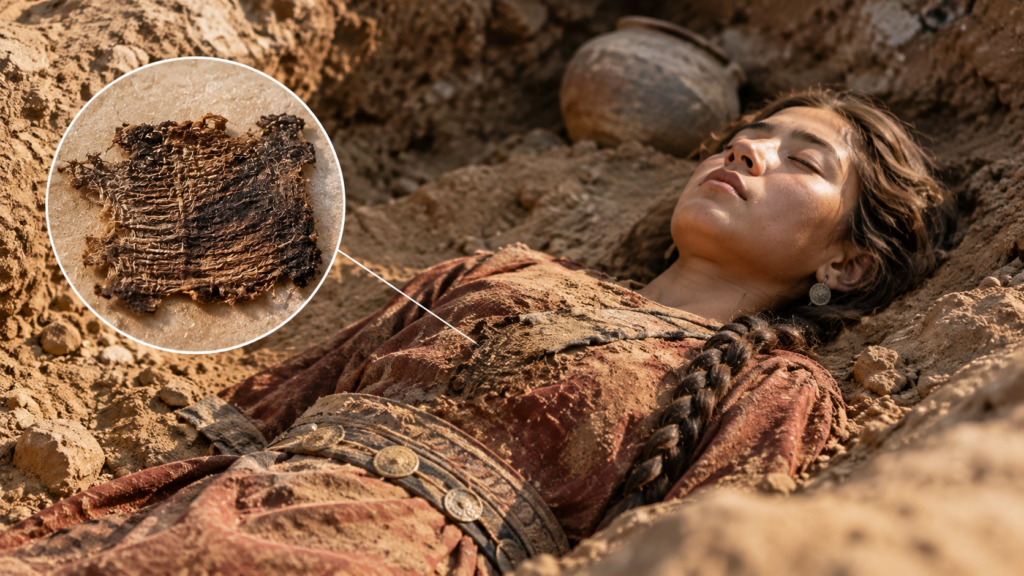
A piece of fabric, small enough to fit in the palm of a hand and discovered in the grave of a young woman in Kazakhstan, has provided significant evidence regarding ancient connections between China and Central Asia. Scientists examining the textile remains—approximately 2,400 years old and degraded to the point of being nearly unrecognizable—determined that the fabric was produced from Chinese tussah silk. The find demonstrates that Chinese silk reached the Eurasian steppes long before the emergence of the historical Silk Road.
The joint research, conducted by the Shaanxi Academy of Archaeology in China and the Issyk National Museum of History and Culture in Kazakhstan, was published in the journal Journal of Archaeological Science: Reports. Zhenzhen Ma and colleagues identified the biological origin of the material by analyzing the fibers and preserved proteins of the fabric, which had previously been suspected to be silk. While providing new evidence of early cultural connections, the study also illustrates how archaeological textiles can be re-evaluated using modern scientific methods.
Silk Preserved in the Grave of a Young Woman
At the center of the study is a fabric remnant recovered from the Karatumma cemetery in the Almaty region of Kazakhstan. The grave, dating between the 5th and 3rd centuries BCE, contained a woman determined to have been approximately 18–25 years old at the time of her death.
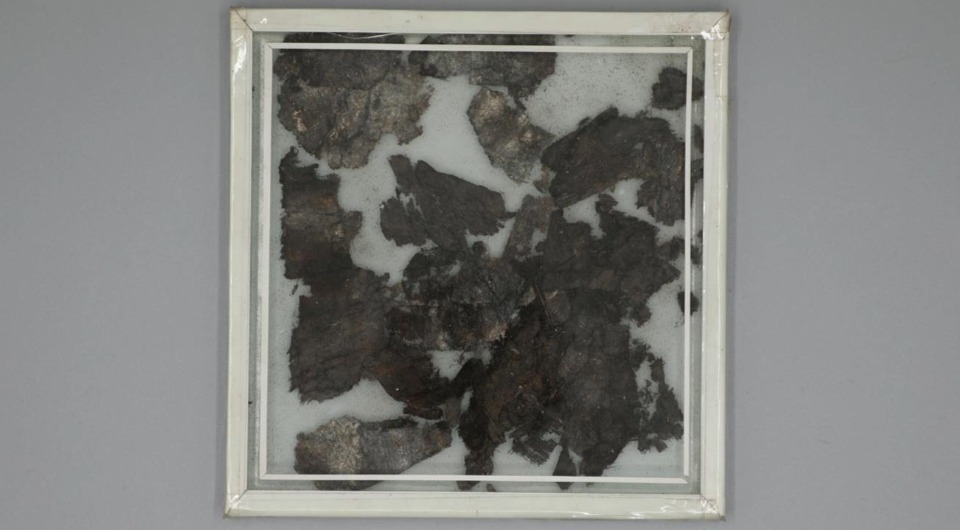
The fabric, found in the central section of the grave, was located approximately 30–40 centimeters away from the arm and leg bones. The position of the dark brown remnant, measuring only 8 x 5 centimeters, led researchers to conclude that it may have been part of the woman’s funerary garment.
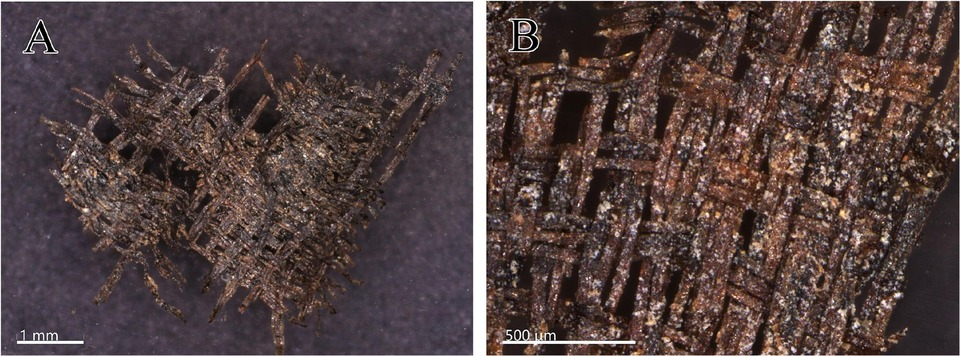
Centuries spent underground had almost completely altered the fabric’s appearance. The fibers had mineralized, portions of the weave had disintegrated, and the surface was coated in dark residues. However, microscopic examinations revealed that vital details of the original weaving structure remained preserved.
Kazakh conservators identified a plain weave technique consisting of fine warp and thicker weft threads. Additionally, they detected two different types of stitching and signs of repair. According to the researchers, the fact that the garment was mended suggests that the fabric held a special value for its owner.
Nevertheless, it is not possible to determine the woman’s social status based solely on these repair marks. The primary objective of the study was to identify the material of the garment and understand its production characteristics.
Microscopic Analysis Identifies Chinese Silk
While it had been previously suggested that the fabric might be silk, this view had not been confirmed through comprehensive laboratory analysis. Work began in 2024 when experts from the Shaanxi Academy of Archaeology examined museum collections in Kazakhstan, evolving into detailed scientific research in 2025.
The team utilized optical microscopy and scanning electron microscopy to examine the fibers and the weaving structure. Infrared spectroscopy and proteomic analyses further enabled them to identify the chemical properties and preserved proteins of the material.
The results indicated that the textile was produced from Chinese tussah silk associated with the species Antheraea pernyi. This wild silkworm, which feeds on the leaves of oak and other broad-leaved trees, differs from the domestic silkworm that feeds on mulberry leaves. Tussah silk holds a significant place in China’s traditional silk production.
The researchers thus supported a previous identification—which had been based on weaving characteristics—with multiple scientific methods. However, identifying the fiber type does not definitively reveal which region of China the fabric was woven in or the specific route it took to reach Karatumma.
Connections Between China and Central Asia Before the Silk Road
The historical importance of the Karatumma find lies in the fact that relations between China and Central Asia extend further back than the traditional narrative of the Silk Road.
In the 2nd century BCE, Zhang Qian, an envoy sent westward by China’s Han Dynasty, undertook extensive journeys to establish diplomatic relations with societies in Central Asia. These expeditions expanded China’s knowledge of the western regions and served as a pivotal turning point in the development of the trade networks later known as the Silk Road.
However, Zhang Qian’s journeys were not the beginning of the interactions between China and Central Asia. Archaeological research indicates that goods, people, and ideas were transported across vast distances in the Eurasian steppes long before these diplomatic contacts.
The fabric from Karatumma adds new evidence to these early connections. The presence of Chinese tussah silk in a grave dating to the 5th–3rd centuries BCE reveals, according to researchers, that this material reached Central Asia before Zhang Qian’s expeditions in the 2nd century BCE.
This result is significant for understanding that the Silk Road was not established by a single journey, as is often thought. Beneath the great trade networks that developed later lay relationships between different communities that stretched back much further.
Still, a single piece of fabric does not prove the existence of a direct and regular trade route between China and Kazakhstan. It is possible that the fabric was transported through trade, gift exchange, or via interconnected communities. The research does not yet clarify which of these possibilities is correct.
Striking Similarities with the Ukok Princess
The Karatumma fabric also shares significant similarities with textiles found in the burial of a Pazyryk-period woman in the Altai Mountains, known as the Ukok Princess.
In the grave of the Ukok Princess, dating to the 4th–3rd centuries BCE, a silk upper garment worn with a wool skirt was discovered. Previous microscopic examinations showed that the fibers used in this garment overlapped with the characteristics of wild silk. However, researchers had considered various possibilities as to whether the fabric originated from China or India.
Kazakh scientists had previously noted that the fabric from Karatumma shared similarities with the garment of the Ukok Princess in terms of yarn characteristics and weaving technique. The new research provides an additional scientific foundation for this comparison by identifying the fiber type of the Karatumma fabric using more comprehensive methods.
While it is not yet possible to establish a direct link between the two graves, these textiles from similar periods demonstrate that the presence of wild silk in the Eurasian steppes was not limited to a single find.
The importance of the Karatumma study is not limited to the information it provides about ancient trade networks. The work also demonstrates how archaeological remains—preserved for years in museum collections and appearing ordinary at first glance—can be re-evaluated through modern analysis.
Ma, Z. et al., (2026). Analytical study on the funerary textile of the tomb owner at Karatumma, Kazakhstan: A civilizational marker of the Prairie Silk Road. Journal of Archaeological Science: Reports, 75, 106026.
