
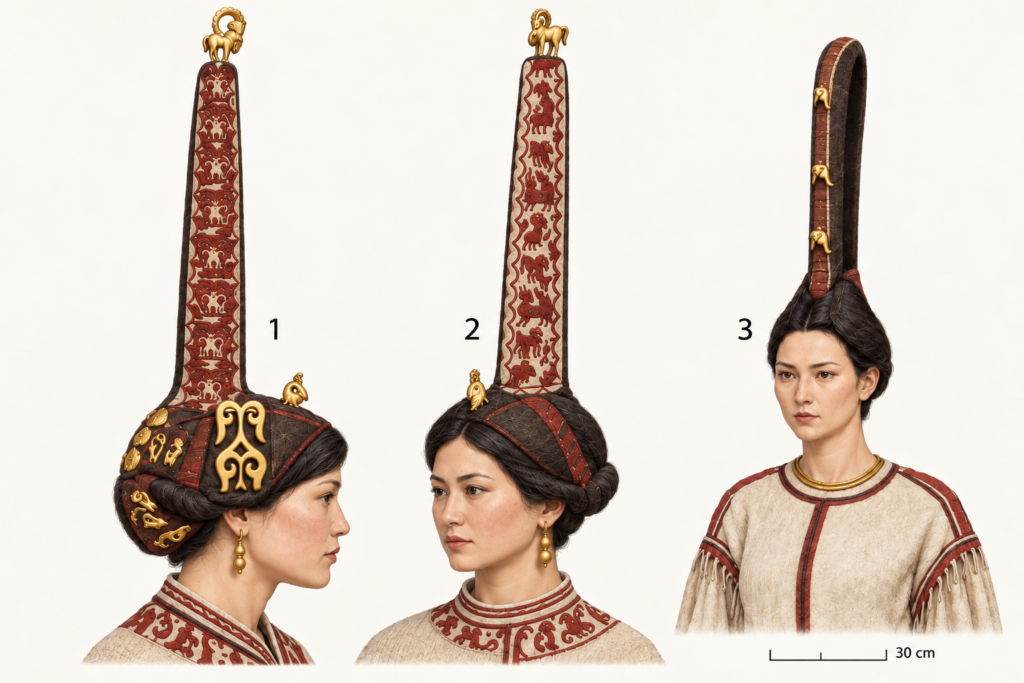
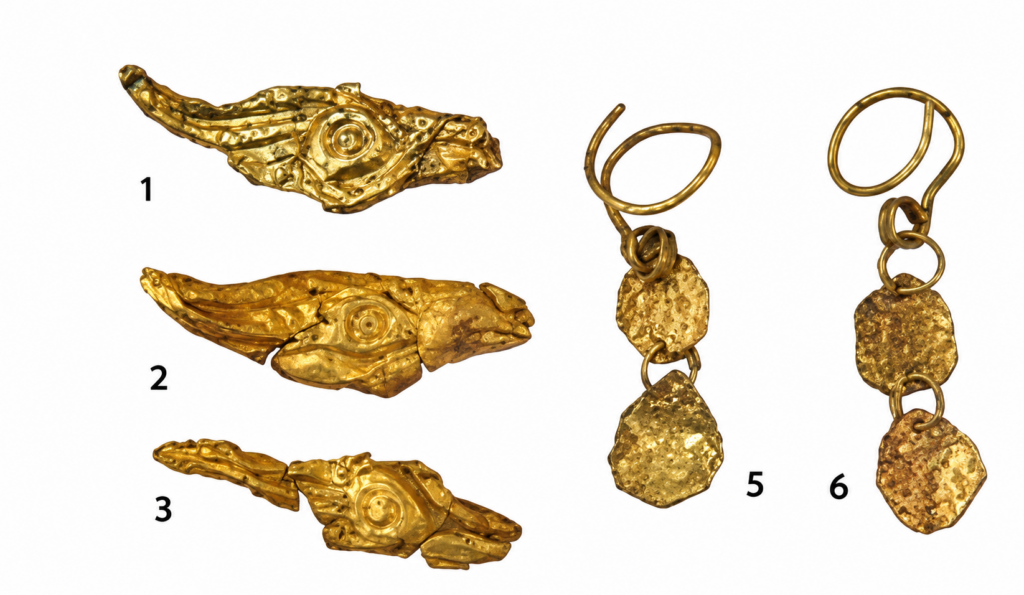
Archaeologists have uncovered the remains of another Pazyryk headdress in the Altai, where fragments survived in the grave of a woman buried more than 2,300 years ago. She was laid to rest with a bronze neck ring covered in gold foil, elaborate gold earrings, and a headdress decorated with gold ornaments, including three appliqués depicting saiga antelope heads.
The burial was discovered in Mound No. 31 at the Khankharinsky Dol cemetery in northwestern Altai. Although much of the organic headdress had decayed, the surviving gold decorations and traces around the woman’s skull have provided archaeologists with enough evidence to reconstruct its appearance and examine what her burial may reveal about Pazyryk dress and social status.
The woman was buried with a bronze neck ring covered in gold foil, two elaborate gold earrings, an iron hairpin, a ceramic vessel, a knife, and ritual food. Taken together, the objects suggest that she occupied a distinct social position within Pazyryk society, although one important marker associated with high-status burials was missing: no horse had been buried beside her.
A rare glimpse of a vanished Pazyryk headdress
Khankharinsky Dol lies in the Krasnoshchyokovsky District of the Altai Territory and forms part of a much larger archaeological landscape around the village of Chineta. More than 40 Scythian-Saka period features have already been excavated at the cemetery, making it an important source for understanding communities that lived in the northwestern Altai during the first millennium BC.
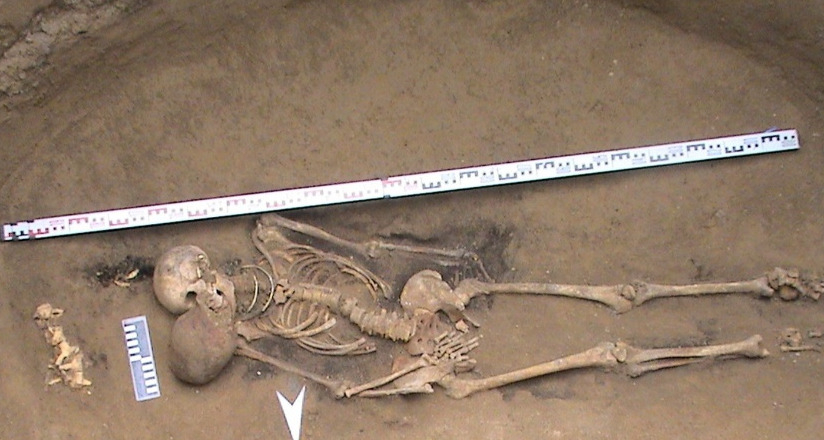
Mound No. 31 was covered by a low stone structure measuring about nine to 9.5 meters across. Beneath it, archaeologists found a deep grave containing the extended skeleton of a woman whose head had been placed toward the east.
That position immediately stood out. Most Pazyryk burials placed the deceased in a contracted position on the right side, while this woman had been laid flat on her back. Extended burials are known elsewhere in the Altai, however, and the researchers suggest that such variations may reflect interaction between different groups living in the contact zone between the mountains and foothills.
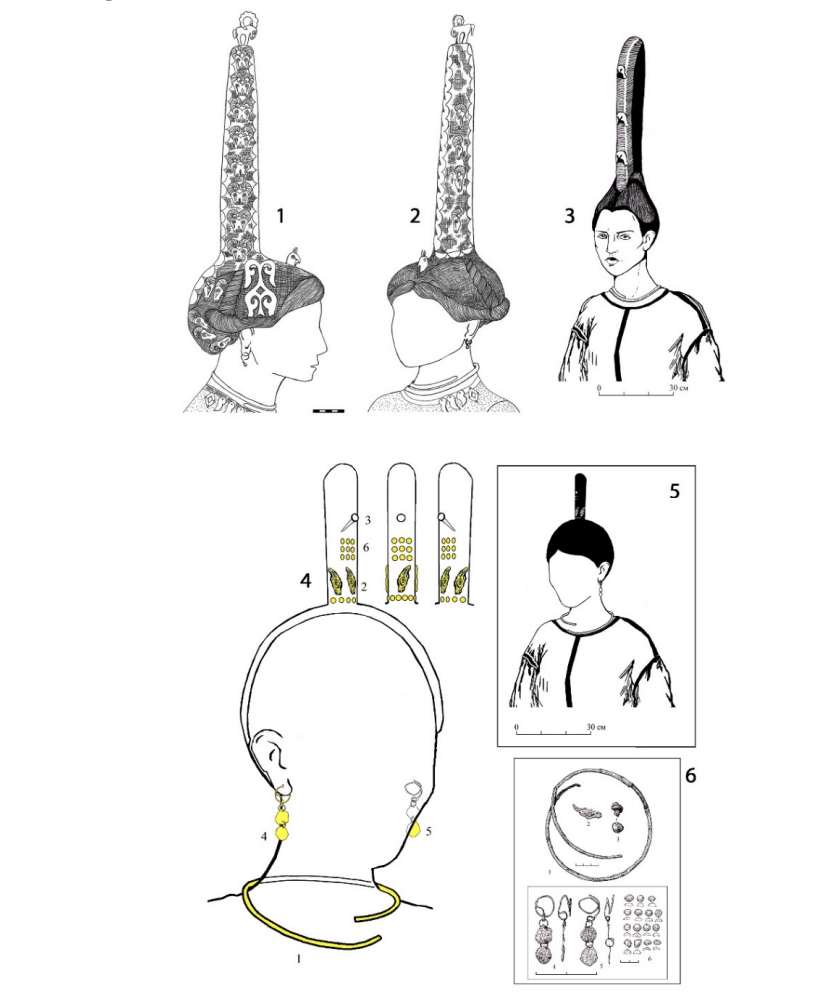
The most fragile part of the burial was also among the most informative. Almost nothing remained of the original headdress except a dark elongated stain beside the skull, surviving decorative elements, and their positions in the grave.
The stain measured about 22.5 centimeters long and between four and eight centimeters wide. From this evidence, the researchers reconstructed a relatively low headdress whose core may have incorporated carbon-rich clay, hair, felt, and fabric. The surviving ornaments appear to have been sewn onto its surface through small perforations.
It was noticeably smaller than several previously reconstructed Pazyryk women’s headdresses. Two comparable examples from Khankharinsky Dol and nearby Chineta-II measured 39.5 and 36 centimeters, making the example from Mound No. 31 almost half their height.
Golden saiga heads survived after the organic structure disappeared
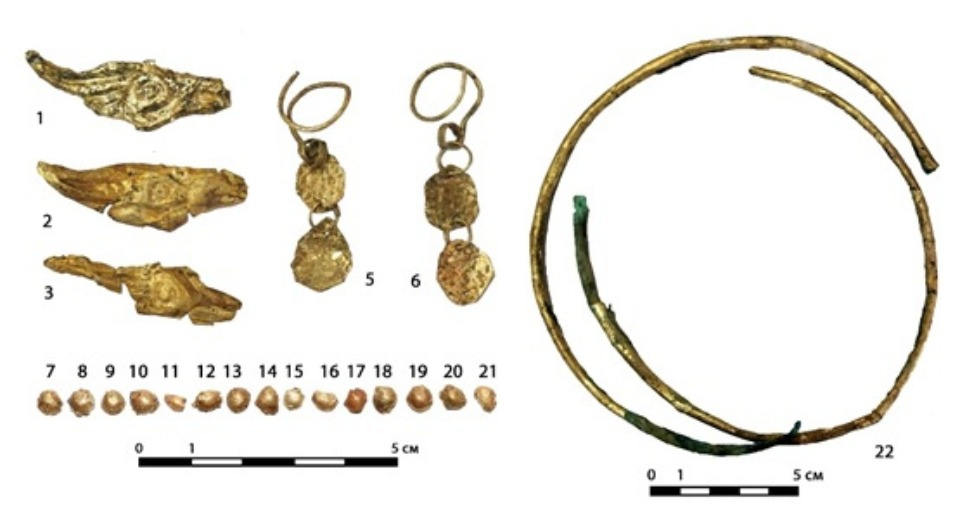
The headdress was decorated with 15 small circular pieces of gold foil and three zoomorphic appliqués positioned close to the woman’s head. The paper describes the three figures as animal heads and discusses them primarily as images of saiga or another antelope-like species.
Such imagery is not among the most common motifs in Pazyryk art. Saiga representations are nevertheless known from horse equipment, clothing ornaments, and other decorated objects found in Altai burials, suggesting that the animal belonged to a broader repertoire of steppe animal imagery.
There is some room for caution over the precise species represented. Earlier researchers had already noted that certain objects identified as saiga could resemble another antelope formerly living in Central Asia. What is clearer is that the appliqués represent an antelope-type animal rather than more familiar Pazyryk motifs such as deer, sheep or goats.
This is also what makes the discovery archaeologically useful. Organic Pazyryk clothing and headgear survive spectacularly in frozen burials, but preservation is far less complete at many other cemeteries. At Khankharinsky Dol, the disappearance of felt, textile, and other organic components did not entirely erase the object because the gold decorations remained in approximately their original positions.
Their distribution effectively preserved the outline of something that had otherwise vanished.
Jewelry points toward wider Achaemenid-era connections
The headdress was only one part of an unusually rich personal assemblage.
Around the woman’s neck lay a tubular bronze torque approximately 14.8 centimeters in diameter, originally covered with gold foil. Metal torques are comparatively uncommon in Pazyryk graves: the study notes that they occur in only about three percent of known nomadic burials, while more than 20 percent of the graves at Khankharinsky Dol contained some form of torque.
Even more intriguing are two gold-wire earrings found at the skull. Each was formed in a figure-eight configuration and carried suspended rings and small gold-foil discs.
Earrings themselves are familiar in Pazyryk burials, but elaborate examples with pendants are much less common. The study points out that comparable jewelry has parallels beyond the Altai and specifically connects the form with traditions known in Asia Minor and objects belonging to the broader Achaemenid artistic sphere.
That comparison does not mean the buried woman came from Iran or another part of the Achaemenid Empire. No genetic, isotopic or other evidence presented in the study establishes her geographic origin.
Instead, the earrings provide evidence of stylistic connections across the wider Eurasian world of the fourth century BC. Jewelry designs, prestige objects and artistic conventions could circulate between communities without requiring the movement of the individual buried with them.
The distinction matters. Rather than identifying the woman as an outsider, the assemblage shows that Pazyryk material culture existed within networks extending well beyond the Altai.
Richly dressed, but was she part of the elite?
The combination of gold-decorated headgear, pendant earrings, and a foil-covered torque strongly suggests elevated status. The cemetery itself reinforces that impression.
Khankharinsky Dol has produced an unusually large number of prestige objects, including headdresses, metal torques and imported goods. Many of its graves were also left largely undisturbed by ancient robbers, giving archaeologists an unusually complete view of burial customs at the site. Researchers have previously raised the possibility that at least part of the cemetery was used by a regional nomadic elite.
Mound No. 31, however, complicates that picture.
At Khankharinsky Dol, nine burials containing metal torques have been documented. Eight also contained accompanying horse burials, one of the most important markers of status in Pazyryk funerary culture.
Mound No. 31 was the exception.
The woman possessed conspicuous gold-decorated objects, yet no sacrificed horse accompanied her. For that reason, the study stops short of simply identifying her as a member of the highest elite. Her burial instead points toward a more nuanced social hierarchy in which prestige could be expressed through dress, jewelry, and funerary display in different combinations.
More precise dating may eventually sharpen that interpretation. The current fourth- to early third-century BC date is based primarily on archaeological comparison, while the researchers note that future radiocarbon analysis could refine both the chronology and the social interpretation of the grave.
What survives already reveals something unusually personal: more than 2,000 years after the organic structure disappeared, a line of gold ornaments around a woman’s skull still preserves the outline of the headdress she wore into the grave.
Dashkovskiy, P. K. (2026). A headdress and a set of jewelry from the female burial of the Pazyryk Culture at the Khankharinsky Dol burial ground (Altai). Vestnik Arheologii, Antropologii i Etnografii, 3(74), 77–87. https://doi.org/10.20874/2071-0437-2026-74-3-6
