
16 April 2026 The Future is the Product of the Past

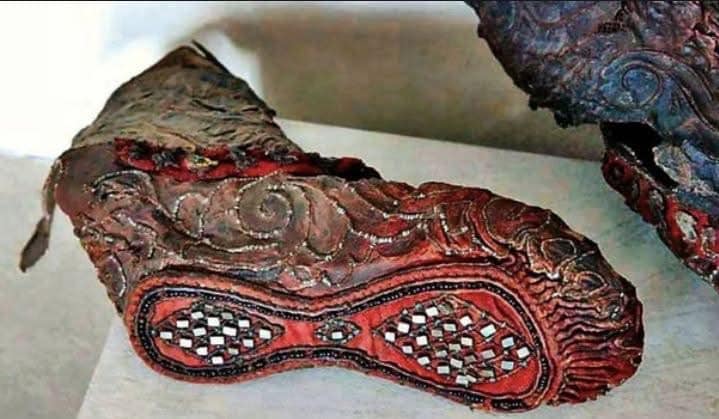
2,300-Year-Old Saka Woman’s Boot from the Altai Mountains Amazes the World

An extraordinary archaeological discovery from the Altai Mountains continues to fascinate historians, archaeologists, and history enthusiasts around the globe. A remarkably preserved 2,300-year-old leather boot believed to belong to a woman of the ancient Saka culture has become one of the most talked-about artifacts from the Eurasian steppe. The unique find provides rare insight into the craftsmanship, fashion, and social life of nomadic peoples who once roamed the region.

Discovery in the Pazyryk Burial Mounds

The ancient boot was discovered during archaeological expeditions in the mid-20th century in the mountainous Altai region of Central Asia. Researchers found it inside one of the famous Pazyryk kurgans—large burial mounds built by nomadic tribes of the Saka and related cultures.

These kurgans were complex burial structures. Archaeologists uncovered deep pits containing wooden chambers where the deceased were laid to rest alongside their belongings. Items typically included jewelry, weapons, clothing, horse equipment, and even preserved food.

After the burial ceremony, the chamber was sealed with layers of stone and soil. Over time, water seeped into the mound and froze due to the region’s harsh climate. This created a natural ice chamber that preserved organic materials for thousands of years.

Permafrost: Nature’s Time Capsule

One of the main reasons the boot survived in such exceptional condition is the permafrost environment of the Altai Mountains. In most climates, materials like leather, textiles, and wood decompose within decades. However, in frozen conditions they can remain intact for millennia.


📣 Our WhatsApp channel is now LIVE! Stay up-to-date with the latest news and updates, just click here to follow us on WhatsApp and never miss a thing!!


The frozen burial chamber effectively acted as a natural freezer, protecting the boot’s shape, color, and decorative elements. Because organic artifacts from ancient periods rarely survive so well, the find is considered extremely valuable to archaeologists studying ancient Eurasian cultures.

Stunning Craftsmanship and Decoration

The boot itself reveals impressive artistry. Made from soft red leather, it features intricate decorative elements that highlight the sophisticated craftsmanship of the Saka people.

Researchers noted that the footwear is decorated with black beads, pyrite crystals, metallic foil, and glass beads arranged in elaborate patterns. One of the most unusual features is the sole of the boot, which is also decorated with geometric designs made from pyrite and dark beads.

Decoration on the sole of ancient footwear is rare, which has sparked curiosity among historians. Some experts believe this design may have held symbolic or social meaning.

A Symbol of Status?

According to several researchers, the decorated sole may have been meant to be seen by others. Nomadic communities often sat on the ground or knelt around campfires, meaning the bottom of the shoe could be visible to people nearby.

Because of this, historians suggest the ornamentation may have served as a status symbol, indicating the wearer belonged to a high social class within the tribe.

Everyday Footwear or Burial Item?

Scholars remain divided about whether the boot was used in daily life or made specifically for burial rituals.

One theory proposes that it belonged to a woman of high status, possibly a member of the tribal elite. Another hypothesis suggests the boot may have been created solely for funerary purposes, which could explain its almost perfect condition and the minimal wear on the sole.

Today, the remarkable artifact is preserved in the collection of the State Hermitage Museum, one of the world’s largest and most famous museums. The boot is considered one of the most iconic objects connected with the Pazyryk culture.

Kyrgyz American Foundation

Cover Image Credit: Kyrgyz American Foundation via Facebook

Related Articles

Archaeologists Unearth Cisterns at Izmir’s Ancient “City of Mother Goddess”

2 June 2021

2 June 2021

In the ancient city of Metropolis, in western Turkey, in the province of Izmir, something that played an important role...

Archaeologists Unearth Monumental Relief Depicting Assyrian King and Major Deities in Ancient Nineveh

15 May 2025

15 May 2025

A team of archaeologists from Heidelberg University has made an extraordinary discovery in the ancient city of Nineveh, near modern-day...

Archaeologists find Viking Age shipyard in Swedish island

15 June 2022

15 June 2022

Archaeologists from Stockholm University have discovered a Viking Age shipyard at Birka on the island of Björkö in Lake Mälaren,...

Ancient tombs discovered at Paris’ Notre-Dame Cathedral

15 March 2022

15 March 2022

Archaeologists discovered several graves and a leaden sarcophagus possibly dating from the 14th century at Paris’ Notre Dame church, France’s...

Hidden past of Ani ruins in eastern Turkey to be uncovered by excavations

31 May 2021

31 May 2021

Archaeological excavations will reveal the historical mystery behind the ruins of Ani on the present-day Turkey-Armenia border. The Ani archaeological...

Scientists identified a unique engraving that could be the oldest three-dimensional (3D) map in the world

4 January 2025

4 January 2025

Scientists working in the Ségognole 3 cave, located in the famous sandstone massif south of Paris have identified a unique...

A One-of-a-Kind Roman Tomb with Bilingual Inscription: The First Monumental Discovery in Dibra, Albania

4 September 2025

4 September 2025

Archaeologists have uncovered a monumental Roman-era tomb in Strikçan, near Bulqiza, in northern Albania’s historic Dibra region, approximately 90 kilometers...

The “Horoscope” Scroll Found In the Judean Desert: A Glimpse Into the Mysterious Sect

26 March 2024

26 March 2024

One of the most interesting and mysterious scrolls discovered in the Judean Desert is a scroll called the “Horoscope.” This...

The Ancient City of Miletos’s “Sacred Cave” Opened to Visitors

2 October 2021

2 October 2021

In the ancient city of Miletos, which had an important place in the advancement of philosophy, art, and science in...

A cave painting found in Egyptian Sahara depicts a nativity scene 3,000 years before Jesus’ Birth

21 December 2023

21 December 2023

5,000-year-old rock art depicting the oldest nativity scene ever found has been found in Egypt’s Sahara Desert: A newborn between...

Evidence found of Goose domestication in Neolithic China 7,000 years ago

8 March 2022

8 March 2022

Geese may have been domesticated in what is now China as early as 7,000 years ago, according to a study...

A Sunken Port Beneath the Red Sea May Have Reshaped the Map of Human Migration Out of Africa 20,000 Years Ago

26 July 2025

26 July 2025

New research suggests an ancient trade hub lies beneath Egypt’s Red Sea coast—offering clues to how early civilizations connected Africa...

Unique Iron & Viking-Age Mortuary Houses Found in Norway

28 August 2024

28 August 2024

While building a road in the village of Vinjeøra in central Norway, three ancient mortuary houses dating back to the...

A Roman sarcophagus bearing the title of “Emperor’s Protector” was found for the first time in Anatolia

29 April 2022

29 April 2022

A sarcophagus carrying the title of “Emperor’s protector” was discovered in the province of Kocaeli in western Turkey. With the...

Huge ancient stone murals discovered in central China: “It is an important discovery that enriches and rewrites the art history of the Song Dynasty”

10 October 2022

10 October 2022

Two stone murals from the Northern Song Dynasty (960-1127) have been discovered in Henan Province, central China, and are the...