
16 April 2026 The Future is the Product of the Past

Standing Swords, Beads, and Magnificent Horse Gear: Viking Treasures Unearthed Along Sweden’s E18

Two upright swords thrust into Viking graves, strings of glittering beads, and richly decorated horse equipment have emerged from the soil of Västmanland, Sweden — treasures that are now rewriting what we know about the Viking Age.

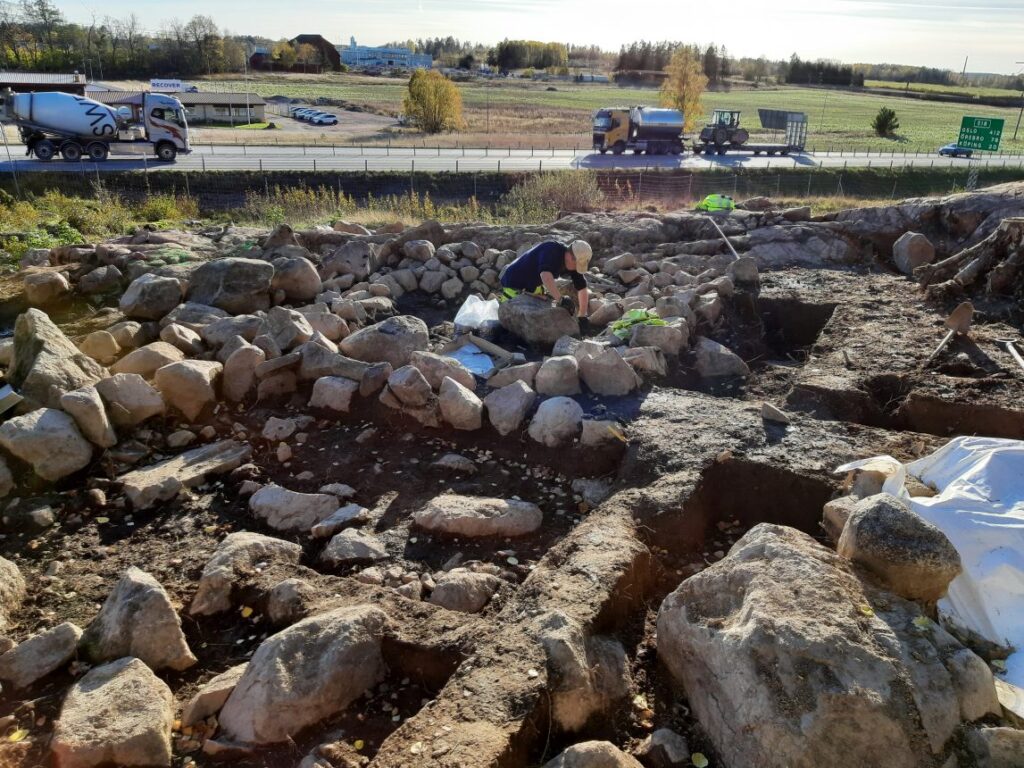
Archaeological excavations conducted between 2021 and 2022 along the E18 motorway between Köping and Västerås have revealed a wealth of artifacts, from warrior burials to cremation platforms visible across the landscape. The findings, documented by Arkeologerna, the archaeological division of the Swedish National Historical Museums, are now presented in a new book titled Människor, möten och minnen – arkeologi längs E18 i Västmanland (People, Meetings, and Memories – Archaeology along the E18 in Västmanland).

“The sites are exciting, but the overall picture is most interesting,” says project leader Fredrik Larsson. “We now have a cross-section through several regions, allowing us to understand how society and the landscape changed over generations.”

A Landscape of Fire and Memory

Among the most remarkable discoveries is a Viking Age cremation site in Rallsta, near Hallstahammar. Here, archaeologists uncovered two large funeral pyres built on a small mountain — an imposing site designed to be seen from miles away. The ashes contained traces of people, animals, and exquisite objects: delicate glass beads, gilded ornaments, and fragments of gold sheet metal that once decorated garnet jewelry.

Larsson describes Rallsta as “a ceremonial center where the dead were honored in spectacular ways — a statement of power and remembrance visible to all who passed.”


📣 Our WhatsApp channel is now LIVE! Stay up-to-date with the latest news and updates, just click here to follow us on WhatsApp and never miss a thing!!


Archaeologists uncover standing swords, glittering beads, and ornate horse gear from Viking graves along Sweden’s E18, revealing a forgotten world. Credit: Arkeologerna

The Mystery of the Standing Swords

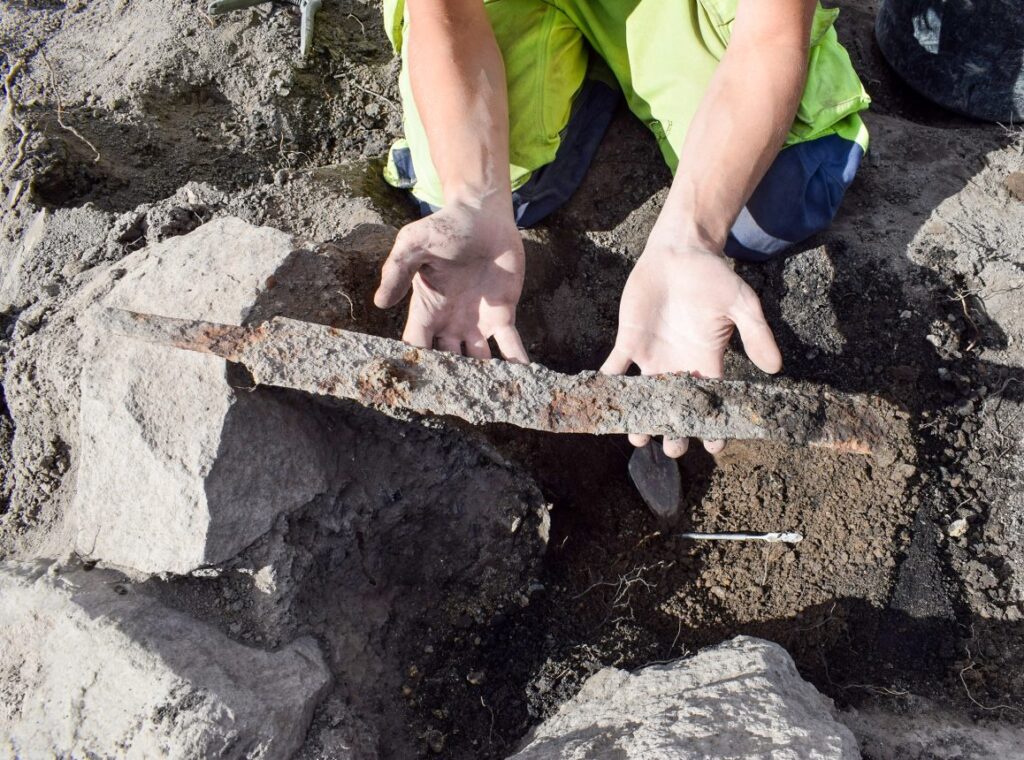
Even more enigmatic is the discovery at Viby/Norrtuna in Munktorp parish. There, Viking Age stone settings were built into an older Vendel Period burial mound, merging two eras of memory into one grand monument. Inside, archaeologists found two swords driven vertically into the earth — so forcefully that the blades had snapped.

“There are only a handful of such sites in Sweden,” says Larsson. “These standing swords may have symbolized warriors of high rank, or perhaps marked the graves of a powerful dynasty.”

One grave contained both a man and a woman, buried side by side. The pairing raises questions about their connection — companions in life, equals in death, or perhaps participants in a ritual sacrifice. Whatever their story, their resting place challenges modern assumptions about Viking gender roles and social identity.
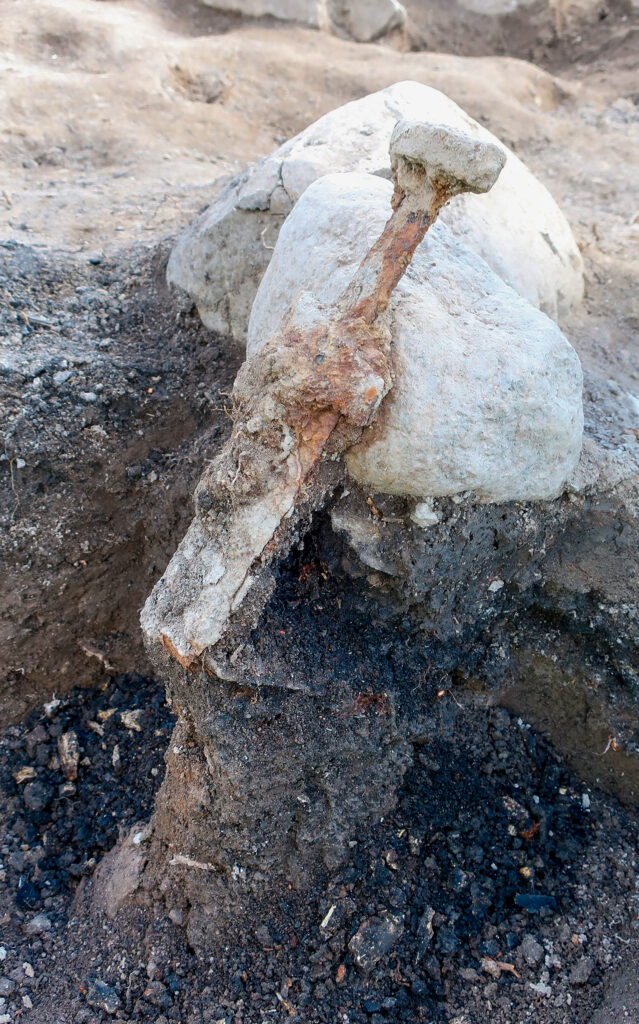
The broken blade shows that the swords were forced into the ground with great strength. Around the blade lies the black cremation layer containing burned bones. Credit: Arkeologerna

Horses of the Afterlife

At Sylta, outside Köping, archaeologists uncovered a Viking burial ground used from the 800s to the early 1200s — one of the last sites to continue pagan burial traditions as Christianity spread across Sweden.

Nearly 30 graves from the 11th century contained horses cremated alongside their owners, adorned with magnificent harnesses, bells, and intricate bronze fittings. These were not ordinary animals, but symbols of prestige and mobility.

“The horse gear was so ornate that it almost functioned as a kind of local costume,” explains Larsson. “Even the horses had their own adornments — shining, jingling, and visible for everyone to see.”

Such discoveries reveal that horses were more than companions; they were extensions of identity, representing status, wealth, and even spiritual passage into the afterlife.
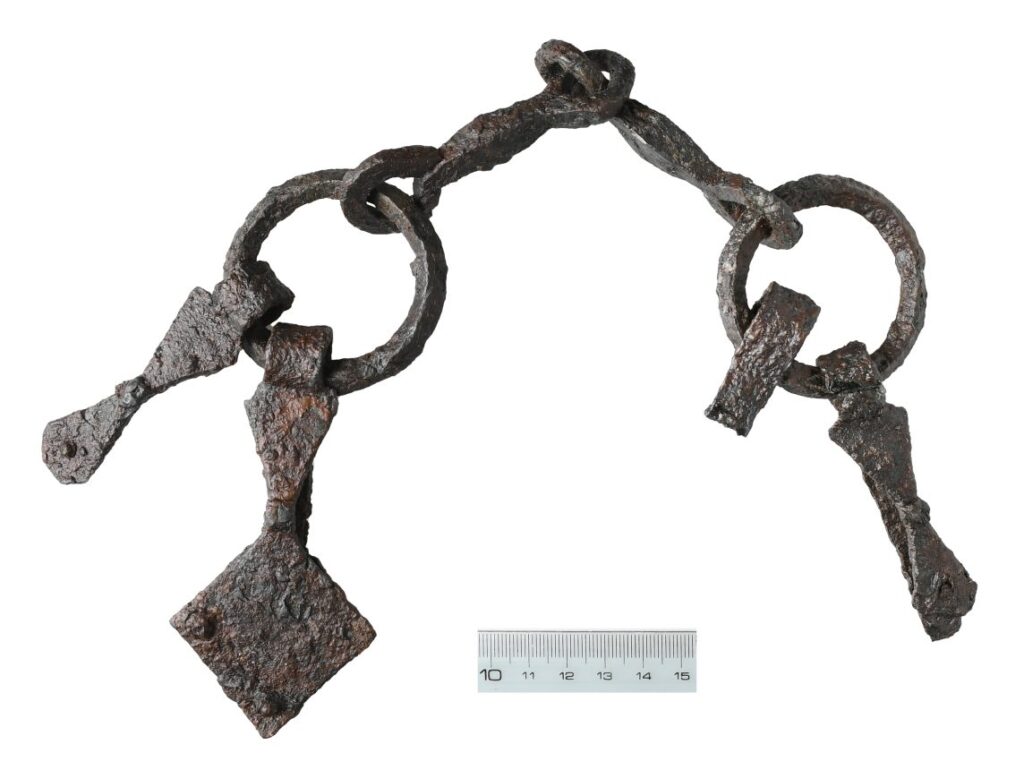
Bit from a grave in Sylta. Credit: Arkeologerna

Everyday Life Beside Sacred Stone

Beyond the burials, the E18 excavations revealed traces of daily Viking life — farms, bread ovens, and iron production workshops — offering a more intimate picture of how people lived and worked a thousand years ago. One site even sat beside Västmanland’s largest rock carving in Häljesta, linking household life with ancient ritual landscapes.

Taken together, the findings form a powerful narrative of continuity and change: from pagan pyres to Christian graves, from warrior dynasties to farming communities, from ancestral ritual to everyday survival.
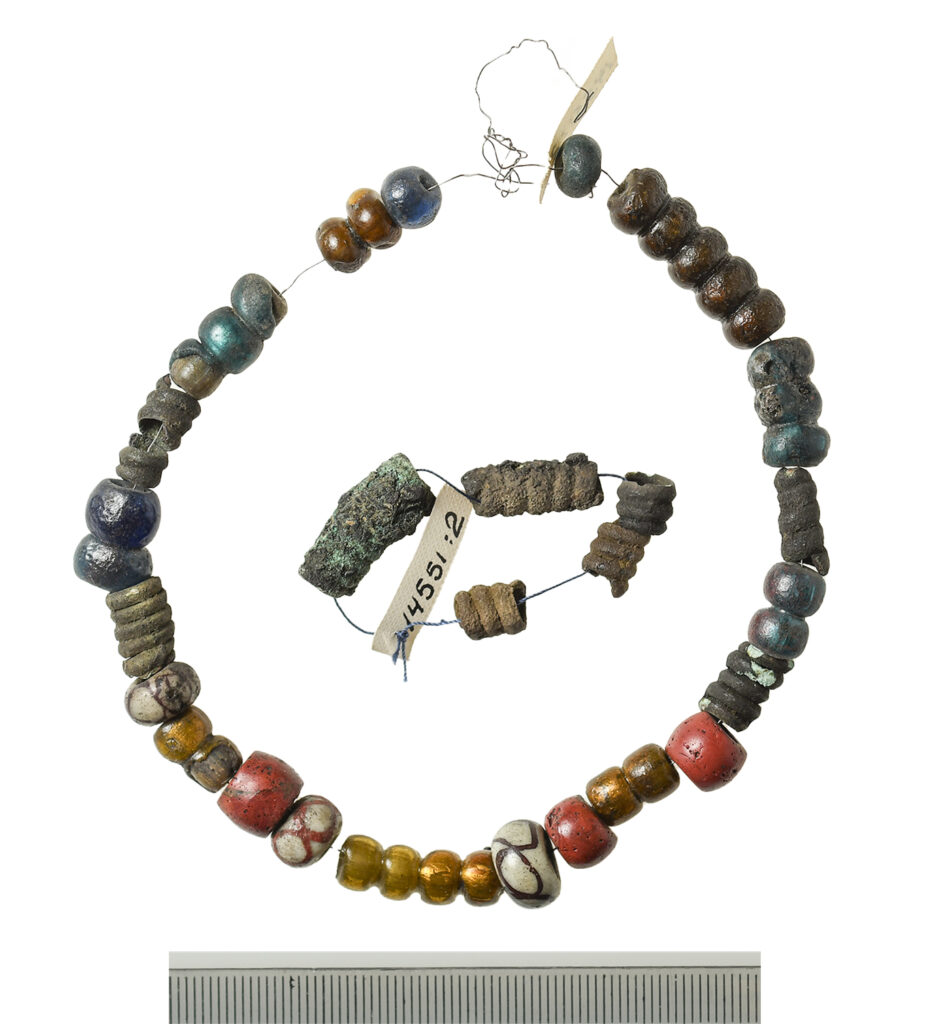
Bead assemblage from Rallsta. Credit: Arkeologerna

From Highway to History

What began as a modern infrastructure project has become one of Sweden’s most significant archaeological undertakings in recent decades. The E18 expansion unearthed not just artifacts, but stories — revealing how deeply history lies beneath the country’s roads and fields.

The results are now available to the public through Människor, möten och minnen – arkeologi längs E18 i Västmanland, funded by Trafikverket (the Swedish Transport Administration). The book can be downloaded as a free PDF or collected in print at the Västmanlands läns museum and Köpings stads museer och utställningshall.

For Larsson and his team, these discoveries are more than scientific data — they are voices from the past.

“Through these graves and artifacts,” he says, “we meet the people who once lived, worked, and dreamed here. The standing swords, the beads, the horses — they remind us that even after a thousand years, the past still speaks.”

Arkeologerna

Cover ımage Credit: Excavation along the E18. Arkeologerna

Related Articles

Illegal digs reveal rare Roman-era mass grave in Turkey

28 July 2022

28 July 2022

A total of 27 skeletons were found in a burial pit carved into the rocks in Adıyaman province, an important...

Archaeologists have unearthed an incredible hoard of over 300 Iron Age ‘potins’ in West London

17 July 2021

17 July 2021

Archaeologists at an HS2 construction site in Hillingdon, West London discovered an astonishing treasure of over 300 Iron Age ‘potins”....

Time Team Cracks Sutton Hoo Mystery: ‘Master Count’ Bucket Was a Burial Urn

20 May 2025

20 May 2025

In a remarkable breakthrough at the historic Sutton Hoo site in Suffolk, England, archaeologists have revealed that a 6th-century Byzantine...

A Baptismal Surprise: Triton Baths in Southeastern Rome Converted into Early Christian Church

7 May 2025

7 May 2025

Recent archaeological excavations within the monumental complex of the Villa di Sette Bassi, situated in the southeastern outskirts of Rome,...

The Mysterious Prehistoric Underwater Structure Beneath Lake Michigan

6 February 2024

6 February 2024

A prehistoric structure reminiscent of England’s iconic Stonehenge has been uncovered in Grand Traverse Bay, an arm of Lake Michigan...

Submerged Land Bridge Beneath the Aegean May Have Carried Early Humans From Türkiye to Europe

21 September 2025

21 September 2025

A groundbreaking archaeological study has revealed that early humans may have crossed from modern-day Türkiye into mainland Europe via a...

Have We Found Moses’ Signature? Ancient Inscriptions in Egypt May Hold the First Written Link to the Bible

29 July 2025

29 July 2025

Mysterious Proto-Sinaitic inscriptions may point to Moses and Joseph as historical figures, sparking global scholarly controversy. A groundbreaking proto-thesis by...

Archaeologists Uncovered a Tile Workshop From the First Century in Corsica

3 December 2024

3 December 2024

Archaeologists from the French National Institute for Preventive Archaeological Research (INRAP) excavations on the east coast of Corsica have uncovered...

Japan’s Ancient Practice Of Cranial Modification: Hirota people in Tanegashima

21 August 2023

21 August 2023

A team of researchers from Kyushu University and the University of Montana has found evidence suggesting that the Hirota community,...

New Elymaean Rock Carving in Iran Shows Possible Parallels with the Hercules–Hydra Motif Known from 325 BC Greek Coinage

21 December 2025

21 December 2025

A newly discovered Elymaean rock carving in southwest Iran is drawing significant scholarly attention for its unusual iconography and its...

Ice Age Cave Entrance that Nobody has Entered for 16,000 Years found in Germany

4 August 2023

4 August 2023

Researchers report they have discovered the official entrance to an Ice Age cave near Engen, Germany, that nobody has entered...

Forged 5,000 Years Ago: The World’s Oldest Swords Discovered at Arslantepe Mound, Türkiye

10 June 2025

10 June 2025

In the arid plains of Eastern Anatolia, nestled along the western bank of the Euphrates River near Malatya, Turkey, lies...

Neanderthals too may have Developed a System of Numerical Notation

2 June 2021

2 June 2021

People developed numbers tens of thousands of years ago, according to archeological findings. Scholars are now investigating the first comprehensive...

For the first time in Turkish history, a gold belt buckle depicted the face of a Göktürk Khagan found

19 December 2023

19 December 2023

A social complex (Külliye) and new artifacts from the Western Gokturk period were discovered in Kazakhstan. Among these items, a...

Mosaics found in Türkiye’s Sinop belong to dining room of a wealthy family

24 June 2023

24 June 2023

The pebble mosaics unearthed during the excavation of a building complex in the province of Sinop on Turkey’s Black Sea...